

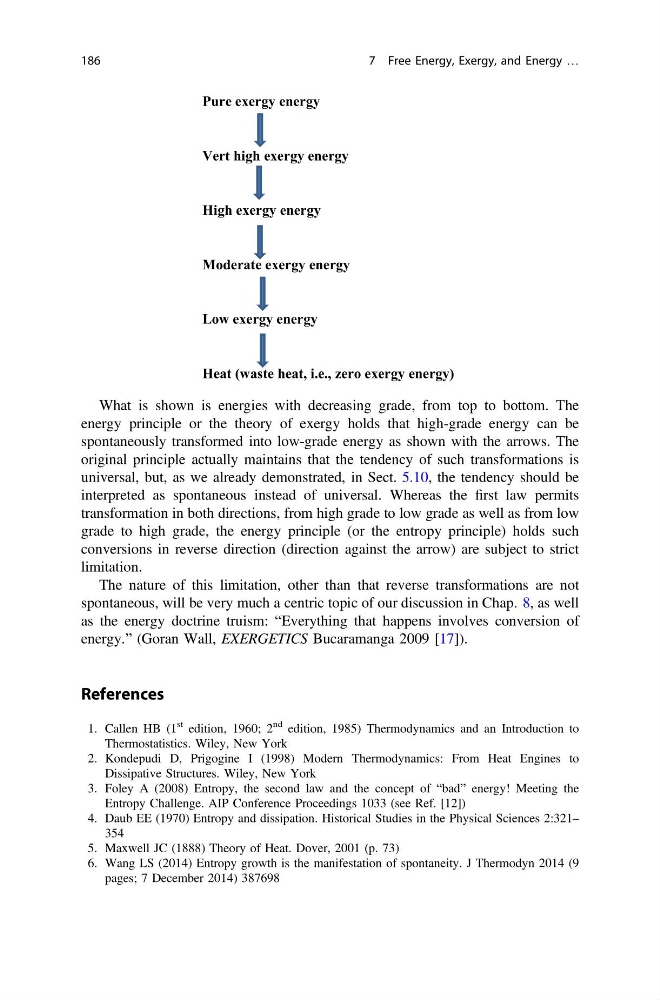
Pure exergy energy
Vert high exergy energy
High exergy energy
Moderate exergy energy
Low exergy energy
Heat (waste heat, i.e., zero exergy energy)
What is shown is energies with decreasing grade, from top to bottom. The
energy principle or the theory of exergy holds that high-grade energy can be
spontaneously transformed into low-grade energy as shown with the arrows. The
original principle actually maintains that the tendency of such transformations is
universal, but, as we already demonstrated, in Sect. 5.10, the tendency should be
interpreted as spontaneous instead of universal. Whereas the first law permits
transformation in both directions, from high grade to low grade as well as from low
grade to high grade, the energy principle (or the entropy principle) holds such
conversions in reverse direction (direction against the arrow) are subject to strict
limitation.
The nature of this limitation, other than that reverse transformations are not
spontaneous, will be very much a centric topic of our discussion in Chap. 8, as well
as the energy doctrine truism: “Everything that happens involves conversion of
energy.” (Goran Wall, EXERGETICS Bucaramanga 2009 [17]).
References
1. Callen HB (1
st edition, 1960; 2
nd edition, 1985) Thermodynamics and an Introduction to
Thermostatistics. Wiley, New York
2. Kondepudi D, Prigogine I (1998) Modern Thermodynamics: From Heat Engines to
Dissipative Structures. Wiley, New York
3. Foley A (2008) Entropy, the second law and the concept of “bad” energy! Meeting the
Entropy Challenge. AIP Conference Proceedings 1033 (see Ref. [12])
4. Daub EE (1970) Entropy and dissipation. Historical Studies in the Physical Sciences 2:321–
354
5. Maxwell JC (1888) Theory of Heat. Dover, 2001 (p. 73)
6. Wang LS (2014) Entropy growth is the manifestation of spontaneity. J Thermodyn 2014 (9
pages; 7 December 2014) 387698
186
7 Free Energy, Exergy, and Energy …
Vert high exergy energy
High exergy energy
Moderate exergy energy
Low exergy energy
Heat (waste heat, i.e., zero exergy energy)
What is shown is energies with decreasing grade, from top to bottom. The
energy principle or the theory of exergy holds that high-grade energy can be
spontaneously transformed into low-grade energy as shown with the arrows. The
original principle actually maintains that the tendency of such transformations is
universal, but, as we already demonstrated, in Sect. 5.10, the tendency should be
interpreted as spontaneous instead of universal. Whereas the first law permits
transformation in both directions, from high grade to low grade as well as from low
grade to high grade, the energy principle (or the entropy principle) holds such
conversions in reverse direction (direction against the arrow) are subject to strict
limitation.
The nature of this limitation, other than that reverse transformations are not
spontaneous, will be very much a centric topic of our discussion in Chap. 8, as well
as the energy doctrine truism: “Everything that happens involves conversion of
energy.” (Goran Wall, EXERGETICS Bucaramanga 2009 [17]).
References
1. Callen HB (1
st edition, 1960; 2
nd edition, 1985) Thermodynamics and an Introduction to
Thermostatistics. Wiley, New York
2. Kondepudi D, Prigogine I (1998) Modern Thermodynamics: From Heat Engines to
Dissipative Structures. Wiley, New York
3. Foley A (2008) Entropy, the second law and the concept of “bad” energy! Meeting the
Entropy Challenge. AIP Conference Proceedings 1033 (see Ref. [12])
4. Daub EE (1970) Entropy and dissipation. Historical Studies in the Physical Sciences 2:321–
354
5. Maxwell JC (1888) Theory of Heat. Dover, 2001 (p. 73)
6. Wang LS (2014) Entropy growth is the manifestation of spontaneity. J Thermodyn 2014 (9
pages; 7 December 2014) 387698
186
7 Free Energy, Exergy, and Energy …