

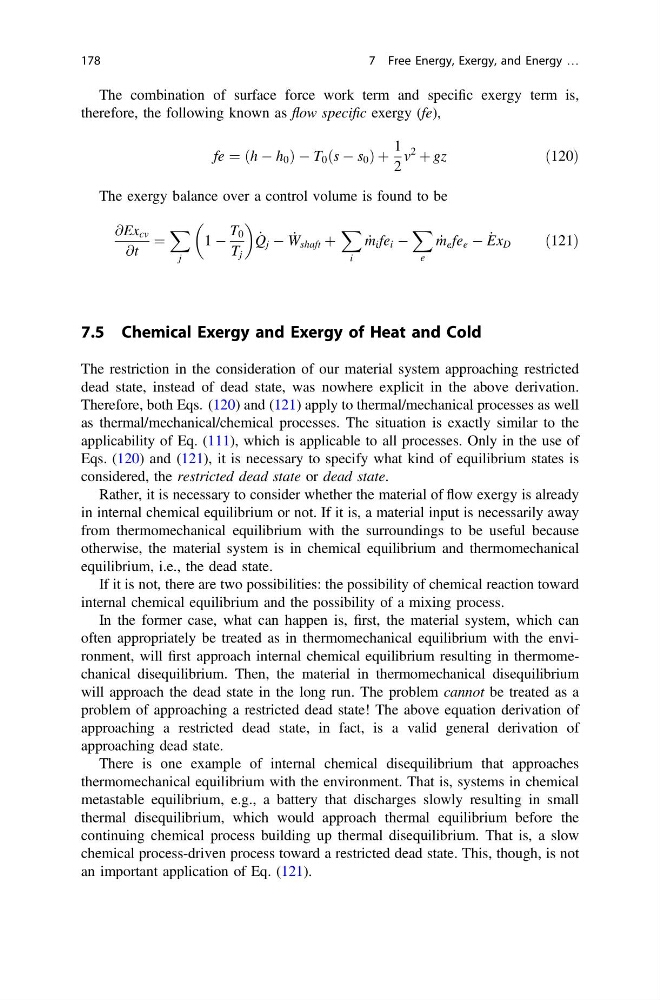
The combination of surface force work term and specific exergy term is,
therefore, the following known as flow specific exergy (fe),
fe ¼ h À h 0
ð
ÞÀT 0 s À s 0
ð
Þþ
1
2
v
2
þ gz
ð120Þ
The exergy balance over a control volume is found to be
@Ex cv
@t
¼
X
j
1 À
T 0
T j
_
Q j À _
W shaft þ
X
i
_
m i fe i À
X
e
_
m e fe e À _
Ex D
ð121Þ
7.5 Chemical Exergy and Exergy of Heat and Cold
The restriction in the consideration of our material system approaching restricted
dead state, instead of dead state, was nowhere explicit in the above derivation.
Therefore, both Eqs. (120) and (121) apply to thermal/mechanical processes as well
as thermal/mechanical/chemical processes. The situation is exactly similar to the
applicability of Eq. (111), which is applicable to all processes. Only in the use of
Eqs. (120) and (121), it is necessary to specify what kind of equilibrium states is
considered, the restricted dead state or dead state.
Rather, it is necessary to consider whether the material of flow exergy is already
in internal chemical equilibrium or not. If it is, a material input is necessarily away
from thermomechanical equilibrium with the surroundings to be useful because
otherwise, the material system is in chemical equilibrium and thermomechanical
equilibrium, i.e., the dead state.
If it is not, there are two possibilities: the possibility of chemical reaction toward
internal chemical equilibrium and the possibility of a mixing process.
In the former case, what can happen is, first, the material system, which can
often appropriately be treated as in thermomechanical equilibrium with the environment, will first approach internal chemical equilibrium resulting in thermomechanical disequilibrium. Then, the material in thermomechanical disequilibrium
will approach the dead state in the long run. The problem cannot be treated as a
problem of approaching a restricted dead state! The above equation derivation of
approaching a restricted dead state, in fact, is a valid general derivation of
approaching dead state.
There is one example of internal chemical disequilibrium that approaches
thermomechanical equilibrium with the environment. That is, systems in chemical
metastable equilibrium, e.g., a battery that discharges slowly resulting in small
thermal disequilibrium, which would approach thermal equilibrium before the
continuing chemical process building up thermal disequilibrium. That is, a slow
chemical process-driven process toward a restricted dead state. This, though, is not
an important application of Eq. (121).
178
7 Free Energy, Exergy, and Energy …
therefore, the following known as flow specific exergy (fe),
fe ¼ h À h 0
ð
ÞÀT 0 s À s 0
ð
Þþ
1
2
v
2
þ gz
ð120Þ
The exergy balance over a control volume is found to be
@Ex cv
@t
¼
X
j
1 À
T 0
T j
_
Q j À _
W shaft þ
X
i
_
m i fe i À
X
e
_
m e fe e À _
Ex D
ð121Þ
7.5 Chemical Exergy and Exergy of Heat and Cold
The restriction in the consideration of our material system approaching restricted
dead state, instead of dead state, was nowhere explicit in the above derivation.
Therefore, both Eqs. (120) and (121) apply to thermal/mechanical processes as well
as thermal/mechanical/chemical processes. The situation is exactly similar to the
applicability of Eq. (111), which is applicable to all processes. Only in the use of
Eqs. (120) and (121), it is necessary to specify what kind of equilibrium states is
considered, the restricted dead state or dead state.
Rather, it is necessary to consider whether the material of flow exergy is already
in internal chemical equilibrium or not. If it is, a material input is necessarily away
from thermomechanical equilibrium with the surroundings to be useful because
otherwise, the material system is in chemical equilibrium and thermomechanical
equilibrium, i.e., the dead state.
If it is not, there are two possibilities: the possibility of chemical reaction toward
internal chemical equilibrium and the possibility of a mixing process.
In the former case, what can happen is, first, the material system, which can
often appropriately be treated as in thermomechanical equilibrium with the environment, will first approach internal chemical equilibrium resulting in thermomechanical disequilibrium. Then, the material in thermomechanical disequilibrium
will approach the dead state in the long run. The problem cannot be treated as a
problem of approaching a restricted dead state! The above equation derivation of
approaching a restricted dead state, in fact, is a valid general derivation of
approaching dead state.
There is one example of internal chemical disequilibrium that approaches
thermomechanical equilibrium with the environment. That is, systems in chemical
metastable equilibrium, e.g., a battery that discharges slowly resulting in small
thermal disequilibrium, which would approach thermal equilibrium before the
continuing chemical process building up thermal disequilibrium. That is, a slow
chemical process-driven process toward a restricted dead state. This, though, is not
an important application of Eq. (121).
178
7 Free Energy, Exergy, and Energy …