

Ex q ¼
Z 2
1
1 À
T 0
T
dQ
The exergy transfer associated with the transfer of work, E w , is,
Ex w ¼ W À p 0 V 2 À V 1
ð
Þ
A positive work output of E w is associated with a decrease in system exergy. The
last term on the right side accounts for the destruction of exergy due to irreversibilities within the system as related to the entropy generation or entropy
growth
Ex D ¼ T 0 S G
In the literature, the expression of Ex D is also known as the Gouy–Stodola
theorem.
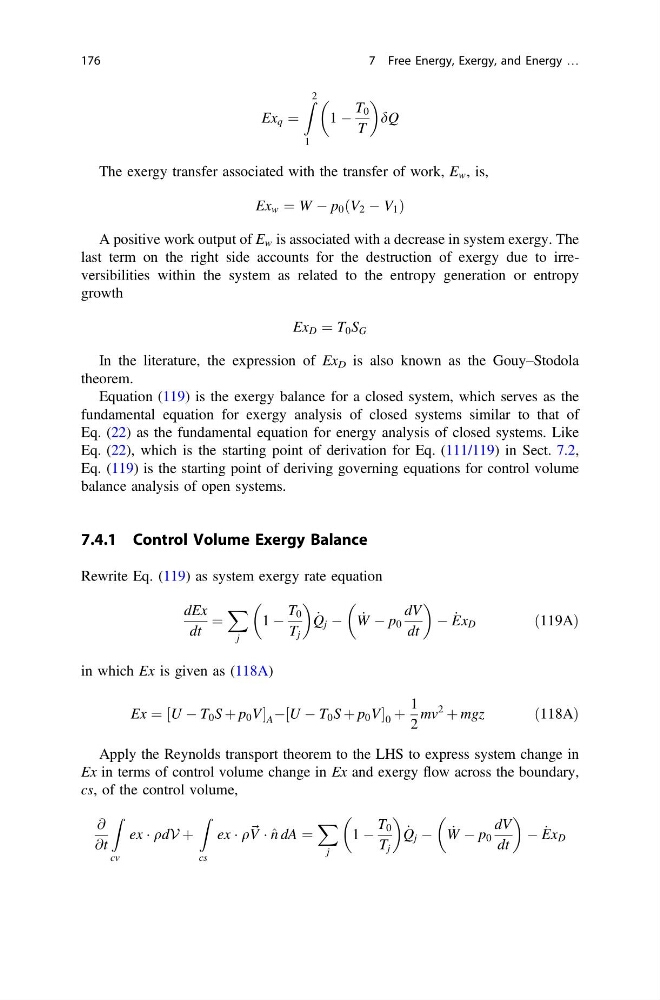
Equation (119) is the exergy balance for a closed system, which serves as the
fundamental equation for exergy analysis of closed systems similar to that of
Eq. (22) as the fundamental equation for energy analysis of closed systems. Like
Eq. (22), which is the starting point of derivation for Eq. (111/119) in Sect. 7.2,
Eq. (119) is the starting point of deriving governing equations for control volume
balance analysis of open systems.
7.4.1 Control Volume Exergy Balance
Rewrite Eq. (119) as system exergy rate equation
dEx
dt
¼
X
j
1 À
T 0
T j
_
Q j À _
W À p 0
dV
dt
À _
Ex D
ð119AÞ
in which Ex is given as (118A)
Ex ¼ U À T 0 S þ p 0 V
½
A À U À T 0 S þ p 0 V
½
0 þ
1
2
mv
2
þ mgz
ð118AÞ
Apply the Reynolds transport theorem to the LHS to express system change in
Ex in terms of control volume change in Ex and exergy flow across the boundary,
cs, of the control volume,
@
@t
Z
cv
ex Á qdV þ
Z
cs
ex Á q ~ V Á ^ n dA ¼
X
j
1 À
T 0
T j
_
Q j À _
W À p 0
dV
dt
À _
Ex D
176
7 Free Energy, Exergy, and Energy …
Z 2
1
1 À
T 0
T
dQ
The exergy transfer associated with the transfer of work, E w , is,
Ex w ¼ W À p 0 V 2 À V 1
ð
Þ
A positive work output of E w is associated with a decrease in system exergy. The
last term on the right side accounts for the destruction of exergy due to irreversibilities within the system as related to the entropy generation or entropy
growth
Ex D ¼ T 0 S G
In the literature, the expression of Ex D is also known as the Gouy–Stodola
theorem.
Equation (119) is the exergy balance for a closed system, which serves as the
fundamental equation for exergy analysis of closed systems similar to that of
Eq. (22) as the fundamental equation for energy analysis of closed systems. Like
Eq. (22), which is the starting point of derivation for Eq. (111/119) in Sect. 7.2,
Eq. (119) is the starting point of deriving governing equations for control volume
balance analysis of open systems.
7.4.1 Control Volume Exergy Balance
Rewrite Eq. (119) as system exergy rate equation
dEx
dt
¼
X
j
1 À
T 0
T j
_
Q j À _
W À p 0
dV
dt
À _
Ex D
ð119AÞ
in which Ex is given as (118A)
Ex ¼ U À T 0 S þ p 0 V
½
A À U À T 0 S þ p 0 V
½
0 þ
1
2
mv
2
þ mgz
ð118AÞ
Apply the Reynolds transport theorem to the LHS to express system change in
Ex in terms of control volume change in Ex and exergy flow across the boundary,
cs, of the control volume,
@
@t
Z
cv
ex Á qdV þ
Z
cs
ex Á q ~ V Á ^ n dA ¼
X
j
1 À
T 0
T j
_
Q j À _
W À p 0
dV
dt
À _
Ex D
176
7 Free Energy, Exergy, and Energy …