

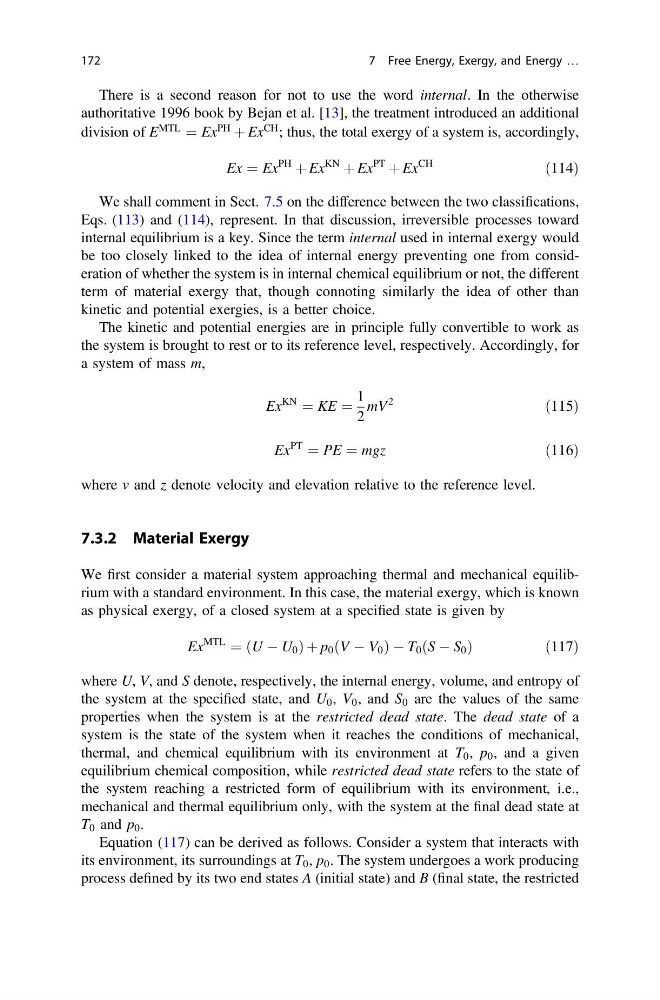
There is a second reason for not to use the word internal. In the otherwise
authoritative 1996 book by Bejan et al. [13], the treatment introduced an additional
division of E
MTL
¼ Ex
PH
þ Ex
CH ; thus, the total exergy of a system is, accordingly,
Ex ¼ Ex
PH
þ Ex
KN
þ Ex
PT
þ Ex
CH
ð114Þ
We shall comment in Sect. 7.5 on the difference between the two classifications,
Eqs. (113) and (114), represent. In that discussion, irreversible processes toward
internal equilibrium is a key. Since the term internal used in internal exergy would
be too closely linked to the idea of internal energy preventing one from consideration of whether the system is in internal chemical equilibrium or not, the different
term of material exergy that, though connoting similarly the idea of other than
kinetic and potential exergies, is a better choice.
The kinetic and potential energies are in principle fully convertible to work as
the system is brought to rest or to its reference level, respectively. Accordingly, for
a system of mass m,
Ex
KN
¼ KE ¼
1
2
mV
2
ð115Þ
Ex
PT
¼ PE ¼ mgz
ð116Þ
where v and z denote velocity and elevation relative to the reference level.
7.3.2 Material Exergy
We first consider a material system approaching thermal and mechanical equilibrium with a standard environment. In this case, the material exergy, which is known
as physical exergy, of a closed system at a specified state is given by
Ex
MTL
¼ U À U 0
ð
Þþp 0 V À V 0
ð
ÞÀT 0 S À S 0
ð
Þ
ð117Þ
where U, V, and S denote, respectively, the internal energy, volume, and entropy of
the system at the specified state, and U 0 , V 0 , and S 0 are the values of the same
properties when the system is at the restricted dead state. The dead state of a
system is the state of the system when it reaches the conditions of mechanical,
thermal, and chemical equilibrium with its environment at T 0 , p 0 , and a given
equilibrium chemical composition, while restricted dead state refers to the state of
the system reaching a restricted form of equilibrium with its environment, i.e.,
mechanical and thermal equilibrium only, with the system at the final dead state at
T 0 and p 0 .
Equation (117) can be derived as follows. Consider a system that interacts with
its environment, its surroundings at T 0 , p 0 . The system undergoes a work producing
process defined by its two end states A (initial state) and B (final state, the restricted
172
7 Free Energy, Exergy, and Energy …
authoritative 1996 book by Bejan et al. [13], the treatment introduced an additional
division of E
MTL
¼ Ex
PH
þ Ex
CH ; thus, the total exergy of a system is, accordingly,
Ex ¼ Ex
PH
þ Ex
KN
þ Ex
PT
þ Ex
CH
ð114Þ
We shall comment in Sect. 7.5 on the difference between the two classifications,
Eqs. (113) and (114), represent. In that discussion, irreversible processes toward
internal equilibrium is a key. Since the term internal used in internal exergy would
be too closely linked to the idea of internal energy preventing one from consideration of whether the system is in internal chemical equilibrium or not, the different
term of material exergy that, though connoting similarly the idea of other than
kinetic and potential exergies, is a better choice.
The kinetic and potential energies are in principle fully convertible to work as
the system is brought to rest or to its reference level, respectively. Accordingly, for
a system of mass m,
Ex
KN
¼ KE ¼
1
2
mV
2
ð115Þ
Ex
PT
¼ PE ¼ mgz
ð116Þ
where v and z denote velocity and elevation relative to the reference level.
7.3.2 Material Exergy
We first consider a material system approaching thermal and mechanical equilibrium with a standard environment. In this case, the material exergy, which is known
as physical exergy, of a closed system at a specified state is given by
Ex
MTL
¼ U À U 0
ð
Þþp 0 V À V 0
ð
ÞÀT 0 S À S 0
ð
Þ
ð117Þ
where U, V, and S denote, respectively, the internal energy, volume, and entropy of
the system at the specified state, and U 0 , V 0 , and S 0 are the values of the same
properties when the system is at the restricted dead state. The dead state of a
system is the state of the system when it reaches the conditions of mechanical,
thermal, and chemical equilibrium with its environment at T 0 , p 0 , and a given
equilibrium chemical composition, while restricted dead state refers to the state of
the system reaching a restricted form of equilibrium with its environment, i.e.,
mechanical and thermal equilibrium only, with the system at the final dead state at
T 0 and p 0 .
Equation (117) can be derived as follows. Consider a system that interacts with
its environment, its surroundings at T 0 , p 0 . The system undergoes a work producing
process defined by its two end states A (initial state) and B (final state, the restricted
172
7 Free Energy, Exergy, and Energy …