

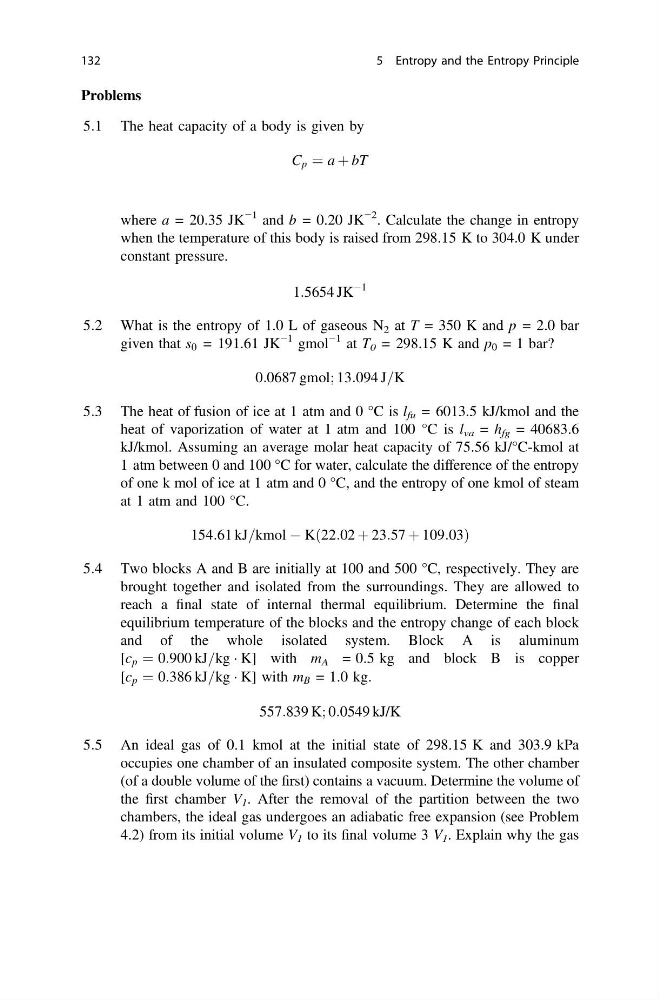
Problems
5:1 The heat capacity of a body is given by
C p ¼ a þ bT
where a = 20.35 JK
−1 and b = 0.20 JK
−2 . Calculate the change in entropy
when the temperature of this body is raised from 298.15 K to 304.0 K under
constant pressure.
1:5654 JK
À1
5:2 What is the entropy of 1.0 L of gaseous N 2 at T = 350 K and p = 2.0 bar
given that s 0 = 191.61 JK
−1 gmol
−1 at T 0 = 298.15 K and p 0 = 1 bar?
0:0687 gmol; 13:094 J=K
5:3 The heat of fusion of ice at 1 atm and 0 °C is l fu = 6013.5 kJ/kmol and the
heat of vaporization of water at 1 atm and 100 °C is l va = h fg = 40683.6
kJ/kmol. Assuming an average molar heat capacity of 75.56 kJ/°C-kmol at
1 atm between 0 and 100 °C for water, calculate the difference of the entropy
of one k mol of ice at 1 atm and 0 °C, and the entropy of one kmol of steam
at 1 atm and 100 °C.
154:61 kJ=kmol À K 22:02 þ 23:57 þ 109:03
ð
Þ
5:4 Two blocks A and B are initially at 100 and 500 °C, respectively. They are
brought together and isolated from the surroundings. They are allowed to
reach a final state of internal thermal equilibrium. Determine the final
equilibrium temperature of the blocks and the entropy change of each block
and of the whole isolated system. Block A is aluminum
[c p ¼ 0:900 kJ=kg Á K] with m A = 0.5 kg and block B is copper
[c p ¼ 0:386 kJ=kg Á K] with m B = 1.0 kg.
557:839 K; 0:0549 kJ/K
5:5 An ideal gas of 0.1 kmol at the initial state of 298.15 K and 303.9 kPa
occupies one chamber of an insulated composite system. The other chamber
(of a double volume of the first) contains a vacuum. Determine the volume of
the first chamber V 1 . After the removal of the partition between the two
chambers, the ideal gas undergoes an adiabatic free expansion (see Problem
4.2) from its initial volume V 1 to its final volume 3 V 1 . Explain why the gas
132
5 Entropy and the Entropy Principle
5:1 The heat capacity of a body is given by
C p ¼ a þ bT
where a = 20.35 JK
−1 and b = 0.20 JK
−2 . Calculate the change in entropy
when the temperature of this body is raised from 298.15 K to 304.0 K under
constant pressure.
1:5654 JK
À1
5:2 What is the entropy of 1.0 L of gaseous N 2 at T = 350 K and p = 2.0 bar
given that s 0 = 191.61 JK
−1 gmol
−1 at T 0 = 298.15 K and p 0 = 1 bar?
0:0687 gmol; 13:094 J=K
5:3 The heat of fusion of ice at 1 atm and 0 °C is l fu = 6013.5 kJ/kmol and the
heat of vaporization of water at 1 atm and 100 °C is l va = h fg = 40683.6
kJ/kmol. Assuming an average molar heat capacity of 75.56 kJ/°C-kmol at
1 atm between 0 and 100 °C for water, calculate the difference of the entropy
of one k mol of ice at 1 atm and 0 °C, and the entropy of one kmol of steam
at 1 atm and 100 °C.
154:61 kJ=kmol À K 22:02 þ 23:57 þ 109:03
ð
Þ
5:4 Two blocks A and B are initially at 100 and 500 °C, respectively. They are
brought together and isolated from the surroundings. They are allowed to
reach a final state of internal thermal equilibrium. Determine the final
equilibrium temperature of the blocks and the entropy change of each block
and of the whole isolated system. Block A is aluminum
[c p ¼ 0:900 kJ=kg Á K] with m A = 0.5 kg and block B is copper
[c p ¼ 0:386 kJ=kg Á K] with m B = 1.0 kg.
557:839 K; 0:0549 kJ/K
5:5 An ideal gas of 0.1 kmol at the initial state of 298.15 K and 303.9 kPa
occupies one chamber of an insulated composite system. The other chamber
(of a double volume of the first) contains a vacuum. Determine the volume of
the first chamber V 1 . After the removal of the partition between the two
chambers, the ideal gas undergoes an adiabatic free expansion (see Problem
4.2) from its initial volume V 1 to its final volume 3 V 1 . Explain why the gas
132
5 Entropy and the Entropy Principle