

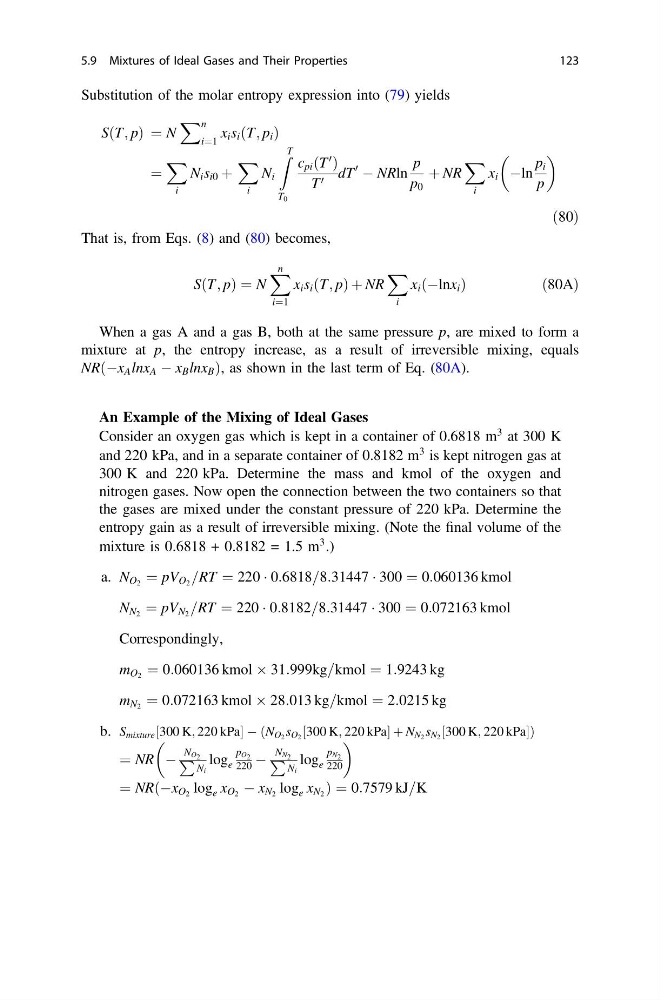
Substitution of the molar entropy expression into (79) yields
S T; p
ð
Þ ¼ N
X n
i¼1
x i s i T; p i
ð
Þ
¼
X
i
N i s i0 þ
X
i
N i
Z T
T 0
c pi T
0
ð Þ
T 0 dT
0
À NRln
p
p 0
þ NR
X
i
x i Àln
p i
p
ð80Þ
That is, from Eqs. (8) and (80) becomes,
S T; p
ð
Þ ¼ N
X n
i¼1
x i s i T; p
ð
ÞþNR
X
i
x i Àlnx i
ð
Þ
ð80AÞ
When a gas A and a gas B, both at the same pressure p, are mixed to form a
mixture at p, the entropy increase, as a result of irreversible mixing, equals
NR Àx A lnx A À x B lnx B
ð
Þ , as shown in the last term of Eq. (80A).
An Example of the Mixing of Ideal Gases
Consider an oxygen gas which is kept in a container of 0.6818 m
3 at 300 K
and 220 kPa, and in a separate container of 0.8182 m
3 is kept nitrogen gas at
300 K and 220 kPa. Determine the mass and kmol of the oxygen and
nitrogen gases. Now open the connection between the two containers so that
the gases are mixed under the constant pressure of 220 kPa. Determine the
entropy gain as a result of irreversible mixing. (Note the final volume of the
mixture is 0.6818 + 0.8182 = 1.5 m
3 .)
a. N O 2 ¼ pV O 2 =RT ¼ 220 Á 0:6818=8:31447 Á 300 ¼ 0:060136 kmol
N N 2 ¼ pV N 2 =RT ¼ 220 Á 0:8182=8:31447 Á 300 ¼ 0:072163 kmol
Correspondingly,
m O 2 ¼ 0:060136 kmol  31:999kg=kmol ¼ 1:9243 kg
m N 2 ¼ 0:072163 kmol  28:013 kg=kmol ¼ 2:0215 kg
b. S mixture 300 K; 220 kPa
½
ÀN O2 s O2 300 K; 220 kPa
½
þ N N2 s N2 300 K; 220 kPa
½
ð
Þ
¼ NR À
N O 2
P
N i
log e
p O 2
220 À
N N 2
P
N i
log e
p N 2
220
¼ NR Àx O 2 log e x O 2 À x N 2 log e x N 2
ð
Þ ¼ 0:7579 kJ=K
5.9 Mixtures of Ideal Gases and Their Properties
123
S T; p
ð
Þ ¼ N
X n
i¼1
x i s i T; p i
ð
Þ
¼
X
i
N i s i0 þ
X
i
N i
Z T
T 0
c pi T
0
ð Þ
T 0 dT
0
À NRln
p
p 0
þ NR
X
i
x i Àln
p i
p
ð80Þ
That is, from Eqs. (8) and (80) becomes,
S T; p
ð
Þ ¼ N
X n
i¼1
x i s i T; p
ð
ÞþNR
X
i
x i Àlnx i
ð
Þ
ð80AÞ
When a gas A and a gas B, both at the same pressure p, are mixed to form a
mixture at p, the entropy increase, as a result of irreversible mixing, equals
NR Àx A lnx A À x B lnx B
ð
Þ , as shown in the last term of Eq. (80A).
An Example of the Mixing of Ideal Gases
Consider an oxygen gas which is kept in a container of 0.6818 m
3 at 300 K
and 220 kPa, and in a separate container of 0.8182 m
3 is kept nitrogen gas at
300 K and 220 kPa. Determine the mass and kmol of the oxygen and
nitrogen gases. Now open the connection between the two containers so that
the gases are mixed under the constant pressure of 220 kPa. Determine the
entropy gain as a result of irreversible mixing. (Note the final volume of the
mixture is 0.6818 + 0.8182 = 1.5 m
3 .)
a. N O 2 ¼ pV O 2 =RT ¼ 220 Á 0:6818=8:31447 Á 300 ¼ 0:060136 kmol
N N 2 ¼ pV N 2 =RT ¼ 220 Á 0:8182=8:31447 Á 300 ¼ 0:072163 kmol
Correspondingly,
m O 2 ¼ 0:060136 kmol  31:999kg=kmol ¼ 1:9243 kg
m N 2 ¼ 0:072163 kmol  28:013 kg=kmol ¼ 2:0215 kg
b. S mixture 300 K; 220 kPa
½
ÀN O2 s O2 300 K; 220 kPa
½
þ N N2 s N2 300 K; 220 kPa
½
ð
Þ
¼ NR À
N O 2
P
N i
log e
p O 2
220 À
N N 2
P
N i
log e
p N 2
220
¼ NR Àx O 2 log e x O 2 À x N 2 log e x N 2
ð
Þ ¼ 0:7579 kJ=K
5.9 Mixtures of Ideal Gases and Their Properties
123