

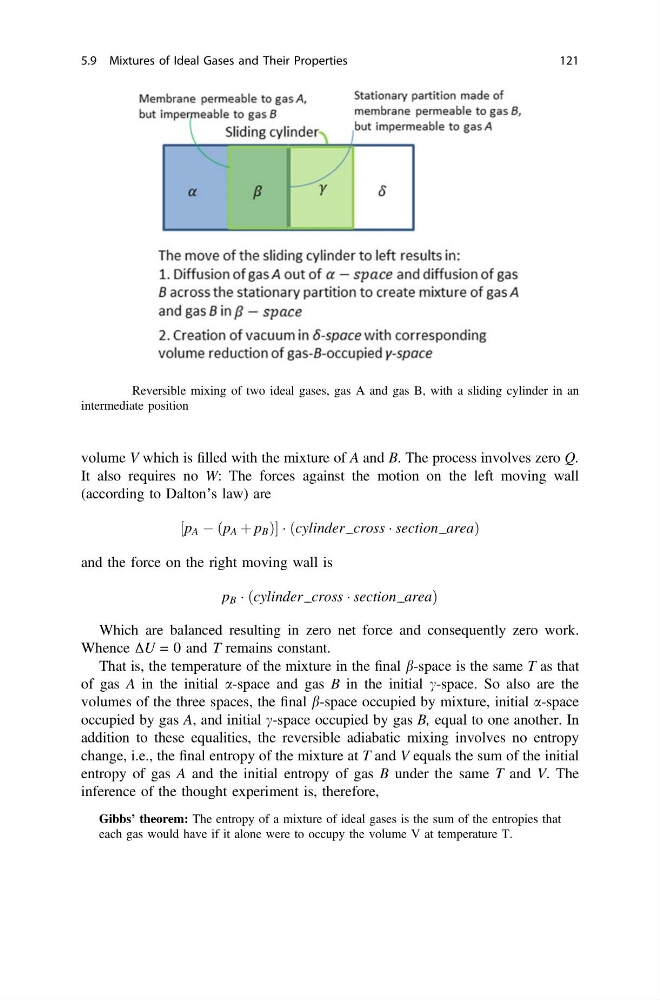
volume V which is filled with the mixture of A and B. The process involves zero Q.
It also requires no W: The forces against the motion on the left moving wall
(according to Dalton’s law) are
p A À p A þ p B
ð
Þ
½
Ácylinder cross Á section area
ð
Þ
and the force on the right moving wall is
p B Á cylinder cross Á section area
ð
Þ
Which are balanced resulting in zero net force and consequently zero work.
Whence ΔU = 0 and T remains constant.
That is, the temperature of the mixture in the final b-space is the same T as that
of gas A in the initial a-space and gas B in the initial c-space. So also are the
volumes of the three spaces, the final b-space occupied by mixture, initial a-space
occupied by gas A, and initial c-space occupied by gas B, equal to one another. In
addition to these equalities, the reversible adiabatic mixing involves no entropy
change, i.e., the final entropy of the mixture at T and V equals the sum of the initial
entropy of gas A and the initial entropy of gas B under the same T and V. The
inference of the thought experiment is, therefore,
Gibbs’ theorem: The entropy of a mixture of ideal gases is the sum of the entropies that
each gas would have if it alone were to occupy the volume V at temperature T.
Fig. 5.6 Reversible mixing of two ideal gases, gas A and gas B, with a sliding cylinder in an
intermediate position
5.9 Mixtures of Ideal Gases and Their Properties
121
It also requires no W: The forces against the motion on the left moving wall
(according to Dalton’s law) are
p A À p A þ p B
ð
Þ
½
Ácylinder cross Á section area
ð
Þ
and the force on the right moving wall is
p B Á cylinder cross Á section area
ð
Þ
Which are balanced resulting in zero net force and consequently zero work.
Whence ΔU = 0 and T remains constant.
That is, the temperature of the mixture in the final b-space is the same T as that
of gas A in the initial a-space and gas B in the initial c-space. So also are the
volumes of the three spaces, the final b-space occupied by mixture, initial a-space
occupied by gas A, and initial c-space occupied by gas B, equal to one another. In
addition to these equalities, the reversible adiabatic mixing involves no entropy
change, i.e., the final entropy of the mixture at T and V equals the sum of the initial
entropy of gas A and the initial entropy of gas B under the same T and V. The
inference of the thought experiment is, therefore,
Gibbs’ theorem: The entropy of a mixture of ideal gases is the sum of the entropies that
each gas would have if it alone were to occupy the volume V at temperature T.
Fig. 5.6 Reversible mixing of two ideal gases, gas A and gas B, with a sliding cylinder in an
intermediate position
5.9 Mixtures of Ideal Gases and Their Properties
121