

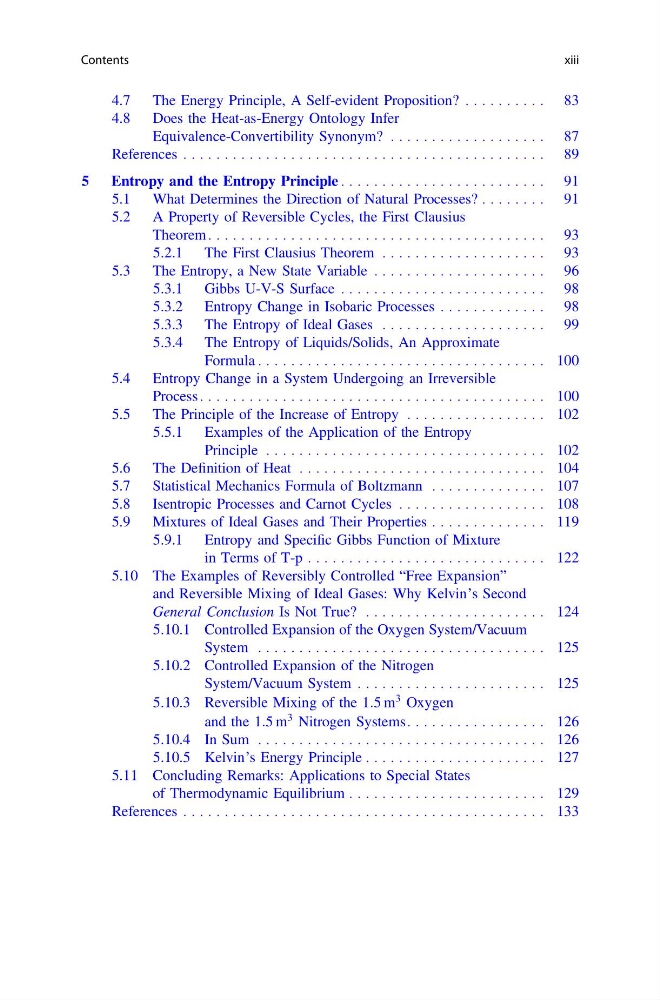
4.7 The Energy Principle, A Self-evident Proposition? . . . . . . . . . . 83
4.8 Does the Heat-as-Energy Ontology Infer
Equivalence-Convertibility Synonym? . . . . . . . . . . . . . . . . . . . 87
References . . . . . . . . . . . . . . . . . . . . . . . . . . . . . . . . . . . . . . . . . . . . 89
5 Entropy and the Entropy Principle . . . . . . . . . . . . . . . . . . . . . . . . . 91
5.1 What Determines the Direction of Natural Processes? . . . . . . . . 91
5.2 A Property of Reversible Cycles, the First Clausius
Theorem . . . . . . . . . . . . . . . . . . . . . . . . . . . . . . . . . . . . . . . . . 93
5.2.1 The First Clausius Theorem . . . . . . . . . . . . . . . . . . . . 93
5.3 The Entropy, a New State Variable . . . . . . . . . . . . . . . . . . . . . 96
5.3.1 Gibbs U-V-S Surface . . . . . . . . . . . . . . . . . . . . . . . . . 98
5.3.2 Entropy Change in Isobaric Processes . . . . . . . . . . . . . 98
5.3.3 The Entropy of Ideal Gases . . . . . . . . . . . . . . . . . . . . 99
5.3.4 The Entropy of Liquids/Solids, An Approximate
Formula . . . . . . . . . . . . . . . . . . . . . . . . . . . . . . . . . . . 100
5.4 Entropy Change in a System Undergoing an Irreversible
Process . . . . . . . . . . . . . . . . . . . . . . . . . . . . . . . . . . . . . . . . . . 100
5.5 The Principle of the Increase of Entropy . . . . . . . . . . . . . . . . . 102
5.5.1 Examples of the Application of the Entropy
Principle . . . . . . . . . . . . . . . . . . . . . . . . . . . . . . . . . . 102
5.6 The Definition of Heat . . . . . . . . . . . . . . . . . . . . . . . . . . . . . . 104
5.7 Statistical Mechanics Formula of Boltzmann . . . . . . . . . . . . . . 107
5.8 Isentropic Processes and Carnot Cycles . . . . . . . . . . . . . . . . . . 108
5.9 Mixtures of Ideal Gases and Their Properties . . . . . . . . . . . . . . 119
5.9.1 Entropy and Specific Gibbs Function of Mixture
in Terms of T-p . . . . . . . . . . . . . . . . . . . . . . . . . . . . . 122
5.10 The Examples of Reversibly Controlled “Free Expansion”
and Reversible Mixing of Ideal Gases: Why Kelvin’s Second
General Conclusion Is Not True? . . . . . . . . . . . . . . . . . . . . . . 124
5.10.1 Controlled Expansion of the Oxygen System/Vacuum
System . . . . . . . . . . . . . . . . . . . . . . . . . . . . . . . . . . . 125
5.10.2 Controlled Expansion of the Nitrogen
System/Vacuum System . . . . . . . . . . . . . . . . . . . . . . . 125
5.10.3 Reversible Mixing of the 1:5 m
3 Oxygen
and the 1:5 m
3 Nitrogen Systems . . . . . . . . . . . . . . . . . 126
5.10.4 In Sum . . . . . . . . . . . . . . . . . . . . . . . . . . . . . . . . . . . 126
5.10.5 Kelvin’s Energy Principle . . . . . . . . . . . . . . . . . . . . . . 127
5.11 Concluding Remarks: Applications to Special States
of Thermodynamic Equilibrium . . . . . . . . . . . . . . . . . . . . . . . . 129
References . . . . . . . . . . . . . . . . . . . . . . . . . . . . . . . . . . . . . . . . . . . . 133
Contents
xiii
4.8 Does the Heat-as-Energy Ontology Infer
Equivalence-Convertibility Synonym? . . . . . . . . . . . . . . . . . . . 87
References . . . . . . . . . . . . . . . . . . . . . . . . . . . . . . . . . . . . . . . . . . . . 89
5 Entropy and the Entropy Principle . . . . . . . . . . . . . . . . . . . . . . . . . 91
5.1 What Determines the Direction of Natural Processes? . . . . . . . . 91
5.2 A Property of Reversible Cycles, the First Clausius
Theorem . . . . . . . . . . . . . . . . . . . . . . . . . . . . . . . . . . . . . . . . . 93
5.2.1 The First Clausius Theorem . . . . . . . . . . . . . . . . . . . . 93
5.3 The Entropy, a New State Variable . . . . . . . . . . . . . . . . . . . . . 96
5.3.1 Gibbs U-V-S Surface . . . . . . . . . . . . . . . . . . . . . . . . . 98
5.3.2 Entropy Change in Isobaric Processes . . . . . . . . . . . . . 98
5.3.3 The Entropy of Ideal Gases . . . . . . . . . . . . . . . . . . . . 99
5.3.4 The Entropy of Liquids/Solids, An Approximate
Formula . . . . . . . . . . . . . . . . . . . . . . . . . . . . . . . . . . . 100
5.4 Entropy Change in a System Undergoing an Irreversible
Process . . . . . . . . . . . . . . . . . . . . . . . . . . . . . . . . . . . . . . . . . . 100
5.5 The Principle of the Increase of Entropy . . . . . . . . . . . . . . . . . 102
5.5.1 Examples of the Application of the Entropy
Principle . . . . . . . . . . . . . . . . . . . . . . . . . . . . . . . . . . 102
5.6 The Definition of Heat . . . . . . . . . . . . . . . . . . . . . . . . . . . . . . 104
5.7 Statistical Mechanics Formula of Boltzmann . . . . . . . . . . . . . . 107
5.8 Isentropic Processes and Carnot Cycles . . . . . . . . . . . . . . . . . . 108
5.9 Mixtures of Ideal Gases and Their Properties . . . . . . . . . . . . . . 119
5.9.1 Entropy and Specific Gibbs Function of Mixture
in Terms of T-p . . . . . . . . . . . . . . . . . . . . . . . . . . . . . 122
5.10 The Examples of Reversibly Controlled “Free Expansion”
and Reversible Mixing of Ideal Gases: Why Kelvin’s Second
General Conclusion Is Not True? . . . . . . . . . . . . . . . . . . . . . . 124
5.10.1 Controlled Expansion of the Oxygen System/Vacuum
System . . . . . . . . . . . . . . . . . . . . . . . . . . . . . . . . . . . 125
5.10.2 Controlled Expansion of the Nitrogen
System/Vacuum System . . . . . . . . . . . . . . . . . . . . . . . 125
5.10.3 Reversible Mixing of the 1:5 m
3 Oxygen
and the 1:5 m
3 Nitrogen Systems . . . . . . . . . . . . . . . . . 126
5.10.4 In Sum . . . . . . . . . . . . . . . . . . . . . . . . . . . . . . . . . . . 126
5.10.5 Kelvin’s Energy Principle . . . . . . . . . . . . . . . . . . . . . . 127
5.11 Concluding Remarks: Applications to Special States
of Thermodynamic Equilibrium . . . . . . . . . . . . . . . . . . . . . . . . 129
References . . . . . . . . . . . . . . . . . . . . . . . . . . . . . . . . . . . . . . . . . . . . 133
Contents
xiii