

88
dissolution of Ni from inner core). In addition, these are inexpensive cores. This is
the first report of unidirectional metal growth on carbon nanoparticles.
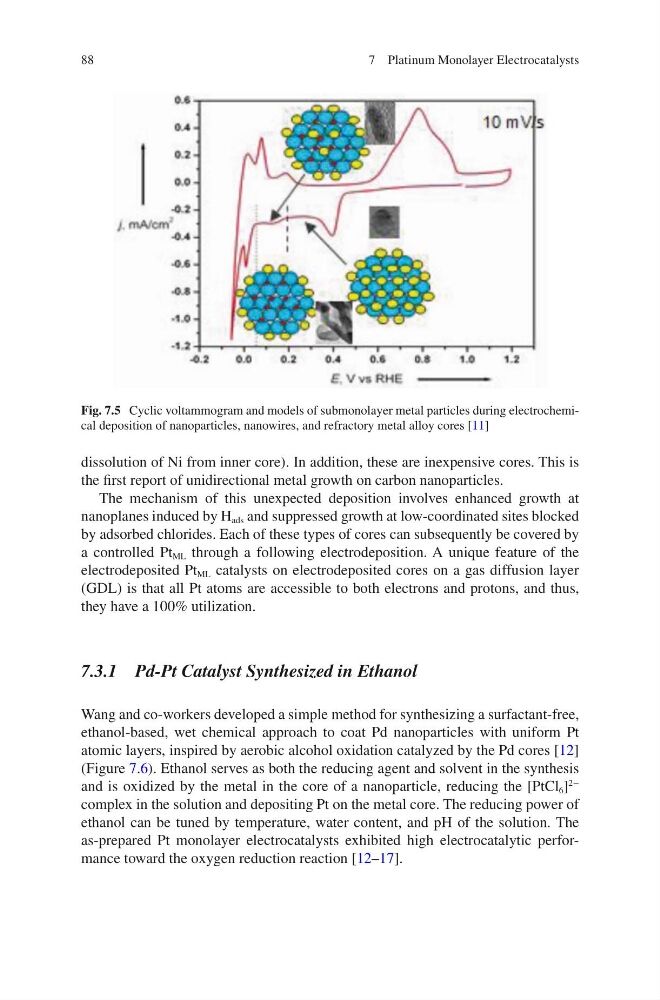
The mechanism of this unexpected deposition involves enhanced growth at
nanoplanes induced by H ads and suppressed growth at low-coordinated sites blocked
by adsorbed chlorides. Each of these types of cores can subsequently be covered by
a controlled Pt ML through a following electrodeposition. A unique feature of the
electrodeposited Pt ML catalysts on electrodeposited cores on a gas diffusion layer
(GDL) is that all Pt atoms are accessible to both electrons and protons, and thus,
they have a 100% utilization.
7.3.1 Pd-Pt Catalyst Synthesized in Ethanol
Wang and co-workers developed a simple method for synthesizing a surfactant-free,
ethanol-based, wet chemical approach to coat Pd nanoparticles with uniform Pt
atomic layers, inspired by aerobic alcohol oxidation catalyzed by the Pd cores [12]
(Figure 7.6). Ethanol serves as both the reducing agent and solvent in the synthesis
and is oxidized by the metal in the core of a nanoparticle, reducing the [PtCl 6 ]
2−
complex in the solution and depositing Pt on the metal core. The reducing power of
ethanol can be tuned by temperature, water content, and pH of the solution. The
as-prepared Pt monolayer electrocatalysts exhibited high electrocatalytic performance toward the oxygen reduction reaction [12–17].
Fig. 7.5 Cyclic voltammogram and models of submonolayer metal particles during electrochemical deposition of nanoparticles, nanowires, and refractory metal alloy cores [11]
7 Platinum Monolayer Electrocatalysts
dissolution of Ni from inner core). In addition, these are inexpensive cores. This is
the first report of unidirectional metal growth on carbon nanoparticles.
The mechanism of this unexpected deposition involves enhanced growth at
nanoplanes induced by H ads and suppressed growth at low-coordinated sites blocked
by adsorbed chlorides. Each of these types of cores can subsequently be covered by
a controlled Pt ML through a following electrodeposition. A unique feature of the
electrodeposited Pt ML catalysts on electrodeposited cores on a gas diffusion layer
(GDL) is that all Pt atoms are accessible to both electrons and protons, and thus,
they have a 100% utilization.
7.3.1 Pd-Pt Catalyst Synthesized in Ethanol
Wang and co-workers developed a simple method for synthesizing a surfactant-free,
ethanol-based, wet chemical approach to coat Pd nanoparticles with uniform Pt
atomic layers, inspired by aerobic alcohol oxidation catalyzed by the Pd cores [12]
(Figure 7.6). Ethanol serves as both the reducing agent and solvent in the synthesis
and is oxidized by the metal in the core of a nanoparticle, reducing the [PtCl 6 ]
2−
complex in the solution and depositing Pt on the metal core. The reducing power of
ethanol can be tuned by temperature, water content, and pH of the solution. The
as-prepared Pt monolayer electrocatalysts exhibited high electrocatalytic performance toward the oxygen reduction reaction [12–17].
Fig. 7.5 Cyclic voltammogram and models of submonolayer metal particles during electrochemical deposition of nanoparticles, nanowires, and refractory metal alloy cores [11]
7 Platinum Monolayer Electrocatalysts