

84
To address the problems of a large content, activity and stability of Pt in electrocatalysts, and the problem of small Pt utilization, Adzic et al. demonstrated a compelling new approach using only one-platinum-atom-thick layer as electrocatalyst:
platinum monolayer electrocatalysts. The validity of the concept was verified with
Pt submonolayer on Ru surfaces for H 2 oxidation CO-tolerant catalyst [1] and a Pt
monolayer supported on Pd surfaces for the oxygen reduction reaction [2]. The
concept of Pt ML electrocatalysts offers a possible exit from impasse for some important electrocatalytic reactions, such as the oxygen reduction reaction (ORR), which
requires a large amount of Pt to compensate its slow reaction kinetics.
This new approach for designing and synthesizing electrocatalysts can dramatically reduce the required Pt content, while affording possibilities to enhance their
catalytic performance. These electrocatalysts consist of a monolayer (one-atomthick layer) of Pt on extended or supported nanoparticle metal or metal-alloy surfaces. The Pt-monolayer (Pt ML ) approach has several attractive features: (i) close to
complete Pt utilization since all Pt atoms are present on the surface and can involve
in catalytic reactions; (ii) tailored electrocatalytic properties resulting from the combined geometric effect (substrate-induced strain) and ligand effect (the electronic
interaction between Pt ML and the substrate); (iii) enhanced stability because of the
decreased oxidation of Pt ML resulting from the interaction with a suitable substrate;
(iv) direct activity correlations between the catalytic and physical properties of Pt ML
as all Pt atoms are involved in the reaction as they are in contact with the reactants.
In contrast, with the common 5 nm Pt/C nanoparticles, 70% Pt atoms do not see the
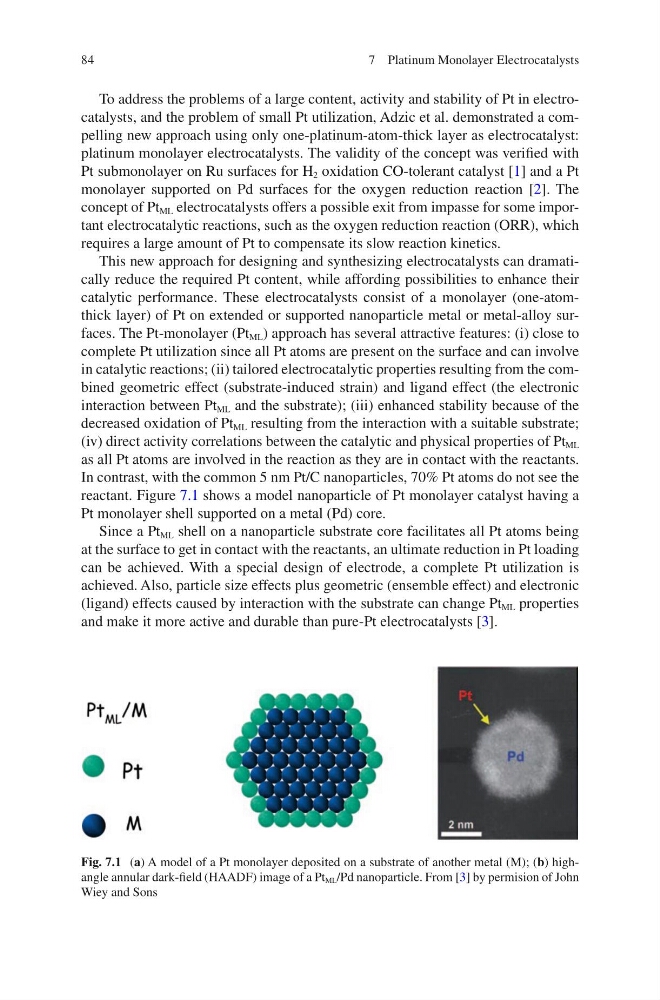
reactant. Figure 7.1 shows a model nanoparticle of Pt monolayer catalyst having a
Pt monolayer shell supported on a metal (Pd) core.
Since a Pt ML shell on a nanoparticle substrate core facilitates all Pt atoms being
at the surface to get in contact with the reactants, an ultimate reduction in Pt loading
can be achieved. With a special design of electrode, a complete Pt utilization is
achieved. Also, particle size effects plus geometric (ensemble effect) and electronic
(ligand) effects caused by interaction with the substrate can change Pt ML properties
and make it more active and durable than pure-Pt electrocatalysts [3].
Fig. 7.1 (a) A model of a Pt monolayer deposited on a substrate of another metal (M); (b) highangle annular dark-field (HAADF) image of a Pt ML /Pd nanoparticle. From [3] by permision of John
Wiey and Sons
7 Platinum Monolayer Electrocatalysts
To address the problems of a large content, activity and stability of Pt in electrocatalysts, and the problem of small Pt utilization, Adzic et al. demonstrated a compelling new approach using only one-platinum-atom-thick layer as electrocatalyst:
platinum monolayer electrocatalysts. The validity of the concept was verified with
Pt submonolayer on Ru surfaces for H 2 oxidation CO-tolerant catalyst [1] and a Pt
monolayer supported on Pd surfaces for the oxygen reduction reaction [2]. The
concept of Pt ML electrocatalysts offers a possible exit from impasse for some important electrocatalytic reactions, such as the oxygen reduction reaction (ORR), which
requires a large amount of Pt to compensate its slow reaction kinetics.
This new approach for designing and synthesizing electrocatalysts can dramatically reduce the required Pt content, while affording possibilities to enhance their
catalytic performance. These electrocatalysts consist of a monolayer (one-atomthick layer) of Pt on extended or supported nanoparticle metal or metal-alloy surfaces. The Pt-monolayer (Pt ML ) approach has several attractive features: (i) close to
complete Pt utilization since all Pt atoms are present on the surface and can involve
in catalytic reactions; (ii) tailored electrocatalytic properties resulting from the combined geometric effect (substrate-induced strain) and ligand effect (the electronic
interaction between Pt ML and the substrate); (iii) enhanced stability because of the
decreased oxidation of Pt ML resulting from the interaction with a suitable substrate;
(iv) direct activity correlations between the catalytic and physical properties of Pt ML
as all Pt atoms are involved in the reaction as they are in contact with the reactants.
In contrast, with the common 5 nm Pt/C nanoparticles, 70% Pt atoms do not see the
reactant. Figure 7.1 shows a model nanoparticle of Pt monolayer catalyst having a
Pt monolayer shell supported on a metal (Pd) core.
Since a Pt ML shell on a nanoparticle substrate core facilitates all Pt atoms being
at the surface to get in contact with the reactants, an ultimate reduction in Pt loading
can be achieved. With a special design of electrode, a complete Pt utilization is
achieved. Also, particle size effects plus geometric (ensemble effect) and electronic
(ligand) effects caused by interaction with the substrate can change Pt ML properties
and make it more active and durable than pure-Pt electrocatalysts [3].
Fig. 7.1 (a) A model of a Pt monolayer deposited on a substrate of another metal (M); (b) highangle annular dark-field (HAADF) image of a Pt ML /Pd nanoparticle. From [3] by permision of John
Wiey and Sons
7 Platinum Monolayer Electrocatalysts