

65
Hydrogen evolution with barrierless discharge – step (1) or barrierless electrochemical desorption step – (3) as the rate-determining step (rds) is expected to occur
with a Tafel slope of −60 and − 30 mV, respectively. This behavior has been
observed with Au and Ag. It has been also observed that hydrogen evolution could
occur at Ni electrode as an activationless process [26], at highly negative potentials
when its energy of activation is no longer affected by the electrode potential.
Most of the investigated cathode materials exhibit Tafel slopes close to −120 mV
at practical current densities. In some cases, a lower Tafel slope ranging from −40
to −60 mV is observed at lower overpotentials. A Tafel slope of –30 mV is observed
mostly with platinum metals in acid solutions.
A complete theory of electrocatalysis has been developed for the hydrogen evolution reaction because the reaction proceeds through a limited number of steps
with possibly only one type of reaction intermediate. The theory predicts that the
electrocatalytic activity depends on the heat of adsorption of the intermediate on the
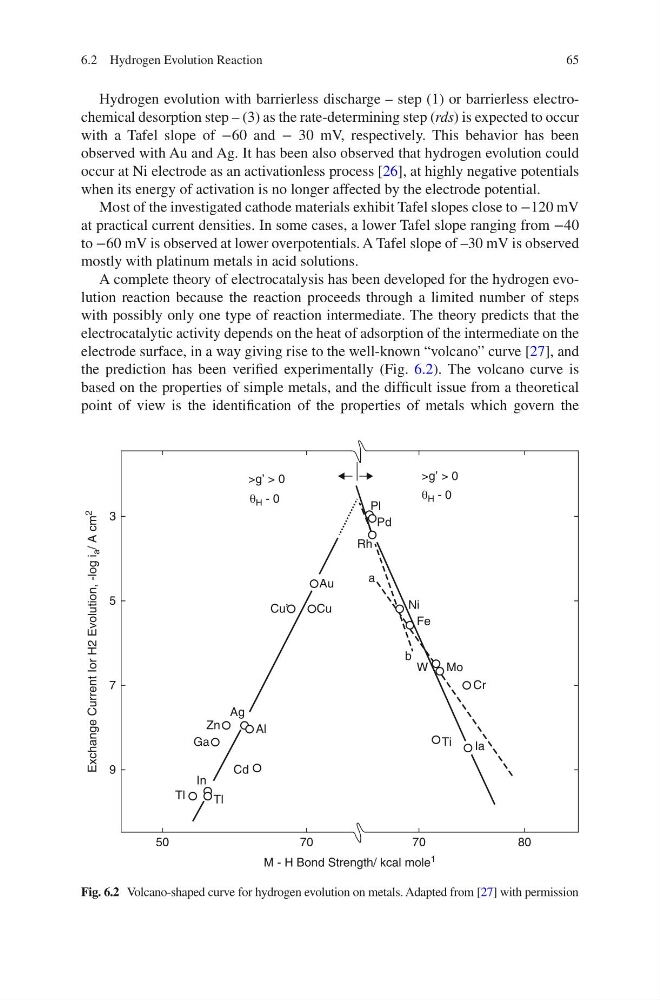
electrode surface, in a way giving rise to the well-known “volcano” curve [27], and
the prediction has been verified experimentally (Fig. 6.2). The volcano curve is
based on the properties of simple metals, and the difficult issue from a theoretical
point of view is the identification of the properties of metals which govern the
3
5
7
9
50
70
70
80
Tl
Tl
In
Ga
Zn
Cd
Ag
Al
Cu’
Cu
Au
a
Rh
Pl
Pd
b
W
Mo
Cr
Fe
Ni
Ti
Ia
>g’ > 0
>g’ > 0
θ H - 0
θ H - 0
M - H Bond Strength/ kcal mole
1
Exchange Current Ior H2 Evolution, -log i
a / A cm
2
Fig. 6.2 Volcano-shaped curve for hydrogen evolution on metals. Adapted from [27] with permission
6.2 Hydrogen Evolution Reaction
Hydrogen evolution with barrierless discharge – step (1) or barrierless electrochemical desorption step – (3) as the rate-determining step (rds) is expected to occur
with a Tafel slope of −60 and − 30 mV, respectively. This behavior has been
observed with Au and Ag. It has been also observed that hydrogen evolution could
occur at Ni electrode as an activationless process [26], at highly negative potentials
when its energy of activation is no longer affected by the electrode potential.
Most of the investigated cathode materials exhibit Tafel slopes close to −120 mV
at practical current densities. In some cases, a lower Tafel slope ranging from −40
to −60 mV is observed at lower overpotentials. A Tafel slope of –30 mV is observed
mostly with platinum metals in acid solutions.
A complete theory of electrocatalysis has been developed for the hydrogen evolution reaction because the reaction proceeds through a limited number of steps
with possibly only one type of reaction intermediate. The theory predicts that the
electrocatalytic activity depends on the heat of adsorption of the intermediate on the
electrode surface, in a way giving rise to the well-known “volcano” curve [27], and
the prediction has been verified experimentally (Fig. 6.2). The volcano curve is
based on the properties of simple metals, and the difficult issue from a theoretical
point of view is the identification of the properties of metals which govern the
3
5
7
9
50
70
70
80
Tl
Tl
In
Ga
Zn
Cd
Ag
Al
Cu’
Cu
Au
a
Rh
Pl
Pd
b
W
Mo
Cr
Fe
Ni
Ti
Ia
>g’ > 0
>g’ > 0
θ H - 0
θ H - 0
M - H Bond Strength/ kcal mole
1
Exchange Current Ior H2 Evolution, -log i
a / A cm
2
Fig. 6.2 Volcano-shaped curve for hydrogen evolution on metals. Adapted from [27] with permission
6.2 Hydrogen Evolution Reaction