

59
O H O e
HO
OH
V
2
2
2
2
0 065
+
+
→
+
= −
−
−
−
Ea
.
(6.6)
is followed either by further two-electron reduction or by decomposition
HO
H O e
OH
V
2
2
2
3
0 867
−
−
−
+
+
+
=
E
.
.
(6.7)
2
2
2
2
HO
OH O
−
−
=
+
(6.8)
The stability of the O–O bond is considerable: the dissociation energy is 494 kJ/
mol, which is the reason that the four-electron reduction is observed on some metals
only. The dissociation energy of the H 2 O 2 molecule is 1-1-6 kJ/mol, which explains
its facile reduction on many surfaces.
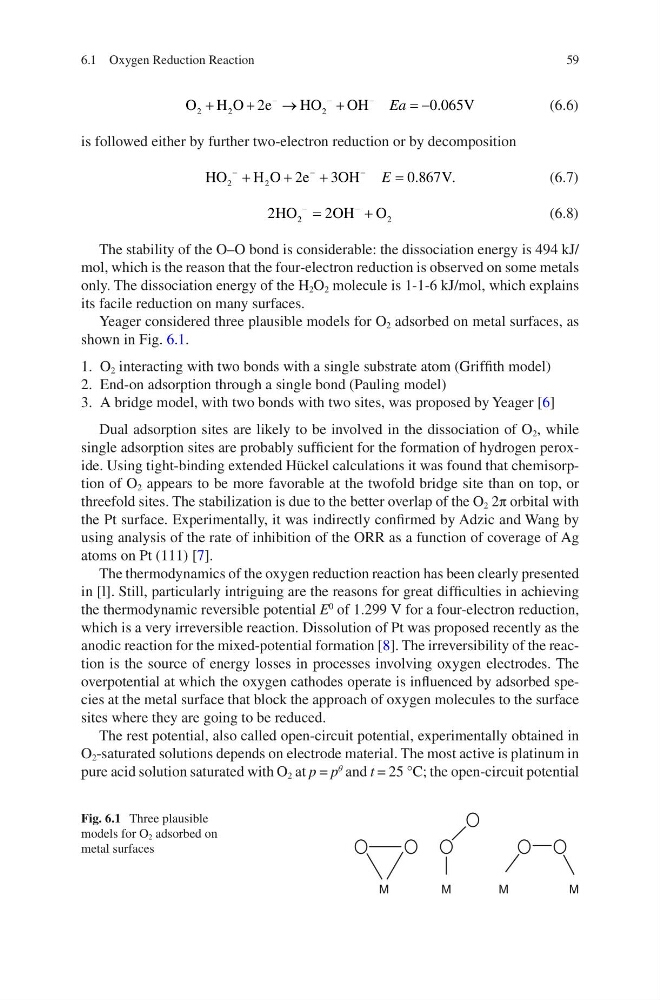
Yeager considered three plausible models for O 2 adsorbed on metal surfaces, as
shown in Fig. 6.1.
1. O 2 interacting with two bonds with a single substrate atom (Griffith model)
2. End-on adsorption through a single bond (Pauling model)
3. A bridge model, with two bonds with two sites, was proposed by Yeager [6]
Dual adsorption sites are likely to be involved in the dissociation of O 2 , while
single adsorption sites are probably sufficient for the formation of hydrogen peroxide. Using tight-binding extended Hückel calculations it was found that chemisorption of O 2 appears to be more favorable at the twofold bridge site than on top, or
threefold sites. The stabilization is due to the better overlap of the O 2 2π orbital with
the Pt surface. Experimentally, it was indirectly confirmed by Adzic and Wang by
using analysis of the rate of inhibition of the ORR as a function of coverage of Ag
atoms on Pt (111) [7].
The thermodynamics of the oxygen reduction reaction has been clearly presented
in [l]. Still, particularly intriguing are the reasons for great difficulties in achieving
the thermodynamic reversible potential E
0
of 1.299 V for a four-electron reduction,
which is a very irreversible reaction. Dissolution of Pt was proposed recently as the
anodic reaction for the mixed-potential formation [8]. The irreversibility of the reaction is the source of energy losses in processes involving oxygen electrodes. The
overpotential at which the oxygen cathodes operate is influenced by adsorbed species at the metal surface that block the approach of oxygen molecules to the surface
sites where they are going to be reduced.
The rest potential, also called open-circuit potential, experimentally obtained in
O 2 -saturated solutions depends on electrode material. The most active is platinum in
pure acid solution saturated with O 2 at p = p
θ
and t = 25 °C; the open-circuit potential
M
M
M
M
Fig. 6.1 Three plausible
models for O 2 adsorbed on
metal surfaces
6.1 Oxygen Reduction Reaction
O H O e
HO
OH
V
2
2
2
2
0 065
+
+
→
+
= −
−
−
−
Ea
.
(6.6)
is followed either by further two-electron reduction or by decomposition
HO
H O e
OH
V
2
2
2
3
0 867
−
−
−
+
+
+
=
E
.
.
(6.7)
2
2
2
2
HO
OH O
−
−
=
+
(6.8)
The stability of the O–O bond is considerable: the dissociation energy is 494 kJ/
mol, which is the reason that the four-electron reduction is observed on some metals
only. The dissociation energy of the H 2 O 2 molecule is 1-1-6 kJ/mol, which explains
its facile reduction on many surfaces.
Yeager considered three plausible models for O 2 adsorbed on metal surfaces, as
shown in Fig. 6.1.
1. O 2 interacting with two bonds with a single substrate atom (Griffith model)
2. End-on adsorption through a single bond (Pauling model)
3. A bridge model, with two bonds with two sites, was proposed by Yeager [6]
Dual adsorption sites are likely to be involved in the dissociation of O 2 , while
single adsorption sites are probably sufficient for the formation of hydrogen peroxide. Using tight-binding extended Hückel calculations it was found that chemisorption of O 2 appears to be more favorable at the twofold bridge site than on top, or
threefold sites. The stabilization is due to the better overlap of the O 2 2π orbital with
the Pt surface. Experimentally, it was indirectly confirmed by Adzic and Wang by
using analysis of the rate of inhibition of the ORR as a function of coverage of Ag
atoms on Pt (111) [7].
The thermodynamics of the oxygen reduction reaction has been clearly presented
in [l]. Still, particularly intriguing are the reasons for great difficulties in achieving
the thermodynamic reversible potential E
0
of 1.299 V for a four-electron reduction,
which is a very irreversible reaction. Dissolution of Pt was proposed recently as the
anodic reaction for the mixed-potential formation [8]. The irreversibility of the reaction is the source of energy losses in processes involving oxygen electrodes. The
overpotential at which the oxygen cathodes operate is influenced by adsorbed species at the metal surface that block the approach of oxygen molecules to the surface
sites where they are going to be reduced.
The rest potential, also called open-circuit potential, experimentally obtained in
O 2 -saturated solutions depends on electrode material. The most active is platinum in
pure acid solution saturated with O 2 at p = p
θ
and t = 25 °C; the open-circuit potential
M
M
M
M
Fig. 6.1 Three plausible
models for O 2 adsorbed on
metal surfaces
6.1 Oxygen Reduction Reaction