

52
tion on Pb/Au. Consequently, the ring current shows that peroxide generation is
almost completely suppressed. A series reaction mechanism, involving a twoelectron reduction to HO 2
−
, followed by an exchange of another two electrons in the
reduction of HO 2
−
to OH
−
, has been found from the analysis of the rotating diskring electrode measurements [35].
A new cell was developed, called electrochemical drop cell, that provides a more
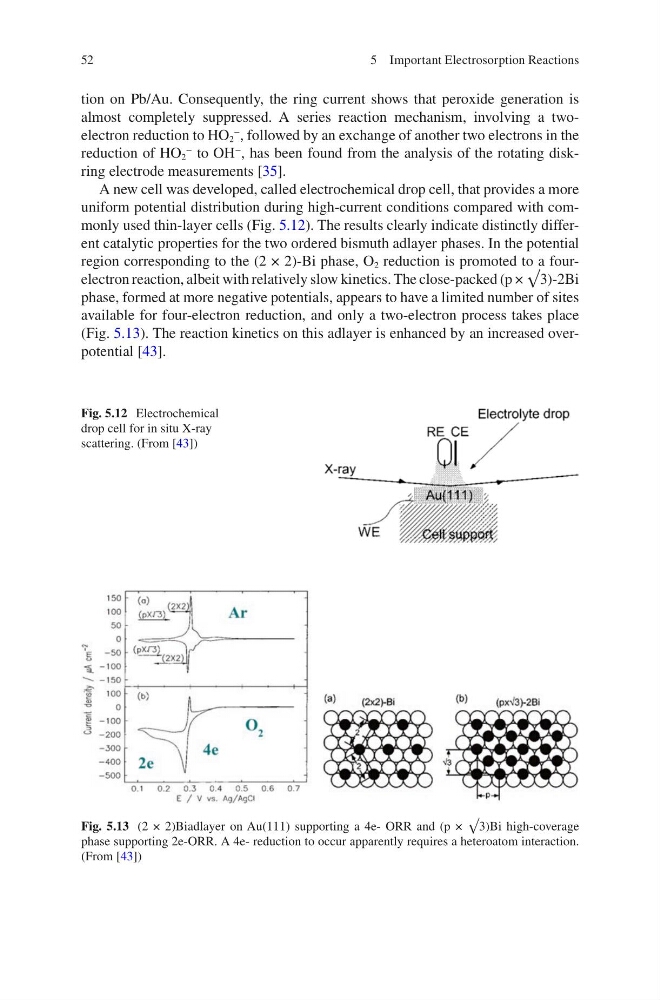
uniform potential distribution during high-current conditions compared with commonly used thin-layer cells (Fig. 5.12). The results clearly indicate distinctly different catalytic properties for the two ordered bismuth adlayer phases. In the potential
region corresponding to the (2 × 2)-Bi phase, O 2 reduction is promoted to a fourelectron reaction, albeit with relatively slow kinetics. The close-packed (p × √3)-2Bi
phase, formed at more negative potentials, appears to have a limited number of sites
available for four-electron reduction, and only a two-electron process takes place
(Fig. 5.13). The reaction kinetics on this adlayer is enhanced by an increased overpotential [43].
Fig. 5.13 (2 × 2)Biadlayer on Au(111) supporting a 4e- ORR and (p × √3)Bi high-coverage
phase supporting 2e-ORR. A 4e- reduction to occur apparently requires a heteroatom interaction.
(From [43])
Fig. 5.12 Electrochemical
drop cell for in situ X-ray
scattering. (From [43])
5 Important Electrosorption Reactions
tion on Pb/Au. Consequently, the ring current shows that peroxide generation is
almost completely suppressed. A series reaction mechanism, involving a twoelectron reduction to HO 2
−
, followed by an exchange of another two electrons in the
reduction of HO 2
−
to OH
−
, has been found from the analysis of the rotating diskring electrode measurements [35].
A new cell was developed, called electrochemical drop cell, that provides a more
uniform potential distribution during high-current conditions compared with commonly used thin-layer cells (Fig. 5.12). The results clearly indicate distinctly different catalytic properties for the two ordered bismuth adlayer phases. In the potential
region corresponding to the (2 × 2)-Bi phase, O 2 reduction is promoted to a fourelectron reaction, albeit with relatively slow kinetics. The close-packed (p × √3)-2Bi
phase, formed at more negative potentials, appears to have a limited number of sites
available for four-electron reduction, and only a two-electron process takes place
(Fig. 5.13). The reaction kinetics on this adlayer is enhanced by an increased overpotential [43].
Fig. 5.13 (2 × 2)Biadlayer on Au(111) supporting a 4e- ORR and (p × √3)Bi high-coverage
phase supporting 2e-ORR. A 4e- reduction to occur apparently requires a heteroatom interaction.
(From [43])
Fig. 5.12 Electrochemical
drop cell for in situ X-ray
scattering. (From [43])
5 Important Electrosorption Reactions