

47
The remarkable catalytic properties of electrode surfaces modified by monolayer
amounts of metal adatoms obtained by underpotential deposition found in these
studies have attracted considerable attention during the last couple of decades. This
interest stems from the possibility of implementing strictly metal surface modifications of electrocatalysts in an elegant, well-controlled way, and these bimetallic
surfaces can serve as models for the design of new catalysts. In addition, some of
these systems may have potential for practical applications. The UPD of metals
facilitates this type of surface modification, which can be performed repeatedly by
potential control. Recent studies of these surfaces and their catalytic properties by
new in situ surface structure sensitive techniques have greatly improved their understanding. Electrocatalytic effects of UPD of metal adatoms on oxidation of small
organic molecules, oxygen reduction, reactions of electroorganic synthesis, electrodeposition of metals, and charge transfers in redox couples were demonstrated in
the mid-1970s [35].
As a conceptual introduction and the ground for comparison with platinum
monolayer catalysts, a short description of several catalytic reactions will be given,
including those on catalytic effects on the oxidation of organic molecules, hydrogen
evolution, and oxygen reduction.
Optical properties of metal adlayers were extensively studied in the late 1970s by
reflectance spectroscopy, ellipsometry, surface plasmon excitation, and Mösbauer
spectroscopy (See Refs. [33–35] and references therein). Pronounced changes of
100
50
0
–150
–100
–0.4 –0.2
0
0.2
0.4
0.6
0.8
1
Current density / µA
cm
–2
E RHE (V)
rot-hex
rot-hex
c(p×√3) (p×√3)2 (√13×√13)3
disordered
Tl
TlBr
TlBr
TlBr 2
Br
Tl
Br 0
0.73
(0.46)
(0.46)
0.33
0.33
0.23
0.46
0
0.48
ML
ML
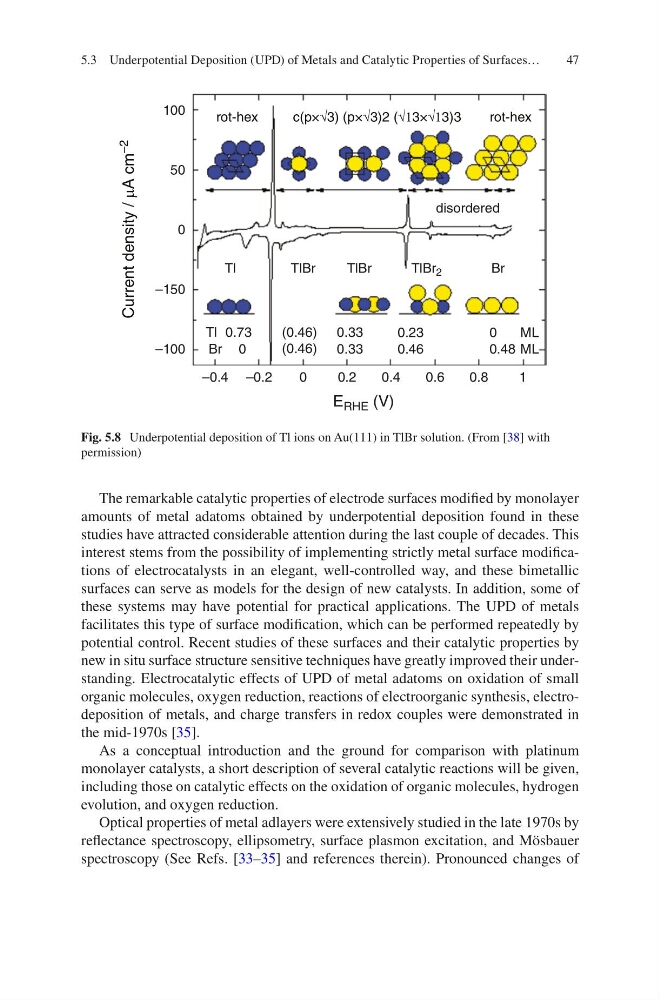
Fig. 5.8 Underpotential deposition of Tl ions on Au(111) in TlBr solution. (From [38] with
permission)
5.3 Underpotential Deposition (UPD) of Metals and Catalytic Properties of Surfaces…
The remarkable catalytic properties of electrode surfaces modified by monolayer
amounts of metal adatoms obtained by underpotential deposition found in these
studies have attracted considerable attention during the last couple of decades. This
interest stems from the possibility of implementing strictly metal surface modifications of electrocatalysts in an elegant, well-controlled way, and these bimetallic
surfaces can serve as models for the design of new catalysts. In addition, some of
these systems may have potential for practical applications. The UPD of metals
facilitates this type of surface modification, which can be performed repeatedly by
potential control. Recent studies of these surfaces and their catalytic properties by
new in situ surface structure sensitive techniques have greatly improved their understanding. Electrocatalytic effects of UPD of metal adatoms on oxidation of small
organic molecules, oxygen reduction, reactions of electroorganic synthesis, electrodeposition of metals, and charge transfers in redox couples were demonstrated in
the mid-1970s [35].
As a conceptual introduction and the ground for comparison with platinum
monolayer catalysts, a short description of several catalytic reactions will be given,
including those on catalytic effects on the oxidation of organic molecules, hydrogen
evolution, and oxygen reduction.
Optical properties of metal adlayers were extensively studied in the late 1970s by
reflectance spectroscopy, ellipsometry, surface plasmon excitation, and Mösbauer
spectroscopy (See Refs. [33–35] and references therein). Pronounced changes of
100
50
0
–150
–100
–0.4 –0.2
0
0.2
0.4
0.6
0.8
1
Current density / µA
cm
–2
E RHE (V)
rot-hex
rot-hex
c(p×√3) (p×√3)2 (√13×√13)3
disordered
Tl
TlBr
TlBr
TlBr 2
Br
Tl
Br 0
0.73
(0.46)
(0.46)
0.33
0.33
0.23
0.46
0
0.48
ML
ML
Fig. 5.8 Underpotential deposition of Tl ions on Au(111) in TlBr solution. (From [38] with
permission)
5.3 Underpotential Deposition (UPD) of Metals and Catalytic Properties of Surfaces…