

29
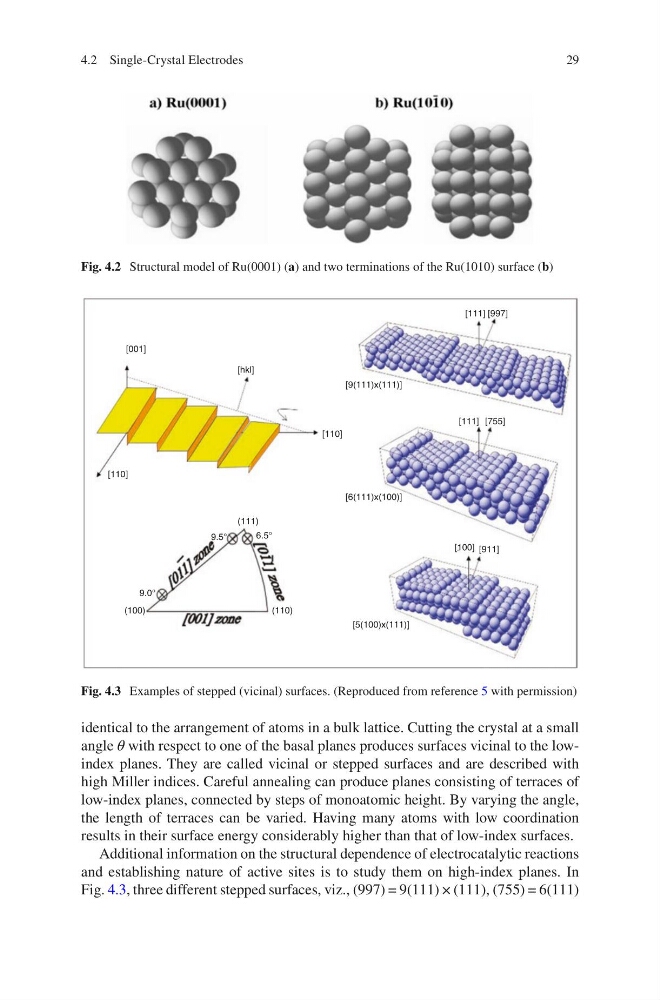
identical to the arrangement of atoms in a bulk lattice. Cutting the crystal at a small
angle θ with respect to one of the basal planes produces surfaces vicinal to the lowindex planes. They are called vicinal or stepped surfaces and are described with
high Miller indices. Careful annealing can produce planes consisting of terraces of
low-index planes, connected by steps of monoatomic height. By varying the angle,
the length of terraces can be varied. Having many atoms with low coordination
results in their surface energy considerably higher than that of low-index surfaces.
Additional information on the structural dependence of electrocatalytic reactions
and establishing nature of active sites is to study them on high-index planes. In
Fig. 4.3, three different stepped surfaces, viz., (997) = 9(111) × (111), (755) = 6(111)
Fig. 4.2 Structural model of Ru(0001) (a) and two terminations of the Ru(1010) surface (b)
[001]
[hkl]
[110]
[111]
[100] [911]
[111] [997]
[755]
[9(111)x(111)]
[6(111)x(100)]
[5(100)x(111)]
(100)
(110)
(111)
9.5°
6.5°
9.0°
[110]
Fig. 4.3 Examples of stepped (vicinal) surfaces. (Reproduced from reference 5 with permission)
4.2 Single-Crystal Electrodes
identical to the arrangement of atoms in a bulk lattice. Cutting the crystal at a small
angle θ with respect to one of the basal planes produces surfaces vicinal to the lowindex planes. They are called vicinal or stepped surfaces and are described with
high Miller indices. Careful annealing can produce planes consisting of terraces of
low-index planes, connected by steps of monoatomic height. By varying the angle,
the length of terraces can be varied. Having many atoms with low coordination
results in their surface energy considerably higher than that of low-index surfaces.
Additional information on the structural dependence of electrocatalytic reactions
and establishing nature of active sites is to study them on high-index planes. In
Fig. 4.3, three different stepped surfaces, viz., (997) = 9(111) × (111), (755) = 6(111)
Fig. 4.2 Structural model of Ru(0001) (a) and two terminations of the Ru(1010) surface (b)
[001]
[hkl]
[110]
[111]
[100] [911]
[111] [997]
[755]
[9(111)x(111)]
[6(111)x(100)]
[5(100)x(111)]
(100)
(110)
(111)
9.5°
6.5°
9.0°
[110]
Fig. 4.3 Examples of stepped (vicinal) surfaces. (Reproduced from reference 5 with permission)
4.2 Single-Crystal Electrodes