

7
The rate of charge transfer across the electrochemical interface depends not only
on the potential but also on the double-layer structure and the adsorption of reactants, intermediates, and products and other eventual solution-phase species. Mass
transport limitations are not considered here. The expression relating current to the
electrode potential can be obtained from the absolute rate theory applied to the electrochemical interface. For that electrochemical reaction case, the heights of the free
energy barriers are functions of the potentials drop across the interface in accordance with the absolute rate theory.
In the simplest case of one electron-transfer reaction:
O e
R
+ ↔
−
(1.7)
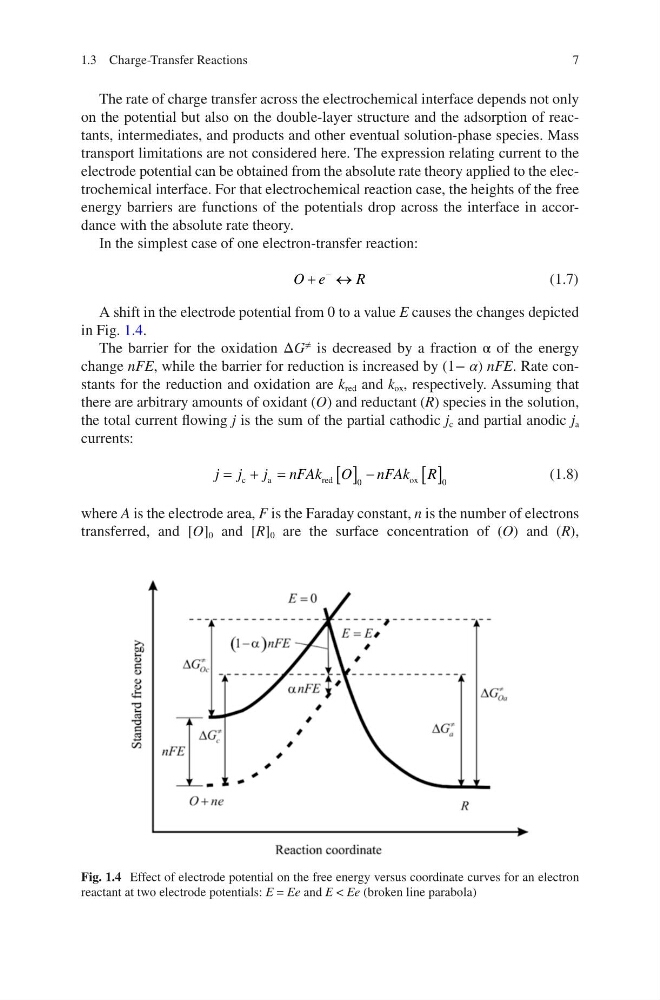
A shift in the electrode potential from 0 to a value E causes the changes depicted
in Fig. 1.4.
The barrier for the oxidation ΔG
≠
is decreased by a fraction α of the energy
change nFE, while the barrier for reduction is increased by (1− α) nFE. Rate constants for the reduction and oxidation are k red and k ox , respectively. Assuming that
there are arbitrary amounts of oxidant (O) and reductant (R) species in the solution,
the total current flowing j is the sum of the partial cathodic j c and partial anodic j a
currents:
j j j nFAk O
nFAk R
= + =
[ ] −
[ ]
c
a
red
o x
0
0
(1.8)
where A is the electrode area, F is the Faraday constant, n is the number of electrons
transferred, and [O] 0 and [R] 0 are the surface concentration of (O) and (R),
Fig. 1.4 Effect of electrode potential on the free energy versus coordinate curves for an electron
reactant at two electrode potentials: E = Ee and E < Ee (broken line parabola)
1.3 Charge-Transfer Reactions
The rate of charge transfer across the electrochemical interface depends not only
on the potential but also on the double-layer structure and the adsorption of reactants, intermediates, and products and other eventual solution-phase species. Mass
transport limitations are not considered here. The expression relating current to the
electrode potential can be obtained from the absolute rate theory applied to the electrochemical interface. For that electrochemical reaction case, the heights of the free
energy barriers are functions of the potentials drop across the interface in accordance with the absolute rate theory.
In the simplest case of one electron-transfer reaction:
O e
R
+ ↔
−
(1.7)
A shift in the electrode potential from 0 to a value E causes the changes depicted
in Fig. 1.4.
The barrier for the oxidation ΔG
≠
is decreased by a fraction α of the energy
change nFE, while the barrier for reduction is increased by (1− α) nFE. Rate constants for the reduction and oxidation are k red and k ox , respectively. Assuming that
there are arbitrary amounts of oxidant (O) and reductant (R) species in the solution,
the total current flowing j is the sum of the partial cathodic j c and partial anodic j a
currents:
j j j nFAk O
nFAk R
= + =
[ ] −
[ ]
c
a
red
o x
0
0
(1.8)
where A is the electrode area, F is the Faraday constant, n is the number of electrons
transferred, and [O] 0 and [R] 0 are the surface concentration of (O) and (R),
Fig. 1.4 Effect of electrode potential on the free energy versus coordinate curves for an electron
reactant at two electrode potentials: E = Ee and E < Ee (broken line parabola)
1.3 Charge-Transfer Reactions