

158
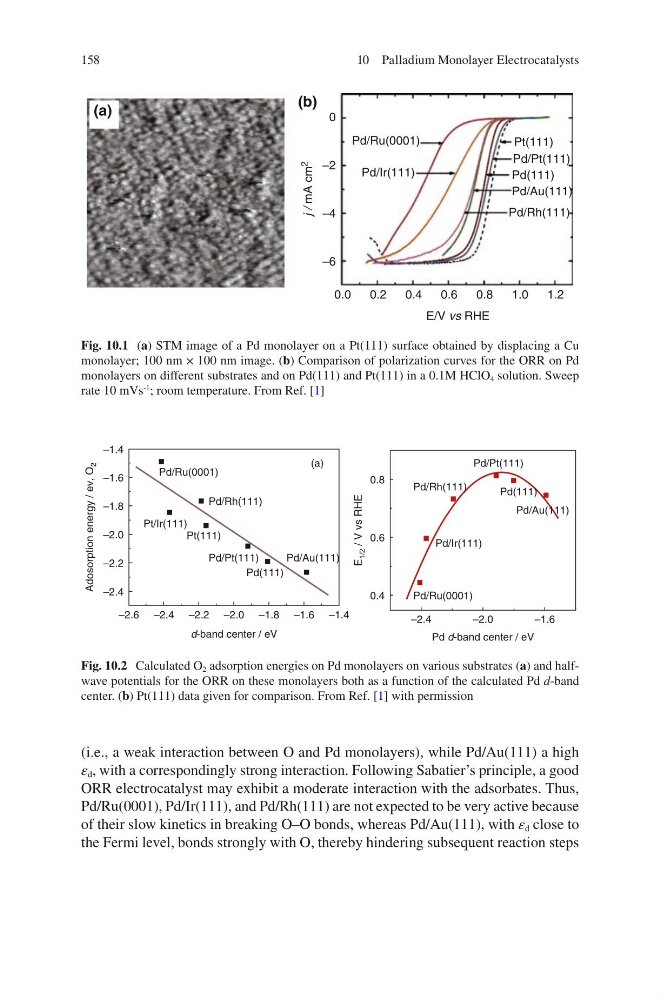
(i.e., a weak interaction between O and Pd monolayers), while Pd/Au(111) a high
ε d , with a correspondingly strong interaction. Following Sabatier’s principle, a good
ORR electrocatalyst may exhibit a moderate interaction with the adsorbates. Thus,
Pd/Ru(0001), Pd/Ir(111), and Pd/Rh(111) are not expected to be very active because
of their slow kinetics in breaking O–O bonds, whereas Pd/Au(111), with ε d close to
the Fermi level, bonds strongly with O, thereby hindering subsequent reaction steps
(b)
0
–2
–4
–6
0.0
0.2
0.4
0.6
0.8
1.0
1.2
E/V vs RHE
j / mA cm
2
Pd/Ru(0001)
Pd/Ir(111)
Pd/Rh(111)
Pd/Au(111)
Pd/Pt(111)
Pd(111)
Pt(111)
(a)
Fig. 10.1 (a) STM image of a Pd monolayer on a Pt(111) surface obtained by displacing a Cu
monolayer; 100 nm × 100 nm image. (b) Comparison of polarization curves for the ORR on Pd
monolayers on different substrates and on Pd(111) and Pt(111) in a 0.1M HClO 4 solution. Sweep
rate 10 mVs
-1
; room temperature. From Ref. [1]
–1.4
–1.4
–1.6
–1.6
–1.8
–1.8
–2.0
–2.0
–2.2
–2.2
–2.4
–2.4
–2.6
d-band center / eV
Adosorption energy / ev, O
2
Pd/Ru(0001)
Pd/Ru(0001)
Pd/Pt(111)
Pd/Au(111)
Pd/Rh(111)
Pd(111)
Pd/Ir(111)
Pd/Rh(111)
Pd/Au(111)
Pd(111)
Pd/Pt(111)
Pt(111)
Pt/Ir(111)
0.8
0.6
0.4
–2.4
–2.0
–1.6
Pd d-band center / eV
E
1/2 / V vs RHE
(a)
Fig. 10.2 Calculated O 2 adsorption energies on Pd monolayers on various substrates (a) and halfwave potentials for the ORR on these monolayers both as a function of the calculated Pd d-band
center. (b) Pt(111) data given for comparison. From Ref. [1] with permission
10 Palladium Monolayer Electrocatalysts
(i.e., a weak interaction between O and Pd monolayers), while Pd/Au(111) a high
ε d , with a correspondingly strong interaction. Following Sabatier’s principle, a good
ORR electrocatalyst may exhibit a moderate interaction with the adsorbates. Thus,
Pd/Ru(0001), Pd/Ir(111), and Pd/Rh(111) are not expected to be very active because
of their slow kinetics in breaking O–O bonds, whereas Pd/Au(111), with ε d close to
the Fermi level, bonds strongly with O, thereby hindering subsequent reaction steps
(b)
0
–2
–4
–6
0.0
0.2
0.4
0.6
0.8
1.0
1.2
E/V vs RHE
j / mA cm
2
Pd/Ru(0001)
Pd/Ir(111)
Pd/Rh(111)
Pd/Au(111)
Pd/Pt(111)
Pd(111)
Pt(111)
(a)
Fig. 10.1 (a) STM image of a Pd monolayer on a Pt(111) surface obtained by displacing a Cu
monolayer; 100 nm × 100 nm image. (b) Comparison of polarization curves for the ORR on Pd
monolayers on different substrates and on Pd(111) and Pt(111) in a 0.1M HClO 4 solution. Sweep
rate 10 mVs
-1
; room temperature. From Ref. [1]
–1.4
–1.4
–1.6
–1.6
–1.8
–1.8
–2.0
–2.0
–2.2
–2.2
–2.4
–2.4
–2.6
d-band center / eV
Adosorption energy / ev, O
2
Pd/Ru(0001)
Pd/Ru(0001)
Pd/Pt(111)
Pd/Au(111)
Pd/Rh(111)
Pd(111)
Pd/Ir(111)
Pd/Rh(111)
Pd/Au(111)
Pd(111)
Pd/Pt(111)
Pt(111)
Pt/Ir(111)
0.8
0.6
0.4
–2.4
–2.0
–1.6
Pd d-band center / eV
E
1/2 / V vs RHE
(a)
Fig. 10.2 Calculated O 2 adsorption energies on Pd monolayers on various substrates (a) and halfwave potentials for the ORR on these monolayers both as a function of the calculated Pd d-band
center. (b) Pt(111) data given for comparison. From Ref. [1] with permission
10 Palladium Monolayer Electrocatalysts