

154
leading to some contraction of the Pt layer. The excess of Pt atoms from a monolayer shell can form a partial bilayered structure, or hollow particles may be formed
due to the Kirkendall effect.
The distribution of Au in PdAu alloy has a great impact on the stabilization of Pd
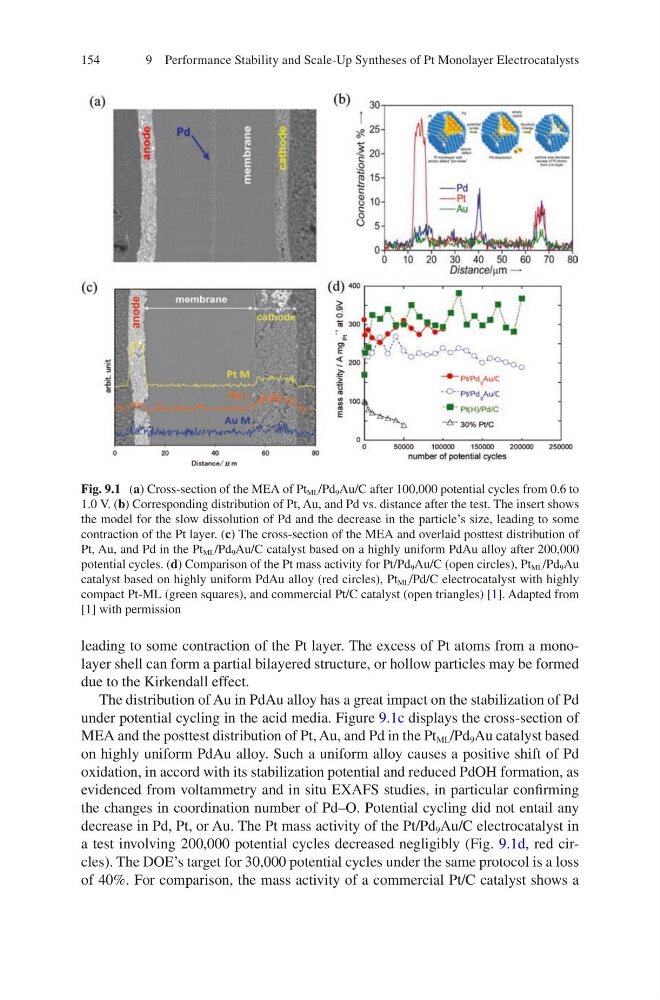
under potential cycling in the acid media. Figure 9.1c displays the cross-section of
MEA and the posttest distribution of Pt, Au, and Pd in the Pt ML /Pd 9 Au catalyst based
on highly uniform PdAu alloy. Such a uniform alloy causes a positive shift of Pd
oxidation, in accord with its stabilization potential and reduced PdOH formation, as
evidenced from voltammetry and in situ EXAFS studies, in particular confirming
the changes in coordination number of Pd–O. Potential cycling did not entail any
decrease in Pd, Pt, or Au. The Pt mass activity of the Pt/Pd 9 Au/C electrocatalyst in
a test involving 200,000 potential cycles decreased negligibly (Fig. 9.1d, red circles). The DOE’s target for 30,000 potential cycles under the same protocol is a loss
of 40%. For comparison, the mass activity of a commercial Pt/C catalyst shows a
Fig. 9.1 (a) Cross-section of the MEA of Pt ML /Pd 9 Au/C after 100,000 potential cycles from 0.6 to
1.0 V. (b) Corresponding distribution of Pt, Au, and Pd vs. distance after the test. The insert shows
the model for the slow dissolution of Pd and the decrease in the particle’s size, leading to some
contraction of the Pt layer. (c) The cross-section of the MEA and overlaid posttest distribution of
Pt, Au, and Pd in the Pt ML /Pd 9 Au/C catalyst based on a highly uniform PdAu alloy after 200,000
potential cycles. (d) Comparison of the Pt mass activity for Pt/Pd 9 Au/C (open circles), Pt ML /Pd 9 Au
catalyst based on highly uniform PdAu alloy (red circles), Pt ML /Pd/C electrocatalyst with highly
compact Pt-ML (green squares), and commercial Pt/C catalyst (open triangles) [1]. Adapted from
[1] with permission
9 Performance Stability and Scale-Up Syntheses of Pt Monolayer Electrocatalysts
leading to some contraction of the Pt layer. The excess of Pt atoms from a monolayer shell can form a partial bilayered structure, or hollow particles may be formed
due to the Kirkendall effect.
The distribution of Au in PdAu alloy has a great impact on the stabilization of Pd
under potential cycling in the acid media. Figure 9.1c displays the cross-section of
MEA and the posttest distribution of Pt, Au, and Pd in the Pt ML /Pd 9 Au catalyst based
on highly uniform PdAu alloy. Such a uniform alloy causes a positive shift of Pd
oxidation, in accord with its stabilization potential and reduced PdOH formation, as
evidenced from voltammetry and in situ EXAFS studies, in particular confirming
the changes in coordination number of Pd–O. Potential cycling did not entail any
decrease in Pd, Pt, or Au. The Pt mass activity of the Pt/Pd 9 Au/C electrocatalyst in
a test involving 200,000 potential cycles decreased negligibly (Fig. 9.1d, red circles). The DOE’s target for 30,000 potential cycles under the same protocol is a loss
of 40%. For comparison, the mass activity of a commercial Pt/C catalyst shows a
Fig. 9.1 (a) Cross-section of the MEA of Pt ML /Pd 9 Au/C after 100,000 potential cycles from 0.6 to
1.0 V. (b) Corresponding distribution of Pt, Au, and Pd vs. distance after the test. The insert shows
the model for the slow dissolution of Pd and the decrease in the particle’s size, leading to some
contraction of the Pt layer. (c) The cross-section of the MEA and overlaid posttest distribution of
Pt, Au, and Pd in the Pt ML /Pd 9 Au/C catalyst based on a highly uniform PdAu alloy after 200,000
potential cycles. (d) Comparison of the Pt mass activity for Pt/Pd 9 Au/C (open circles), Pt ML /Pd 9 Au
catalyst based on highly uniform PdAu alloy (red circles), Pt ML /Pd/C electrocatalyst with highly
compact Pt-ML (green squares), and commercial Pt/C catalyst (open triangles) [1]. Adapted from
[1] with permission
9 Performance Stability and Scale-Up Syntheses of Pt Monolayer Electrocatalysts