

5
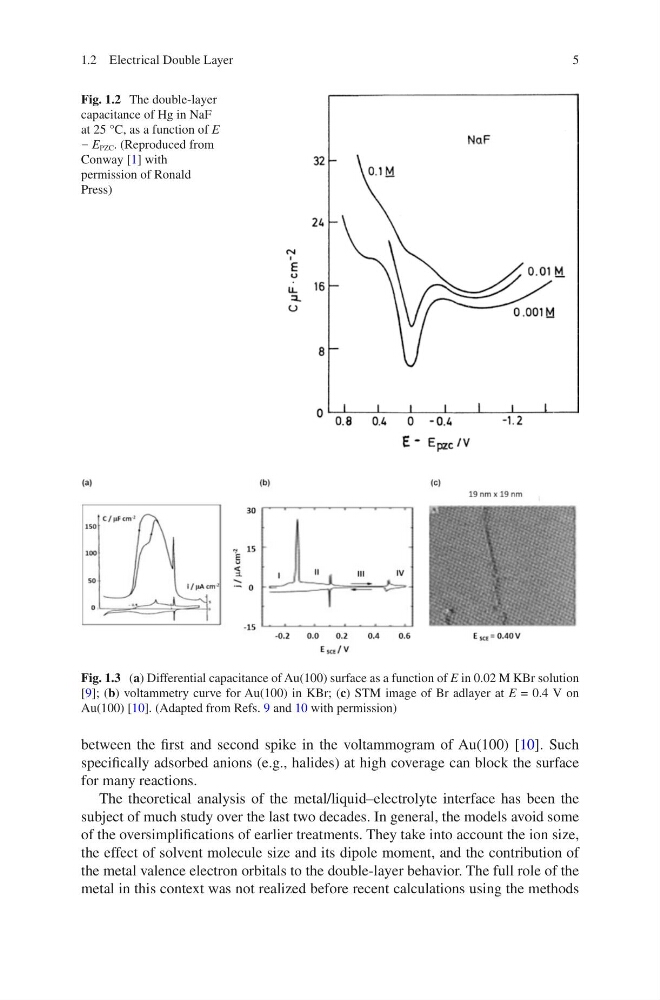
between the first and second spike in the voltammogram of Au(100) [10]. Such
specifically adsorbed anions (e.g., halides) at high coverage can block the surface
for many reactions.
The theoretical analysis of the metal/liquid–electrolyte interface has been the
subject of much study over the last two decades. In general, the models avoid some
of the oversimplifications of earlier treatments. They take into account the ion size,
the effect of solvent molecule size and its dipole moment, and the contribution of
the metal valence electron orbitals to the double-layer behavior. The full role of the
metal in this context was not realized before recent calculations using the methods
Fig. 1.2 The double-layer
capacitance of Hg in NaF
at 25 °C, as a function of E
− E PZC . (Reproduced from
Conway [1] with
permission of Ronald
Press)
Fig. 1.3 (a) Differential capacitance of Au(100) surface as a function of E in 0.02 M KBr solution
[9]; (b) voltammetry curve for Au(100) in KBr; (c) STM image of Br adlayer at E = 0.4 V on
Au(100) [10]. (Adapted from Refs. 9 and 10 with permission)
1.2 Electrical Double Layer
between the first and second spike in the voltammogram of Au(100) [10]. Such
specifically adsorbed anions (e.g., halides) at high coverage can block the surface
for many reactions.
The theoretical analysis of the metal/liquid–electrolyte interface has been the
subject of much study over the last two decades. In general, the models avoid some
of the oversimplifications of earlier treatments. They take into account the ion size,
the effect of solvent molecule size and its dipole moment, and the contribution of
the metal valence electron orbitals to the double-layer behavior. The full role of the
metal in this context was not realized before recent calculations using the methods
Fig. 1.2 The double-layer
capacitance of Hg in NaF
at 25 °C, as a function of E
− E PZC . (Reproduced from
Conway [1] with
permission of Ronald
Press)
Fig. 1.3 (a) Differential capacitance of Au(100) surface as a function of E in 0.02 M KBr solution
[9]; (b) voltammetry curve for Au(100) in KBr; (c) STM image of Br adlayer at E = 0.4 V on
Au(100) [10]. (Adapted from Refs. 9 and 10 with permission)
1.2 Electrical Double Layer