

134
electronic and geometric effects under the fuel cell conditions are essential in rationalizing the increase in the ORR activity of nitride core PtMN/C compared to Pt/C.
Core-shell catalysts have unique properties of reducing the precious metal for the
reaction and at the same time increasing the ORR activity by combined geometrical
and electronic effects; therefore, they hold promise for the future of fuel cell
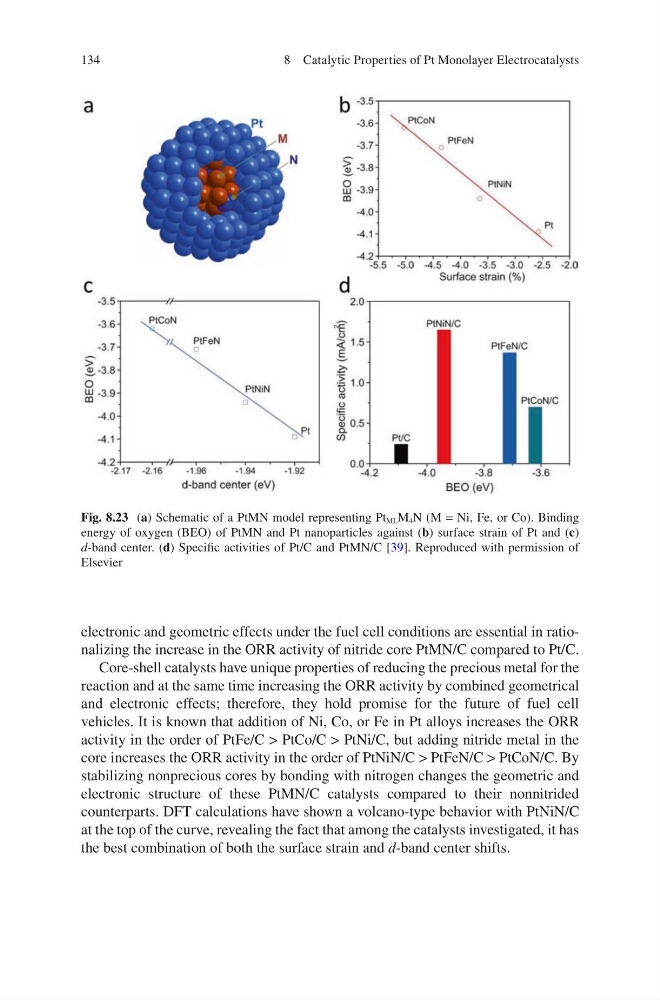
vehicles. It is known that addition of Ni, Co, or Fe in Pt alloys increases the ORR
activity in the order of PtFe/C > PtCo/C > PtNi/C, but adding nitride metal in the
core increases the ORR activity in the order of PtNiN/C > PtFeN/C > PtCoN/C. By
stabilizing nonprecious cores by bonding with nitrogen changes the geometric and
electronic structure of these PtMN/C catalysts compared to their nonnitrided
counterparts. DFT calculations have shown a volcano-type behavior with PtNiN/C
at the top of the curve, revealing the fact that among the catalysts investigated, it has
the best combination of both the surface strain and d-band center shifts.
Fig. 8.23 (a) Schematic of a PtMN model representing Pt ML M 4 N (M = Ni, Fe, or Co). Binding
energy of oxygen (BEO) of PtMN and Pt nanoparticles against (b) surface strain of Pt and (c)
d-band center. (d) Specific activities of Pt/C and PtMN/C [39]. Reproduced with permission of
Elsevier
8 Catalytic Properties of Pt Monolayer Electrocatalysts
electronic and geometric effects under the fuel cell conditions are essential in rationalizing the increase in the ORR activity of nitride core PtMN/C compared to Pt/C.
Core-shell catalysts have unique properties of reducing the precious metal for the
reaction and at the same time increasing the ORR activity by combined geometrical
and electronic effects; therefore, they hold promise for the future of fuel cell
vehicles. It is known that addition of Ni, Co, or Fe in Pt alloys increases the ORR
activity in the order of PtFe/C > PtCo/C > PtNi/C, but adding nitride metal in the
core increases the ORR activity in the order of PtNiN/C > PtFeN/C > PtCoN/C. By
stabilizing nonprecious cores by bonding with nitrogen changes the geometric and
electronic structure of these PtMN/C catalysts compared to their nonnitrided
counterparts. DFT calculations have shown a volcano-type behavior with PtNiN/C
at the top of the curve, revealing the fact that among the catalysts investigated, it has
the best combination of both the surface strain and d-band center shifts.
Fig. 8.23 (a) Schematic of a PtMN model representing Pt ML M 4 N (M = Ni, Fe, or Co). Binding
energy of oxygen (BEO) of PtMN and Pt nanoparticles against (b) surface strain of Pt and (c)
d-band center. (d) Specific activities of Pt/C and PtMN/C [39]. Reproduced with permission of
Elsevier
8 Catalytic Properties of Pt Monolayer Electrocatalysts