

125
Figure 8.17 shows the ORR polarization curves obtained with the Pt/PtPb, Pt/
PdPb, and Pt/PdFe electrocatalysts as a thin film rotating disk electrode (RDE). The
activity of these catalysts increases in the following sequence: Pt/PtPb > Pt/PdFe >
Pt/PdPb. As expected, the substrate profoundly affects the activity of a Pt monolayer
having high half- wave potential, E 1/2 = 0.9 V, and a Pt monolayer mass activity of
0.97 A/mg. The role of substrate in determining the activity of a Pt monolayer for
the ORR is established as being the volcano-type dependence of kinetic currents as
a function of the d-band center energy, ε d . The d-band center of metal monolayers is
directly linked to their adsorption energies and activation barriers. Probably Pt
replaces Pb and Fe from the top layer, and the resulting structures are compressed
too much (in Pt/PdFe), or expanded (in Pt/PdPb). Apparently, the Pt/PtPd surface is
the more adequate substrate. Thus, the electronic property of the Pt monolayer,
0.4
0.3
0.2
0.1
0.0
0
50000
100000
150000
200000
n
A/A mg
Pt
–1
at 0.9V
20
15
10
5
0
0
4
2
6
8
1 0
d/mn
/
C/wt %
Pt/C 0.102 mg Pt cm
–2
Pt ML /PdAu/C 0.062 mg Pt cm
–2
(a)
(b)
Pd
Pt
Au
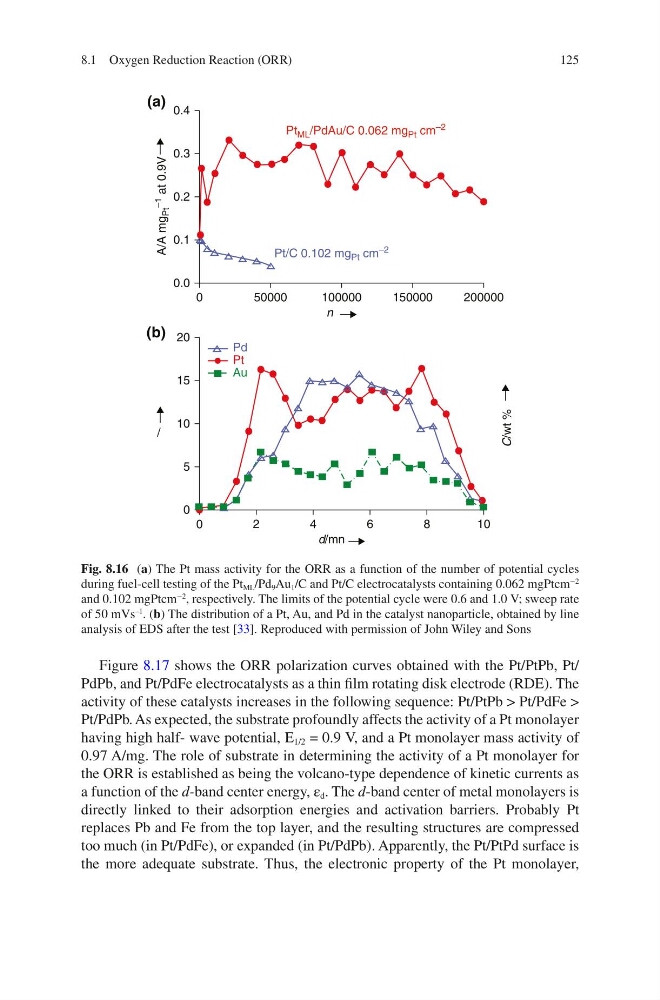
Fig. 8.16 (a) The Pt mass activity for the ORR as a function of the number of potential cycles
during fuel-cell testing of the Pt ML /Pd 9 Au 1 /C and Pt/C electrocatalysts containing 0.062 mgPtcm
−2
and 0.102 mgPtcm
−2 , respectively. The limits of the potential cycle were 0.6 and 1.0 V; sweep rate
of 50 mVs
–1
. (b) The distribution of a Pt, Au, and Pd in the catalyst nanoparticle, obtained by line
analysis of EDS after the test [33]. Reproduced with permission of John Wiley and Sons
8.1 Oxygen Reduction Reaction (ORR)
Figure 8.17 shows the ORR polarization curves obtained with the Pt/PtPb, Pt/
PdPb, and Pt/PdFe electrocatalysts as a thin film rotating disk electrode (RDE). The
activity of these catalysts increases in the following sequence: Pt/PtPb > Pt/PdFe >
Pt/PdPb. As expected, the substrate profoundly affects the activity of a Pt monolayer
having high half- wave potential, E 1/2 = 0.9 V, and a Pt monolayer mass activity of
0.97 A/mg. The role of substrate in determining the activity of a Pt monolayer for
the ORR is established as being the volcano-type dependence of kinetic currents as
a function of the d-band center energy, ε d . The d-band center of metal monolayers is
directly linked to their adsorption energies and activation barriers. Probably Pt
replaces Pb and Fe from the top layer, and the resulting structures are compressed
too much (in Pt/PdFe), or expanded (in Pt/PdPb). Apparently, the Pt/PtPd surface is
the more adequate substrate. Thus, the electronic property of the Pt monolayer,
0.4
0.3
0.2
0.1
0.0
0
50000
100000
150000
200000
n
A/A mg
Pt
–1
at 0.9V
20
15
10
5
0
0
4
2
6
8
1 0
d/mn
/
C/wt %
Pt/C 0.102 mg Pt cm
–2
Pt ML /PdAu/C 0.062 mg Pt cm
–2
(a)
(b)
Pd
Pt
Au
Fig. 8.16 (a) The Pt mass activity for the ORR as a function of the number of potential cycles
during fuel-cell testing of the Pt ML /Pd 9 Au 1 /C and Pt/C electrocatalysts containing 0.062 mgPtcm
−2
and 0.102 mgPtcm
−2 , respectively. The limits of the potential cycle were 0.6 and 1.0 V; sweep rate
of 50 mVs
–1
. (b) The distribution of a Pt, Au, and Pd in the catalyst nanoparticle, obtained by line
analysis of EDS after the test [33]. Reproduced with permission of John Wiley and Sons
8.1 Oxygen Reduction Reaction (ORR)