

110
DFT calculations using a sphere-like model for the nanoparticle demonstrated that
mixing Ni with Ir (Pt ML /IrNi/C) induces geometric, electronic, and segregation
effects, thus weakening the binding energy of oxygen, and so resulting in higher
activity than in pure Pt/C and Pt ML /Ir/C electrocatalysts.
Iridium, given its stability, could be a good candidate as a substrate for
Pt ML . However, Ir as a core causes the Pt lattice to contract too much, significantly
decreasing the d-band center, and it thus entails a very weak adsorption of O 2 on Pt,
resulting in slow ORR kinetics. An addition of a Pd monolayer (interlayer), placed
between the Pt monolayer and the Ir core, that is Pt ML /Pd ML /Ir/C, lowers the excessive effect of Ir as corroborated by DFT calculation and consequently ameliorates
the ORR kinetics [19]. Xing et al. used the Pd-Au alloy as the interlayer to mediate
the Pt ML catalytic properties [20]. Besides an enhanced activity, this catalyst showed
an excellent stability, which may be due to the stabilizing effect of Au [21].
Induced Lattice Contraction by Hollow Core The study on Pt hollow nanoparticles shows that the hollow structure induces a lattice contraction in the Pt shell and
exhibits higher activity and better stability than solid Pt nanoparticles for the ORR
[22]. The lattice contraction not only enhances the ORR kinetics but also prevents
the instability caused by dissolution of core materials. Placing a Pt ML on Pd and
Pd-Au hollow cores, obtained using Ni nanoparticles as sacrificial templates,
improved its properties for the ORR. The hollow architecture results from the
combination of galvanic replacement and the Kirkendall effect [23]. The larger
j
k
g
m
.
A
/
-1
@0.9V
P t / C
P t A u N i 5 / C
0.0
0.3
0.6
0.9
1.2
P t / C
P t A u N i 5 / C
P t / C
P t A u N i 5 / C
P t / C
P t A u N i 5 / C
Pt mass activity
Noble metal mass activity
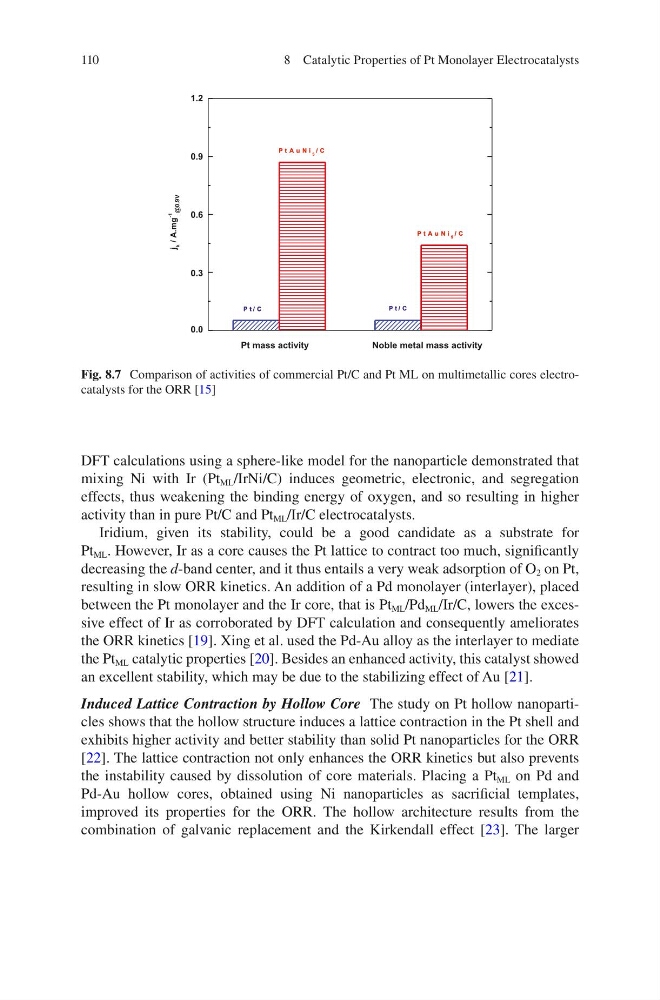
Fig. 8.7 Comparison of activities of commercial Pt/C and Pt ML on multimetallic cores electrocatalysts for the ORR [15]
8 Catalytic Properties of Pt Monolayer Electrocatalysts
DFT calculations using a sphere-like model for the nanoparticle demonstrated that
mixing Ni with Ir (Pt ML /IrNi/C) induces geometric, electronic, and segregation
effects, thus weakening the binding energy of oxygen, and so resulting in higher
activity than in pure Pt/C and Pt ML /Ir/C electrocatalysts.
Iridium, given its stability, could be a good candidate as a substrate for
Pt ML . However, Ir as a core causes the Pt lattice to contract too much, significantly
decreasing the d-band center, and it thus entails a very weak adsorption of O 2 on Pt,
resulting in slow ORR kinetics. An addition of a Pd monolayer (interlayer), placed
between the Pt monolayer and the Ir core, that is Pt ML /Pd ML /Ir/C, lowers the excessive effect of Ir as corroborated by DFT calculation and consequently ameliorates
the ORR kinetics [19]. Xing et al. used the Pd-Au alloy as the interlayer to mediate
the Pt ML catalytic properties [20]. Besides an enhanced activity, this catalyst showed
an excellent stability, which may be due to the stabilizing effect of Au [21].
Induced Lattice Contraction by Hollow Core The study on Pt hollow nanoparticles shows that the hollow structure induces a lattice contraction in the Pt shell and
exhibits higher activity and better stability than solid Pt nanoparticles for the ORR
[22]. The lattice contraction not only enhances the ORR kinetics but also prevents
the instability caused by dissolution of core materials. Placing a Pt ML on Pd and
Pd-Au hollow cores, obtained using Ni nanoparticles as sacrificial templates,
improved its properties for the ORR. The hollow architecture results from the
combination of galvanic replacement and the Kirkendall effect [23]. The larger
j
k
g
m
.
A
/
-1
@0.9V
P t / C
P t A u N i 5 / C
0.0
0.3
0.6
0.9
1.2
P t / C
P t A u N i 5 / C
P t / C
P t A u N i 5 / C
P t / C
P t A u N i 5 / C
Pt mass activity
Noble metal mass activity
Fig. 8.7 Comparison of activities of commercial Pt/C and Pt ML on multimetallic cores electrocatalysts for the ORR [15]
8 Catalytic Properties of Pt Monolayer Electrocatalysts