

95
offset by 0.3–0.5 Å due to phase shift. The actual distances between the atoms are
revealed by the subsequent fitting of the experimental spectrum to the theoretical
one constructed from the crystal lattice of a selected model featuring scattered
atoms, their coordination number, and the distance to the absorber.
Processing of an EXAFS spectrum is accomplished by fitting the spectrum to a
predicted structure and based on reasonable assumptions, or other information
about the sample. From the fitting, one obtains coordination numbers and the distance between the atoms measured. If the probed structure is a mixture, as in
Fig. 7.12, it can be shown that the relative coordination numbers among the atoms
of different nature in a nanoparticle reflects the type of the metallic mixture, that is
alloy or core-shell, and the total coordination number and the distance between the
atoms give information about the size of the nanoparticle [25–27].
7.4.3 Rotating Disk Electrode
The rotating disk electrode (RDE) and rotating ring-disk (RRDE) electrode are the
most powerful electrochemical methods that can provide a broad range of information about electrochemical systems with great accuracy. Measuring reaction current
unaffected by solution movement cannot be done in quiescent solutions without
limitations imposed by convections that occur due to temperature variation and
vibrations. For the forced convection obtained with the rotating disk electrode
(RDE), which provides a fast transport of reacting species under steady-state conditions, there is no such limitation. The rate constant and its dependence on potential
can be calculated from experimental data. For rotating disk electrode, upon rotation,
a stagnant hydrodynamic boundary layer forms on the disk. Another thinner layer
known as diffusion layer also forms, through which ions and solution species are
transported to the electrode surface by diffusion. Transport of solution species to the
electrode surface can be described by applying general convection-diffusion concepts from fluid dynamics.
The first mathematical treatment of convection and diffusion towards a rotating
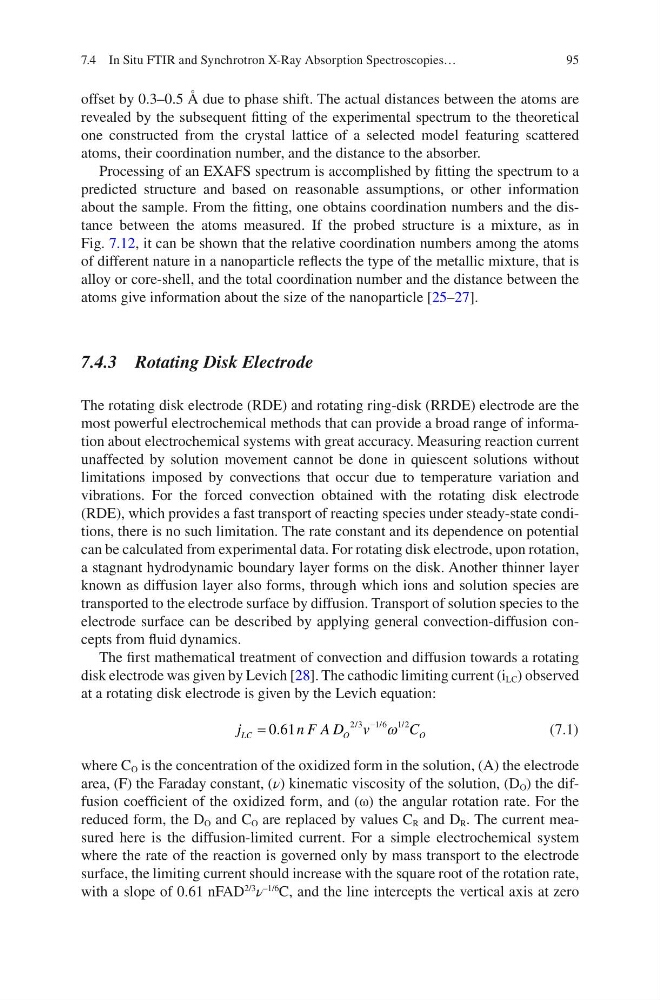
disk electrode was given by Levich [28]. The cathodic limiting current (i LC ) observed
at a rotating disk electrode is given by the Levich equation:
j
nF A D v
C
LC
O
O
=
−
0 61
2 3 1 6 1 2
.
/
/
/
ω
(7.1)
where C O is the concentration of the oxidized form in the solution, (A) the electrode
area, (F) the Faraday constant, (ν) kinematic viscosity of the solution, (D O ) the diffusion coefficient of the oxidized form, and (ω) the angular rotation rate. For the
reduced form, the D O and C O are replaced by values C R and D R . The current measured here is the diffusion-limited current. For a simple electrochemical system
where the rate of the reaction is governed only by mass transport to the electrode
surface, the limiting current should increase with the square root of the rotation rate,
with a slope of 0.61 nFAD
2/3
ν
–1/6
C, and the line intercepts the vertical axis at zero
7.4 In Situ FTIR and Synchrotron X-Ray Absorption Spectroscopies…
offset by 0.3–0.5 Å due to phase shift. The actual distances between the atoms are
revealed by the subsequent fitting of the experimental spectrum to the theoretical
one constructed from the crystal lattice of a selected model featuring scattered
atoms, their coordination number, and the distance to the absorber.
Processing of an EXAFS spectrum is accomplished by fitting the spectrum to a
predicted structure and based on reasonable assumptions, or other information
about the sample. From the fitting, one obtains coordination numbers and the distance between the atoms measured. If the probed structure is a mixture, as in
Fig. 7.12, it can be shown that the relative coordination numbers among the atoms
of different nature in a nanoparticle reflects the type of the metallic mixture, that is
alloy or core-shell, and the total coordination number and the distance between the
atoms give information about the size of the nanoparticle [25–27].
7.4.3 Rotating Disk Electrode
The rotating disk electrode (RDE) and rotating ring-disk (RRDE) electrode are the
most powerful electrochemical methods that can provide a broad range of information about electrochemical systems with great accuracy. Measuring reaction current
unaffected by solution movement cannot be done in quiescent solutions without
limitations imposed by convections that occur due to temperature variation and
vibrations. For the forced convection obtained with the rotating disk electrode
(RDE), which provides a fast transport of reacting species under steady-state conditions, there is no such limitation. The rate constant and its dependence on potential
can be calculated from experimental data. For rotating disk electrode, upon rotation,
a stagnant hydrodynamic boundary layer forms on the disk. Another thinner layer
known as diffusion layer also forms, through which ions and solution species are
transported to the electrode surface by diffusion. Transport of solution species to the
electrode surface can be described by applying general convection-diffusion concepts from fluid dynamics.
The first mathematical treatment of convection and diffusion towards a rotating
disk electrode was given by Levich [28]. The cathodic limiting current (i LC ) observed
at a rotating disk electrode is given by the Levich equation:
j
nF A D v
C
LC
O
O
=
−
0 61
2 3 1 6 1 2
.
/
/
/
ω
(7.1)
where C O is the concentration of the oxidized form in the solution, (A) the electrode
area, (F) the Faraday constant, (ν) kinematic viscosity of the solution, (D O ) the diffusion coefficient of the oxidized form, and (ω) the angular rotation rate. For the
reduced form, the D O and C O are replaced by values C R and D R . The current measured here is the diffusion-limited current. For a simple electrochemical system
where the rate of the reaction is governed only by mass transport to the electrode
surface, the limiting current should increase with the square root of the rotation rate,
with a slope of 0.61 nFAD
2/3
ν
–1/6
C, and the line intercepts the vertical axis at zero
7.4 In Situ FTIR and Synchrotron X-Ray Absorption Spectroscopies…