

5.1 Panel flexure
75
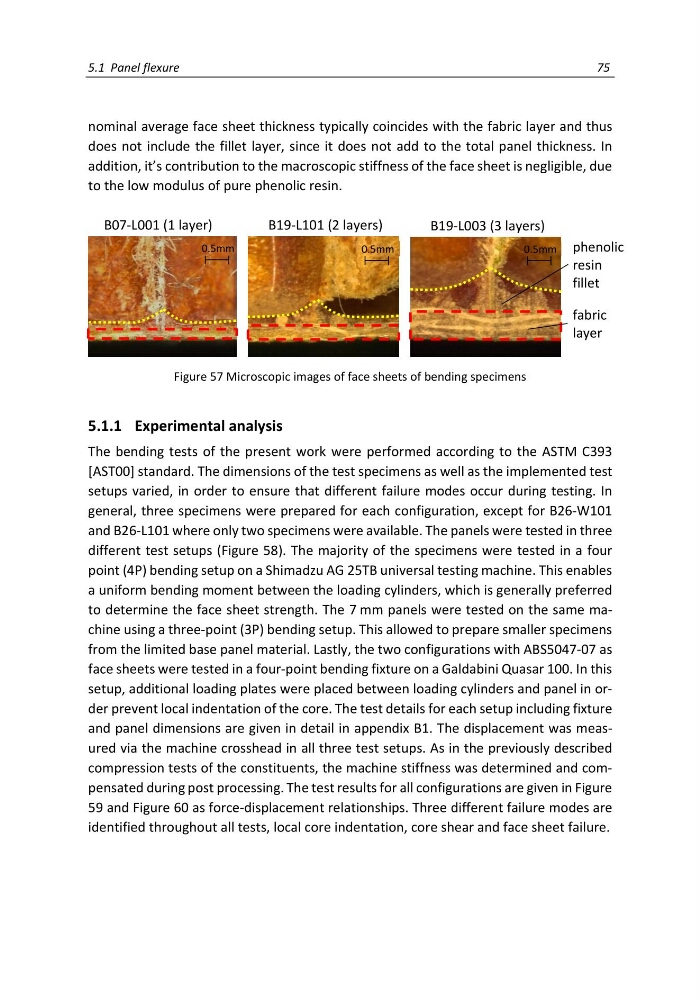
nominal average face sheet thickness typically coincides with the fabric layer and thus
does not include the fillet layer, since it does not add to the total panel thickness. In
addition, it’s contribution to the macroscopic stiffness of the face sheet is negligible, due
to the low modulus of pure phenolic resin.
Figure 57 Microscopic images of face sheets of bending specimens
5.1.1 Experimental analysis
The bending tests of the present work were performed according to the ASTM C393
[AST00] standard. The dimensions of the test specimens as well as the implemented test
setups varied, in order to ensure that different failure modes occur during testing. In
general, three specimens were prepared for each configuration, except for B26-W101
and B26-L101 where only two specimens were available. The panels were tested in three
different test setups (Figure 58). The majority of the specimens were tested in a four
point (4P) bending setup on a Shimadzu AG 25TB universal testing machine. This enables
a uniform bending moment between the loading cylinders, which is generally preferred
to determine the face sheet strength. The 7 mm panels were tested on the same machine using a three-point (3P) bending setup. This allowed to prepare smaller specimens
from the limited base panel material. Lastly, the two configurations with ABS5047-07 as
face sheets were tested in a four-point bending fixture on a Galdabini Quasar 100. In this
setup, additional loading plates were placed between loading cylinders and panel in order prevent local indentation of the core. The test details for each setup including fixture
and panel dimensions are given in detail in appendix B1. The displacement was measured via the machine crosshead in all three test setups. As in the previously described
compression tests of the constituents, the machine stiffness was determined and compensated during post processing. The test results for all configurations are given in Figure
59 and Figure 60 as force-displacement relationships. Three different failure modes are
identified throughout all tests, local core indentation, core shear and face sheet failure.
0.5mm
0.5mm
0.5mm
B07-L001 (1 layer)
B19-L101 (2 layers)
B19-L003 (3 layers)
phenolic
resin
fillet
fabric
layer
75
nominal average face sheet thickness typically coincides with the fabric layer and thus
does not include the fillet layer, since it does not add to the total panel thickness. In
addition, it’s contribution to the macroscopic stiffness of the face sheet is negligible, due
to the low modulus of pure phenolic resin.
Figure 57 Microscopic images of face sheets of bending specimens
5.1.1 Experimental analysis
The bending tests of the present work were performed according to the ASTM C393
[AST00] standard. The dimensions of the test specimens as well as the implemented test
setups varied, in order to ensure that different failure modes occur during testing. In
general, three specimens were prepared for each configuration, except for B26-W101
and B26-L101 where only two specimens were available. The panels were tested in three
different test setups (Figure 58). The majority of the specimens were tested in a four
point (4P) bending setup on a Shimadzu AG 25TB universal testing machine. This enables
a uniform bending moment between the loading cylinders, which is generally preferred
to determine the face sheet strength. The 7 mm panels were tested on the same machine using a three-point (3P) bending setup. This allowed to prepare smaller specimens
from the limited base panel material. Lastly, the two configurations with ABS5047-07 as
face sheets were tested in a four-point bending fixture on a Galdabini Quasar 100. In this
setup, additional loading plates were placed between loading cylinders and panel in order prevent local indentation of the core. The test details for each setup including fixture
and panel dimensions are given in detail in appendix B1. The displacement was measured via the machine crosshead in all three test setups. As in the previously described
compression tests of the constituents, the machine stiffness was determined and compensated during post processing. The test results for all configurations are given in Figure
59 and Figure 60 as force-displacement relationships. Three different failure modes are
identified throughout all tests, local core indentation, core shear and face sheet failure.
0.5mm
0.5mm
0.5mm
B07-L001 (1 layer)
B19-L101 (2 layers)
B19-L003 (3 layers)
phenolic
resin
fillet
fabric
layer