

58
4 Mechanical characterization on constituent level
(iRegC) hexagon configuration are about the same. This is attributed to the increased
moment of inertia of the curved hexagon cell walls resulting in postponed web crippling
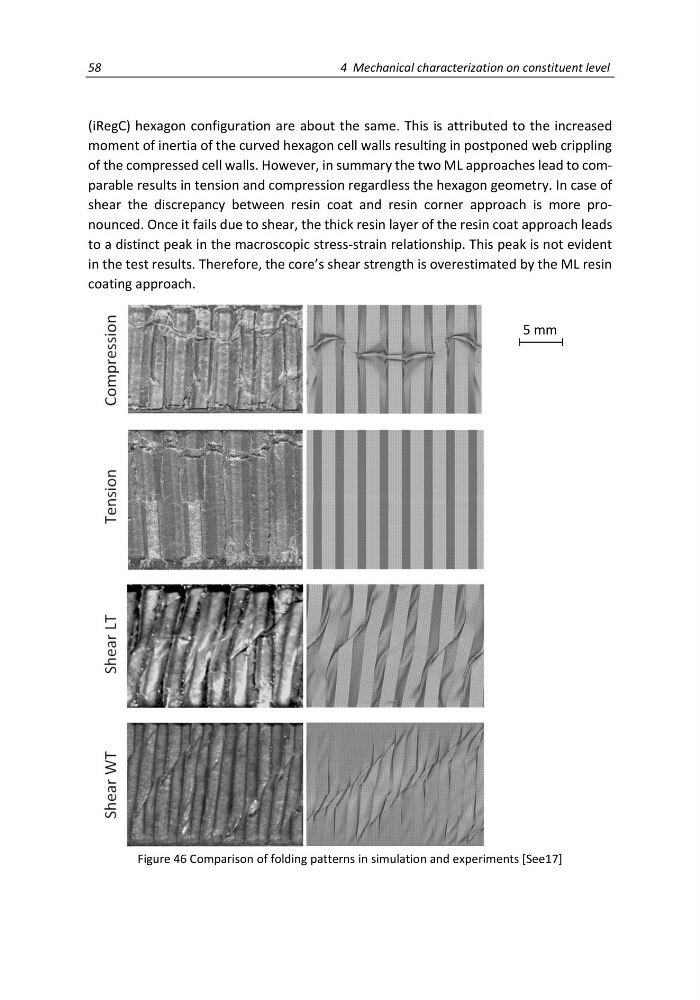
of the compressed cell walls. However, in summary the two ML approaches lead to comparable results in tension and compression regardless the hexagon geometry. In case of
shear the discrepancy between resin coat and resin corner approach is more pronounced. Once it fails due to shear, the thick resin layer of the resin coat approach leads
to a distinct peak in the macroscopic stress-strain relationship. This peak is not evident
in the test results. Therefore, the core’s shear strength is overestimated by the ML resin
coating approach.
Figure 46 Comparison of folding patterns in simulation and experiments [See17]
5 mm
4 Mechanical characterization on constituent level
(iRegC) hexagon configuration are about the same. This is attributed to the increased
moment of inertia of the curved hexagon cell walls resulting in postponed web crippling
of the compressed cell walls. However, in summary the two ML approaches lead to comparable results in tension and compression regardless the hexagon geometry. In case of
shear the discrepancy between resin coat and resin corner approach is more pronounced. Once it fails due to shear, the thick resin layer of the resin coat approach leads
to a distinct peak in the macroscopic stress-strain relationship. This peak is not evident
in the test results. Therefore, the core’s shear strength is overestimated by the ML resin
coating approach.
Figure 46 Comparison of folding patterns in simulation and experiments [See17]
5 mm