

4.1 Sandwich core
53
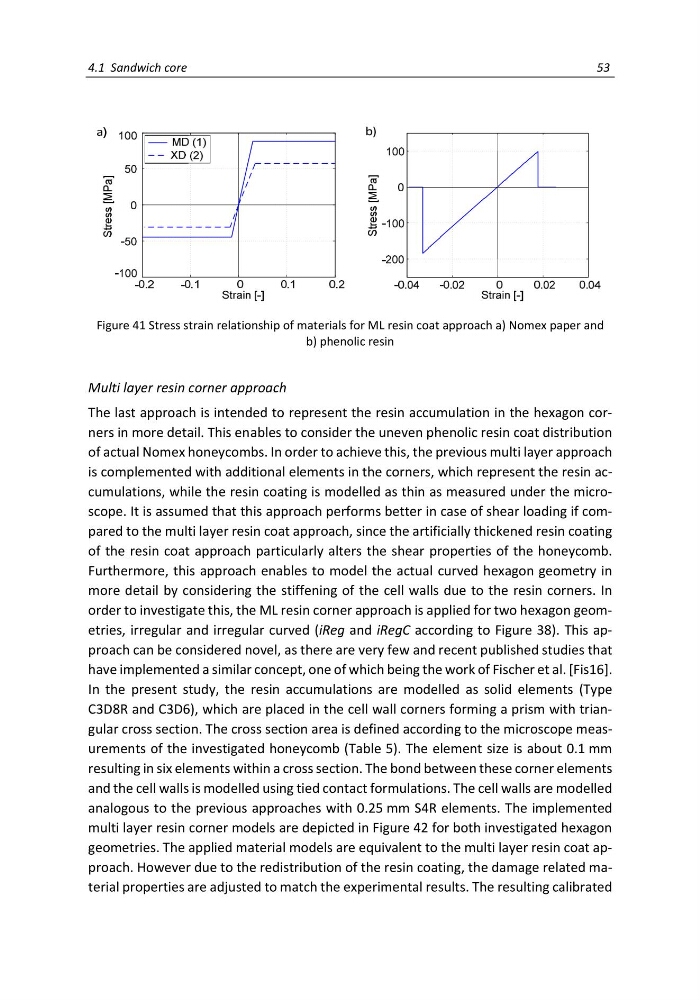
Figure 41 Stress strain relationship of materials for ML resin coat approach a) Nomex paper and
b) phenolic resin
Multi layer resin corner approach
The last approach is intended to represent the resin accumulation in the hexagon corners in more detail. This enables to consider the uneven phenolic resin coat distribution
of actual Nomex honeycombs. In order to achieve this, the previous multi layer approach
is complemented with additional elements in the corners, which represent the resin accumulations, while the resin coating is modelled as thin as measured under the microscope. It is assumed that this approach performs better in case of shear loading if compared to the multi layer resin coat approach, since the artificially thickened resin coating
of the resin coat approach particularly alters the shear properties of the honeycomb.
Furthermore, this approach enables to model the actual curved hexagon geometry in
more detail by considering the stiffening of the cell walls due to the resin corners. In
order to investigate this, the ML resin corner approach is applied for two hexagon geometries, irregular and irregular curved (iReg and iRegC according to Figure 38). This approach can be considered novel, as there are very few and recent published studies that
have implemented a similar concept, one of which being the work of Fischer et al. [Fis16].
In the present study, the resin accumulations are modelled as solid elements (Type
C3D8R and C3D6), which are placed in the cell wall corners forming a prism with triangular cross section. The cross section area is defined according to the microscope measurements of the investigated honeycomb (Table 5). The element size is about 0.1 mm
resulting in six elements within a cross section. The bond between these corner elements
and the cell walls is modelled using tied contact formulations. The cell walls are modelled
analogous to the previous approaches with 0.25 mm S4R elements. The implemented
multi layer resin corner models are depicted in Figure 42 for both investigated hexagon
geometries. The applied material models are equivalent to the multi layer resin coat approach. However due to the redistribution of the resin coating, the damage related material properties are adjusted to match the experimental results. The resulting calibrated
53
Figure 41 Stress strain relationship of materials for ML resin coat approach a) Nomex paper and
b) phenolic resin
Multi layer resin corner approach
The last approach is intended to represent the resin accumulation in the hexagon corners in more detail. This enables to consider the uneven phenolic resin coat distribution
of actual Nomex honeycombs. In order to achieve this, the previous multi layer approach
is complemented with additional elements in the corners, which represent the resin accumulations, while the resin coating is modelled as thin as measured under the microscope. It is assumed that this approach performs better in case of shear loading if compared to the multi layer resin coat approach, since the artificially thickened resin coating
of the resin coat approach particularly alters the shear properties of the honeycomb.
Furthermore, this approach enables to model the actual curved hexagon geometry in
more detail by considering the stiffening of the cell walls due to the resin corners. In
order to investigate this, the ML resin corner approach is applied for two hexagon geometries, irregular and irregular curved (iReg and iRegC according to Figure 38). This approach can be considered novel, as there are very few and recent published studies that
have implemented a similar concept, one of which being the work of Fischer et al. [Fis16].
In the present study, the resin accumulations are modelled as solid elements (Type
C3D8R and C3D6), which are placed in the cell wall corners forming a prism with triangular cross section. The cross section area is defined according to the microscope measurements of the investigated honeycomb (Table 5). The element size is about 0.1 mm
resulting in six elements within a cross section. The bond between these corner elements
and the cell walls is modelled using tied contact formulations. The cell walls are modelled
analogous to the previous approaches with 0.25 mm S4R elements. The implemented
multi layer resin corner models are depicted in Figure 42 for both investigated hexagon
geometries. The applied material models are equivalent to the multi layer resin coat approach. However due to the redistribution of the resin coating, the damage related material properties are adjusted to match the experimental results. The resulting calibrated