

44
4 Mechanical characterization on constituent level
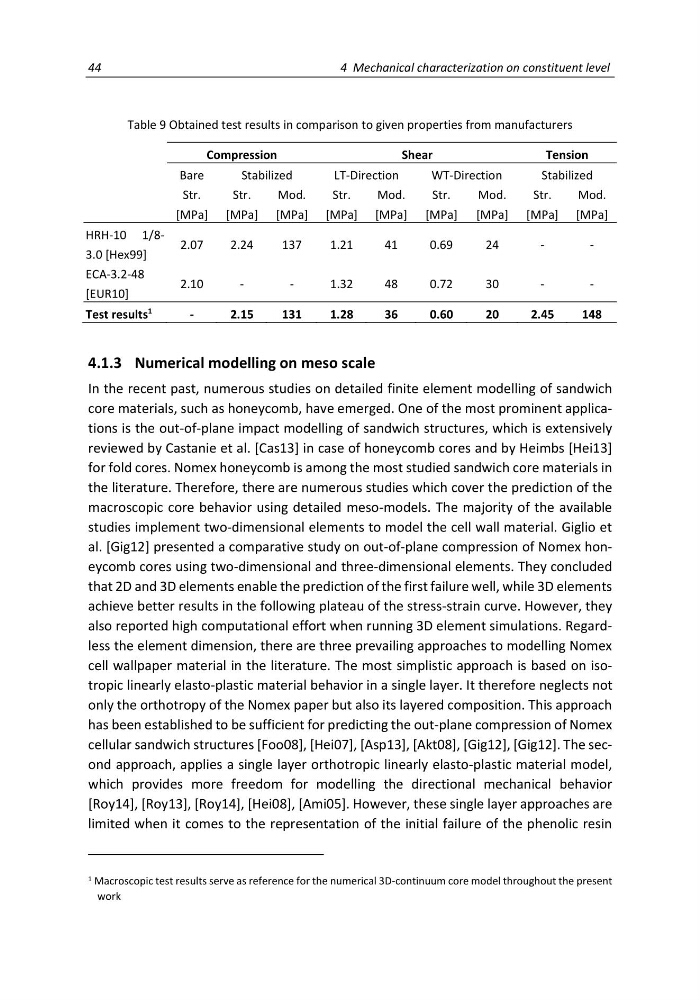
Table 9 Obtained test results in comparison to given properties from manufacturers
Compression
Shear
Tension
Bare
Stabilized
LT-Direction
WT-Direction
Stabilized
Str.
[MPa]
Str.
[MPa]
Mod.
[MPa]
Str.
[MPa]
Mod.
[MPa]
Str.
[MPa]
Mod.
[MPa]
Str.
[MPa]
Mod.
[MPa]
HRH-10 1/83.0 [Hex99]
2.07
2.24
137
1.21
41
0.69
24
-
-
ECA-3.2-48
[EUR10]
2.10
-
-
1.32
48
0.72
30
-
-
Test results
1
-
2.15
131
1.28
36
0.60
20
2.45
148
4.1.3 Numerical modelling on meso scale
In the recent past, numerous studies on detailed finite element modelling of sandwich
core materials, such as honeycomb, have emerged. One of the most prominent applications is the out-of-plane impact modelling of sandwich structures, which is extensively
reviewed by Castanie et al. [Cas13] in case of honeycomb cores and by Heimbs [Hei13]
for fold cores. Nomex honeycomb is among the most studied sandwich core materials in
the literature. Therefore, there are numerous studies which cover the prediction of the
macroscopic core behavior using detailed meso-models. The majority of the available
studies implement two-dimensional elements to model the cell wall material. Giglio et
al. [Gig12] presented a comparative study on out-of-plane compression of Nomex honeycomb cores using two-dimensional and three-dimensional elements. They concluded
that 2D and 3D elements enable the prediction of the first failure well, while 3D elements
achieve better results in the following plateau of the stress-strain curve. However, they
also reported high computational effort when running 3D element simulations. Regardless the element dimension, there are three prevailing approaches to modelling Nomex
cell wallpaper material in the literature. The most simplistic approach is based on isotropic linearly elasto-plastic material behavior in a single layer. It therefore neglects not
only the orthotropy of the Nomex paper but also its layered composition. This approach
has been established to be sufficient for predicting the out-plane compression of Nomex
cellular sandwich structures [Foo08], [Hei07], [Asp13], [Akt08], [Gig12], [Gig12]. The second approach, applies a single layer orthotropic linearly elasto-plastic material model,
which provides more freedom for modelling the directional mechanical behavior
[Roy14], [Roy13], [Roy14], [Hei08], [Ami05]. However, these single layer approaches are
limited when it comes to the representation of the initial failure of the phenolic resin
1 Macroscopic test results serve as reference for the numerical 3D-continuum core model throughout the present
work
4 Mechanical characterization on constituent level
Table 9 Obtained test results in comparison to given properties from manufacturers
Compression
Shear
Tension
Bare
Stabilized
LT-Direction
WT-Direction
Stabilized
Str.
[MPa]
Str.
[MPa]
Mod.
[MPa]
Str.
[MPa]
Mod.
[MPa]
Str.
[MPa]
Mod.
[MPa]
Str.
[MPa]
Mod.
[MPa]
HRH-10 1/83.0 [Hex99]
2.07
2.24
137
1.21
41
0.69
24
-
-
ECA-3.2-48
[EUR10]
2.10
-
-
1.32
48
0.72
30
-
-
Test results
1
-
2.15
131
1.28
36
0.60
20
2.45
148
4.1.3 Numerical modelling on meso scale
In the recent past, numerous studies on detailed finite element modelling of sandwich
core materials, such as honeycomb, have emerged. One of the most prominent applications is the out-of-plane impact modelling of sandwich structures, which is extensively
reviewed by Castanie et al. [Cas13] in case of honeycomb cores and by Heimbs [Hei13]
for fold cores. Nomex honeycomb is among the most studied sandwich core materials in
the literature. Therefore, there are numerous studies which cover the prediction of the
macroscopic core behavior using detailed meso-models. The majority of the available
studies implement two-dimensional elements to model the cell wall material. Giglio et
al. [Gig12] presented a comparative study on out-of-plane compression of Nomex honeycomb cores using two-dimensional and three-dimensional elements. They concluded
that 2D and 3D elements enable the prediction of the first failure well, while 3D elements
achieve better results in the following plateau of the stress-strain curve. However, they
also reported high computational effort when running 3D element simulations. Regardless the element dimension, there are three prevailing approaches to modelling Nomex
cell wallpaper material in the literature. The most simplistic approach is based on isotropic linearly elasto-plastic material behavior in a single layer. It therefore neglects not
only the orthotropy of the Nomex paper but also its layered composition. This approach
has been established to be sufficient for predicting the out-plane compression of Nomex
cellular sandwich structures [Foo08], [Hei07], [Asp13], [Akt08], [Gig12], [Gig12]. The second approach, applies a single layer orthotropic linearly elasto-plastic material model,
which provides more freedom for modelling the directional mechanical behavior
[Roy14], [Roy13], [Roy14], [Hei08], [Ami05]. However, these single layer approaches are
limited when it comes to the representation of the initial failure of the phenolic resin
1 Macroscopic test results serve as reference for the numerical 3D-continuum core model throughout the present
work