

34
3 Overall concept of mechanical characterization
high product variety due to individual customer requirements and the optimization of
lightweight structures to further increase fuel efficiency. Both aspects require increasing
effort for structural simulation and testing in order to validate the mechanical product
properties during the development phase. High product variety, results in additional effort due to airworthiness regulations, which require that every variant needs to be substantiated and lightweight design essentially depends on accurate mechanical characterization to reduce reserve factors. The superordinate approach tackles these challenges by providing methods for synergetic combination of test and simulation based on
the building approach, with the objective of reducing the physical testing effort. The approach additionally considers both, static and periodic dynamic (i.e sustained engine imbalance) mechanical properties. This distinction is necessary since, the dynamic behavior
is governed by mechanical effects which are usually neglected in static analyses (mass,
damping etc.). At the same time, periodic dynamic characterization is generally less focused on damage prediction. As a result, the hierarchy levels and the investigations
within the different levels differ significantly between static and dynamic contexts. The
present thesis contributes to the superordinate approach by providing a virtual testing
approach for sandwich panel joints, which enables the virtual evaluation of numerous
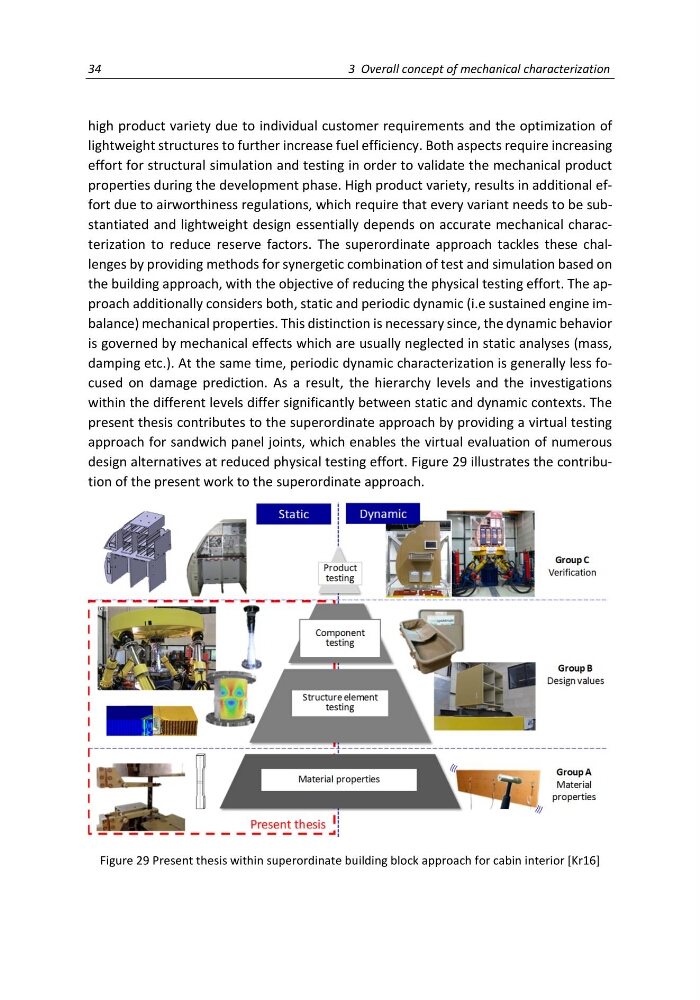
design alternatives at reduced physical testing effort. Figure 29 illustrates the contribution of the present work to the superordinate approach.
Figure 29 Present thesis within superordinate building block approach for cabin interior [Kr16]
3 Overall concept of mechanical characterization
high product variety due to individual customer requirements and the optimization of
lightweight structures to further increase fuel efficiency. Both aspects require increasing
effort for structural simulation and testing in order to validate the mechanical product
properties during the development phase. High product variety, results in additional effort due to airworthiness regulations, which require that every variant needs to be substantiated and lightweight design essentially depends on accurate mechanical characterization to reduce reserve factors. The superordinate approach tackles these challenges by providing methods for synergetic combination of test and simulation based on
the building approach, with the objective of reducing the physical testing effort. The approach additionally considers both, static and periodic dynamic (i.e sustained engine imbalance) mechanical properties. This distinction is necessary since, the dynamic behavior
is governed by mechanical effects which are usually neglected in static analyses (mass,
damping etc.). At the same time, periodic dynamic characterization is generally less focused on damage prediction. As a result, the hierarchy levels and the investigations
within the different levels differ significantly between static and dynamic contexts. The
present thesis contributes to the superordinate approach by providing a virtual testing
approach for sandwich panel joints, which enables the virtual evaluation of numerous
design alternatives at reduced physical testing effort. Figure 29 illustrates the contribution of the present work to the superordinate approach.
Figure 29 Present thesis within superordinate building block approach for cabin interior [Kr16]