

28
2 State of the art
first place. This is highly dependent on the particular details of the investigated structure
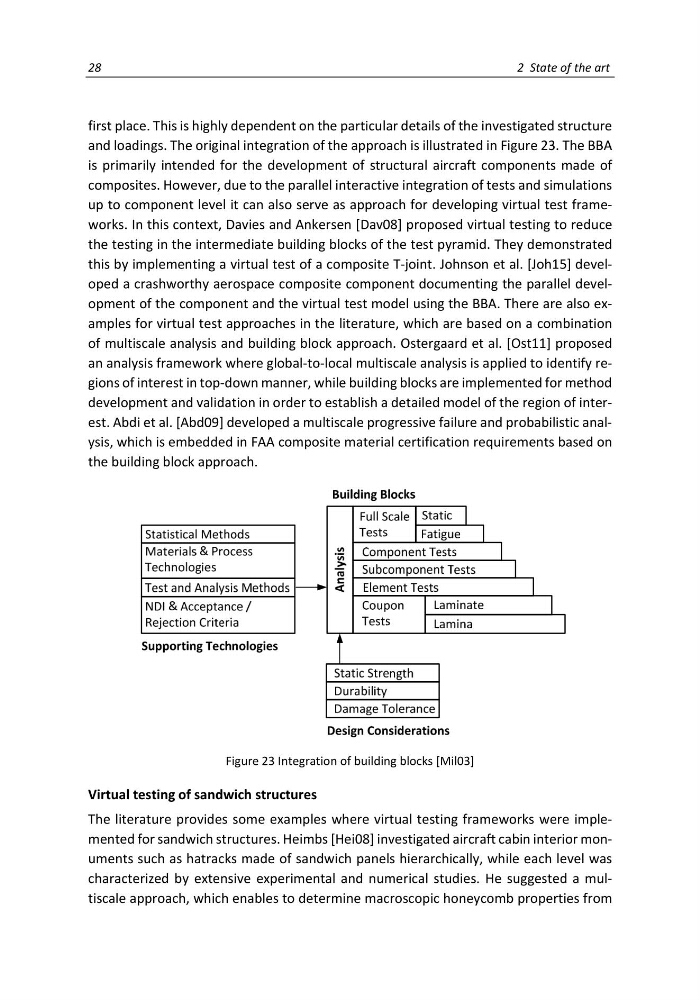
and loadings. The original integration of the approach is illustrated in Figure 23. The BBA
is primarily intended for the development of structural aircraft components made of
composites. However, due to the parallel interactive integration of tests and simulations
up to component level it can also serve as approach for developing virtual test frameworks. In this context, Davies and Ankersen [Dav08] proposed virtual testing to reduce
the testing in the intermediate building blocks of the test pyramid. They demonstrated
this by implementing a virtual test of a composite T-joint. Johnson et al. [Joh15] developed a crashworthy aerospace composite component documenting the parallel development of the component and the virtual test model using the BBA. There are also examples for virtual test approaches in the literature, which are based on a combination
of multiscale analysis and building block approach. Ostergaard et al. [Ost11] proposed
an analysis framework where global-to-local multiscale analysis is applied to identify regions of interest in top-down manner, while building blocks are implemented for method
development and validation in order to establish a detailed model of the region of interest. Abdi et al. [Abd09] developed a multiscale progressive failure and probabilistic analysis, which is embedded in FAA composite material certification requirements based on
the building block approach.
Virtual testing of sandwich structures
The literature provides some examples where virtual testing frameworks were implemented for sandwich structures. Heimbs [Hei08] investigated aircraft cabin interior monuments such as hatracks made of sandwich panels hierarchically, while each level was
characterized by extensive experimental and numerical studies. He suggested a multiscale approach, which enables to determine macroscopic honeycomb properties from
Figure 23 Integration of building blocks [Mil03]
2 State of the art
first place. This is highly dependent on the particular details of the investigated structure
and loadings. The original integration of the approach is illustrated in Figure 23. The BBA
is primarily intended for the development of structural aircraft components made of
composites. However, due to the parallel interactive integration of tests and simulations
up to component level it can also serve as approach for developing virtual test frameworks. In this context, Davies and Ankersen [Dav08] proposed virtual testing to reduce
the testing in the intermediate building blocks of the test pyramid. They demonstrated
this by implementing a virtual test of a composite T-joint. Johnson et al. [Joh15] developed a crashworthy aerospace composite component documenting the parallel development of the component and the virtual test model using the BBA. There are also examples for virtual test approaches in the literature, which are based on a combination
of multiscale analysis and building block approach. Ostergaard et al. [Ost11] proposed
an analysis framework where global-to-local multiscale analysis is applied to identify regions of interest in top-down manner, while building blocks are implemented for method
development and validation in order to establish a detailed model of the region of interest. Abdi et al. [Abd09] developed a multiscale progressive failure and probabilistic analysis, which is embedded in FAA composite material certification requirements based on
the building block approach.
Virtual testing of sandwich structures
The literature provides some examples where virtual testing frameworks were implemented for sandwich structures. Heimbs [Hei08] investigated aircraft cabin interior monuments such as hatracks made of sandwich panels hierarchically, while each level was
characterized by extensive experimental and numerical studies. He suggested a multiscale approach, which enables to determine macroscopic honeycomb properties from
Figure 23 Integration of building blocks [Mil03]