

2.4 Virtual testing
25
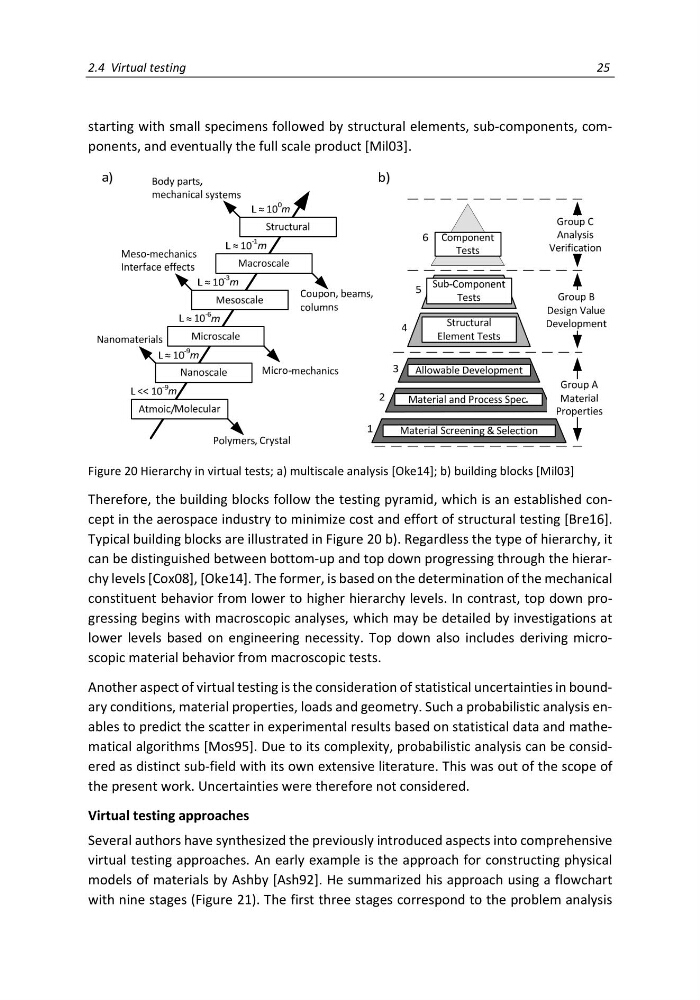
starting with small specimens followed by structural elements, sub-components, components, and eventually the full scale product [Mil03].
Figure 20 Hierarchy in virtual tests; a) multiscale analysis [Oke14]; b) building blocks [Mil03]
Therefore, the building blocks follow the testing pyramid, which is an established concept in the aerospace industry to minimize cost and effort of structural testing [Bre16].
Typical building blocks are illustrated in Figure 20 b). Regardless the type of hierarchy, it
can be distinguished between bottom-up and top down progressing through the hierarchy levels [Cox08], [Oke14]. The former, is based on the determination of the mechanical
constituent behavior from lower to higher hierarchy levels. In contrast, top down progressing begins with macroscopic analyses, which may be detailed by investigations at
lower levels based on engineering necessity. Top down also includes deriving microscopic material behavior from macroscopic tests.
Another aspect of virtual testing is the consideration of statistical uncertainties in boundary conditions, material properties, loads and geometry. Such a probabilistic analysis enables to predict the scatter in experimental results based on statistical data and mathematical algorithms [Mos95]. Due to its complexity, probabilistic analysis can be considered as distinct sub-field with its own extensive literature. This was out of the scope of
the present work. Uncertainties were therefore not considered.
Virtual testing approaches
Several authors have synthesized the previously introduced aspects into comprehensive
virtual testing approaches. An early example is the approach for constructing physical
models of materials by Ashby [Ash92]. He summarized his approach using a flowchart
with nine stages (Figure 21). The first three stages correspond to the problem analysis
25
starting with small specimens followed by structural elements, sub-components, components, and eventually the full scale product [Mil03].
Figure 20 Hierarchy in virtual tests; a) multiscale analysis [Oke14]; b) building blocks [Mil03]
Therefore, the building blocks follow the testing pyramid, which is an established concept in the aerospace industry to minimize cost and effort of structural testing [Bre16].
Typical building blocks are illustrated in Figure 20 b). Regardless the type of hierarchy, it
can be distinguished between bottom-up and top down progressing through the hierarchy levels [Cox08], [Oke14]. The former, is based on the determination of the mechanical
constituent behavior from lower to higher hierarchy levels. In contrast, top down progressing begins with macroscopic analyses, which may be detailed by investigations at
lower levels based on engineering necessity. Top down also includes deriving microscopic material behavior from macroscopic tests.
Another aspect of virtual testing is the consideration of statistical uncertainties in boundary conditions, material properties, loads and geometry. Such a probabilistic analysis enables to predict the scatter in experimental results based on statistical data and mathematical algorithms [Mos95]. Due to its complexity, probabilistic analysis can be considered as distinct sub-field with its own extensive literature. This was out of the scope of
the present work. Uncertainties were therefore not considered.
Virtual testing approaches
Several authors have synthesized the previously introduced aspects into comprehensive
virtual testing approaches. An early example is the approach for constructing physical
models of materials by Ashby [Ash92]. He summarized his approach using a flowchart
with nine stages (Figure 21). The first three stages correspond to the problem analysis