

22
2 State of the art
Large time increments
Small time increments
A 1
A n
B 1
B n
C 1
C n
D 1
D n
Time
Function value
Function value
Time
Actual curve
progression
Implicit
solution
Iterative
solutions
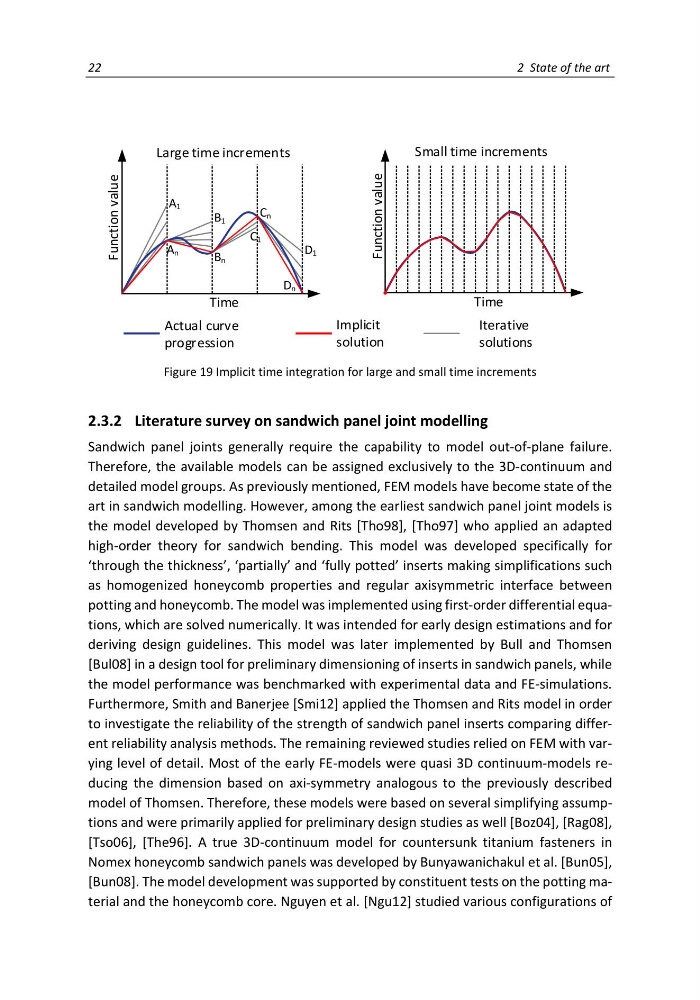
Figure 19 Implicit time integration for large and small time increments
2.3.2 Literature survey on sandwich panel joint modelling
Sandwich panel joints generally require the capability to model out-of-plane failure.
Therefore, the available models can be assigned exclusively to the 3D-continuum and
detailed model groups. As previously mentioned, FEM models have become state of the
art in sandwich modelling. However, among the earliest sandwich panel joint models is
the model developed by Thomsen and Rits [Tho98], [Tho97] who applied an adapted
high-order theory for sandwich bending. This model was developed specifically for
‘through the thickness’, ‘partially’ and ‘fully potted’ inserts making simplifications such
as homogenized honeycomb properties and regular axisymmetric interface between
potting and honeycomb. The model was implemented using first-order differential equations, which are solved numerically. It was intended for early design estimations and for
deriving design guidelines. This model was later implemented by Bull and Thomsen
[Bul08] in a design tool for preliminary dimensioning of inserts in sandwich panels, while
the model performance was benchmarked with experimental data and FE-simulations.
Furthermore, Smith and Banerjee [Smi12] applied the Thomsen and Rits model in order
to investigate the reliability of the strength of sandwich panel inserts comparing different reliability analysis methods. The remaining reviewed studies relied on FEM with varying level of detail. Most of the early FE-models were quasi 3D continuum-models reducing the dimension based on axi-symmetry analogous to the previously described
model of Thomsen. Therefore, these models were based on several simplifying assumptions and were primarily applied for preliminary design studies as well [Boz04], [Rag08],
[Tso06], [The96]. A true 3D-continuum model for countersunk titanium fasteners in
Nomex honeycomb sandwich panels was developed by Bunyawanichakul et al. [Bun05],
[Bun08]. The model development was supported by constituent tests on the potting material and the honeycomb core. Nguyen et al. [Ngu12] studied various configurations of
2 State of the art
Large time increments
Small time increments
A 1
A n
B 1
B n
C 1
C n
D 1
D n
Time
Function value
Function value
Time
Actual curve
progression
Implicit
solution
Iterative
solutions
Figure 19 Implicit time integration for large and small time increments
2.3.2 Literature survey on sandwich panel joint modelling
Sandwich panel joints generally require the capability to model out-of-plane failure.
Therefore, the available models can be assigned exclusively to the 3D-continuum and
detailed model groups. As previously mentioned, FEM models have become state of the
art in sandwich modelling. However, among the earliest sandwich panel joint models is
the model developed by Thomsen and Rits [Tho98], [Tho97] who applied an adapted
high-order theory for sandwich bending. This model was developed specifically for
‘through the thickness’, ‘partially’ and ‘fully potted’ inserts making simplifications such
as homogenized honeycomb properties and regular axisymmetric interface between
potting and honeycomb. The model was implemented using first-order differential equations, which are solved numerically. It was intended for early design estimations and for
deriving design guidelines. This model was later implemented by Bull and Thomsen
[Bul08] in a design tool for preliminary dimensioning of inserts in sandwich panels, while
the model performance was benchmarked with experimental data and FE-simulations.
Furthermore, Smith and Banerjee [Smi12] applied the Thomsen and Rits model in order
to investigate the reliability of the strength of sandwich panel inserts comparing different reliability analysis methods. The remaining reviewed studies relied on FEM with varying level of detail. Most of the early FE-models were quasi 3D continuum-models reducing the dimension based on axi-symmetry analogous to the previously described
model of Thomsen. Therefore, these models were based on several simplifying assumptions and were primarily applied for preliminary design studies as well [Boz04], [Rag08],
[Tso06], [The96]. A true 3D-continuum model for countersunk titanium fasteners in
Nomex honeycomb sandwich panels was developed by Bunyawanichakul et al. [Bun05],
[Bun08]. The model development was supported by constituent tests on the potting material and the honeycomb core. Nguyen et al. [Ngu12] studied various configurations of