

10
2 State of the art
Figure 6 Fillet conditions depending on the process parameters according to Campbell [Cam04]
One additional effect has to be considered in the bonded sandwich panel. In the vacuum
bag process the sandwich panel has two sides, the bag side and the tool side. In particular
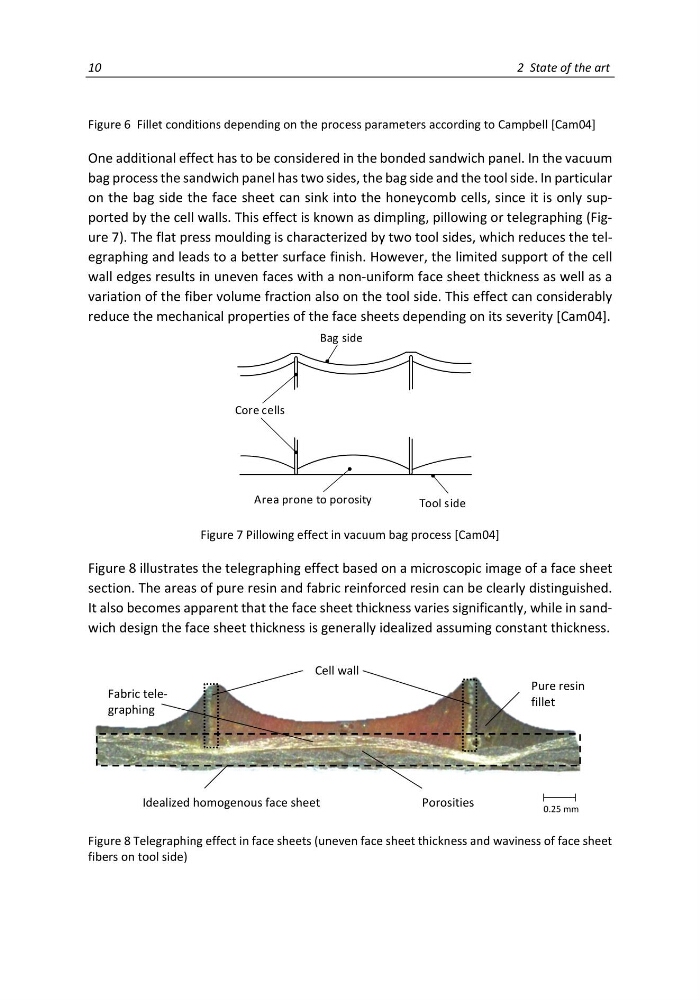
on the bag side the face sheet can sink into the honeycomb cells, since it is only supported by the cell walls. This effect is known as dimpling, pillowing or telegraphing (Figure 7). The flat press moulding is characterized by two tool sides, which reduces the telegraphing and leads to a better surface finish. However, the limited support of the cell
wall edges results in uneven faces with a non-uniform face sheet thickness as well as a
variation of the fiber volume fraction also on the tool side. This effect can considerably
reduce the mechanical properties of the face sheets depending on its severity [Cam04].
Figure 7 Pillowing effect in vacuum bag process [Cam04]
Figure 8 illustrates the telegraphing effect based on a microscopic image of a face sheet
section. The areas of pure resin and fabric reinforced resin can be clearly distinguished.
It also becomes apparent that the face sheet thickness varies significantly, while in sandwich design the face sheet thickness is generally idealized assuming constant thickness.
Figure 8 Telegraphing effect in face sheets (uneven face sheet thickness and waviness of face sheet
fibers on tool side)
Cell wall
Idealized homogenous face sheet
Porosities
Pure resin
fillet
Fabric telegraphing
0.25 mm
Bag side
Tool side
Core cells
Area prone to porosity
2 State of the art
Figure 6 Fillet conditions depending on the process parameters according to Campbell [Cam04]
One additional effect has to be considered in the bonded sandwich panel. In the vacuum
bag process the sandwich panel has two sides, the bag side and the tool side. In particular
on the bag side the face sheet can sink into the honeycomb cells, since it is only supported by the cell walls. This effect is known as dimpling, pillowing or telegraphing (Figure 7). The flat press moulding is characterized by two tool sides, which reduces the telegraphing and leads to a better surface finish. However, the limited support of the cell
wall edges results in uneven faces with a non-uniform face sheet thickness as well as a
variation of the fiber volume fraction also on the tool side. This effect can considerably
reduce the mechanical properties of the face sheets depending on its severity [Cam04].
Figure 7 Pillowing effect in vacuum bag process [Cam04]
Figure 8 illustrates the telegraphing effect based on a microscopic image of a face sheet
section. The areas of pure resin and fabric reinforced resin can be clearly distinguished.
It also becomes apparent that the face sheet thickness varies significantly, while in sandwich design the face sheet thickness is generally idealized assuming constant thickness.
Figure 8 Telegraphing effect in face sheets (uneven face sheet thickness and waviness of face sheet
fibers on tool side)
Cell wall
Idealized homogenous face sheet
Porosities
Pure resin
fillet
Fabric telegraphing
0.25 mm
Bag side
Tool side
Core cells
Area prone to porosity