

6
2 State of the art
primary requirements of a given application. These requirements may include, high stiffness and strength, impact resistance, surface finish and environmental resistance (UV,
flammability etc.) [Zen97]. In lightweight design, fiber reinforced composites are among
the most commonly used face sheet materials, while glass fibers are the most common
reinforcement material. This is due to their good mechanical properties and environmental resistance at low price. In advanced aerospace applications carbon fiber reinforced plastics (CFRP) can also be found as face sheets, owing to their superior weight
specific stiffness [Zen97]. In aircraft interiors, these two fiber materials make up the vast
majority found as face sheet reinforcement, while glass fibers make up about 65% and
carbon fibers most of the remainder [Red12]. Typically, aircraft interior face sheets are
reinforced using woven fabrics, which are characterized by two orthogonally oriented
fiber directions using warp and weft yarns. Woven fabrics are favorable for planar components, since they allow to apply two fiber directions in only one manufacturing step,
while they can still be tailored according to the applied loads by adjusting the fiber content of the warp and weft yarns [Sch07]. Woven fabrics are available in an abundant
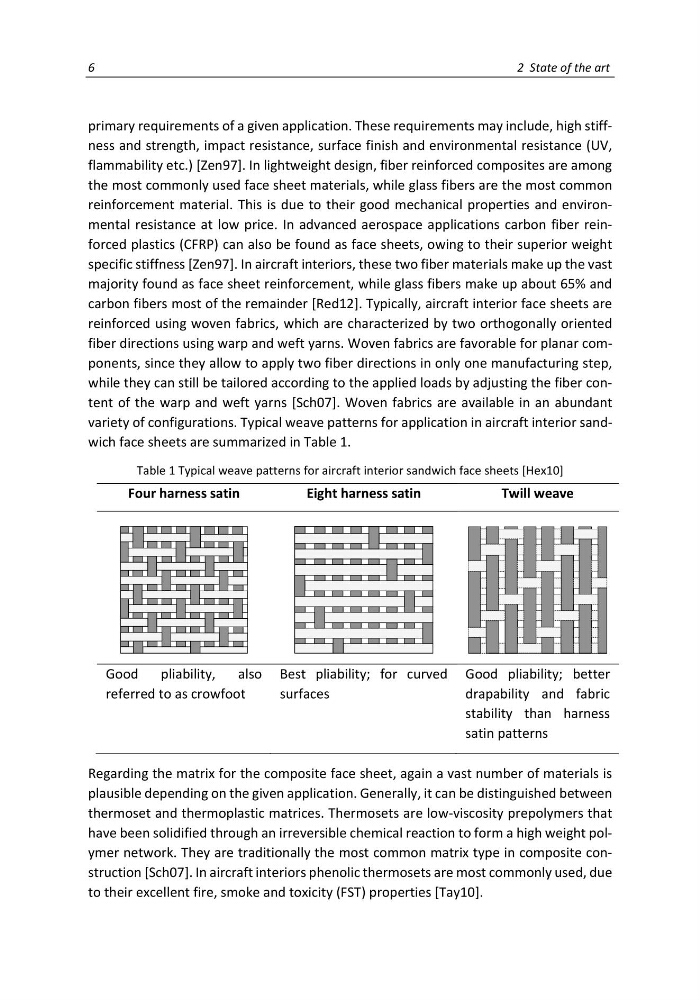
variety of configurations. Typical weave patterns for application in aircraft interior sandwich face sheets are summarized in Table 1.
Regarding the matrix for the composite face sheet, again a vast number of materials is
plausible depending on the given application. Generally, it can be distinguished between
thermoset and thermoplastic matrices. Thermosets are low-viscosity prepolymers that
have been solidified through an irreversible chemical reaction to form a high weight polymer network. They are traditionally the most common matrix type in composite construction [Sch07]. In aircraft interiors phenolic thermosets are most commonly used, due
to their excellent fire, smoke and toxicity (FST) properties [Tay10].
Table 1 Typical weave patterns for aircraft interior sandwich face sheets [Hex10]
Four harness satin
Eight harness satin
Twill weave
Good
pliability,
also
referred to as crowfoot
Best pliability; for curved
surfaces
Good pliability; better
drapability and fabric
stability than harness
satin patterns
2 State of the art
primary requirements of a given application. These requirements may include, high stiffness and strength, impact resistance, surface finish and environmental resistance (UV,
flammability etc.) [Zen97]. In lightweight design, fiber reinforced composites are among
the most commonly used face sheet materials, while glass fibers are the most common
reinforcement material. This is due to their good mechanical properties and environmental resistance at low price. In advanced aerospace applications carbon fiber reinforced plastics (CFRP) can also be found as face sheets, owing to their superior weight
specific stiffness [Zen97]. In aircraft interiors, these two fiber materials make up the vast
majority found as face sheet reinforcement, while glass fibers make up about 65% and
carbon fibers most of the remainder [Red12]. Typically, aircraft interior face sheets are
reinforced using woven fabrics, which are characterized by two orthogonally oriented
fiber directions using warp and weft yarns. Woven fabrics are favorable for planar components, since they allow to apply two fiber directions in only one manufacturing step,
while they can still be tailored according to the applied loads by adjusting the fiber content of the warp and weft yarns [Sch07]. Woven fabrics are available in an abundant
variety of configurations. Typical weave patterns for application in aircraft interior sandwich face sheets are summarized in Table 1.
Regarding the matrix for the composite face sheet, again a vast number of materials is
plausible depending on the given application. Generally, it can be distinguished between
thermoset and thermoplastic matrices. Thermosets are low-viscosity prepolymers that
have been solidified through an irreversible chemical reaction to form a high weight polymer network. They are traditionally the most common matrix type in composite construction [Sch07]. In aircraft interiors phenolic thermosets are most commonly used, due
to their excellent fire, smoke and toxicity (FST) properties [Tay10].
Table 1 Typical weave patterns for aircraft interior sandwich face sheets [Hex10]
Four harness satin
Eight harness satin
Twill weave
Good
pliability,
also
referred to as crowfoot
Best pliability; for curved
surfaces
Good pliability; better
drapability and fabric
stability than harness
satin patterns