

7.7 Validation based on different joint configurations
143
2. Definition of model
framework
Detailed model
Explicit solver
1. Problem analysis
Prediction of
catastrophic failure
2-4h computational time
Two relevant mechancial
effects
3. Model development
Four additional
investigations
Core model is adopted
from modelling database
4. Application of virtual
test method
Parameter studies
Evaluation of design
alternatives
Structural elements
Constituents
Level 1
Level 2
Level 3
Model synthesis
Constituents
Structural elements
Sub-component
Bonded face sheet
Compr & shear
properties
Adhesive Delo –
material model
Face sheet
tensile properties
ABS 5047-07
ABS 5047-07
Modelling database
Detailed core model
ABS 5035-A4
1
2
3
4
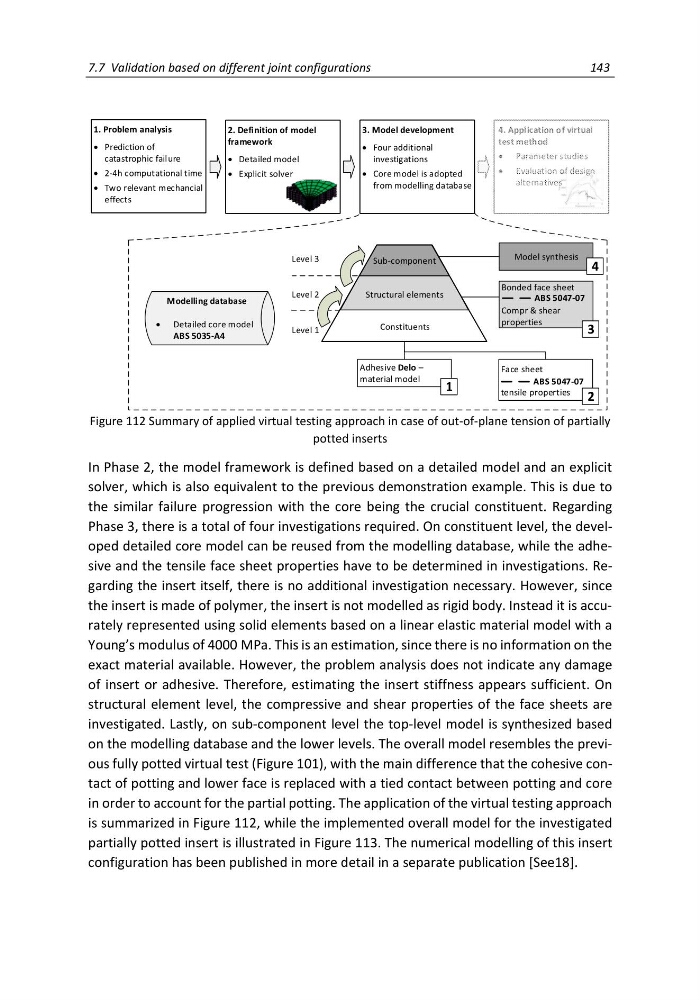
Figure 112 Summary of applied virtual testing approach in case of out-of-plane tension of partially
potted inserts
In Phase 2, the model framework is defined based on a detailed model and an explicit
solver, which is also equivalent to the previous demonstration example. This is due to
the similar failure progression with the core being the crucial constituent. Regarding
Phase 3, there is a total of four investigations required. On constituent level, the developed detailed core model can be reused from the modelling database, while the adhesive and the tensile face sheet properties have to be determined in investigations. Regarding the insert itself, there is no additional investigation necessary. However, since
the insert is made of polymer, the insert is not modelled as rigid body. Instead it is accurately represented using solid elements based on a linear elastic material model with a
Young’s modulus of 4000 MPa. This is an estimation, since there is no information on the
exact material available. However, the problem analysis does not indicate any damage
of insert or adhesive. Therefore, estimating the insert stiffness appears sufficient. On
structural element level, the compressive and shear properties of the face sheets are
investigated. Lastly, on sub-component level the top-level model is synthesized based
on the modelling database and the lower levels. The overall model resembles the previous fully potted virtual test (Figure 101), with the main difference that the cohesive contact of potting and lower face is replaced with a tied contact between potting and core
in order to account for the partial potting. The application of the virtual testing approach
is summarized in Figure 112, while the implemented overall model for the investigated
partially potted insert is illustrated in Figure 113. The numerical modelling of this insert
configuration has been published in more detail in a separate publication [See18].
143
2. Definition of model
framework
Detailed model
Explicit solver
1. Problem analysis
Prediction of
catastrophic failure
2-4h computational time
Two relevant mechancial
effects
3. Model development
Four additional
investigations
Core model is adopted
from modelling database
4. Application of virtual
test method
Parameter studies
Evaluation of design
alternatives
Structural elements
Constituents
Level 1
Level 2
Level 3
Model synthesis
Constituents
Structural elements
Sub-component
Bonded face sheet
Compr & shear
properties
Adhesive Delo –
material model
Face sheet
tensile properties
ABS 5047-07
ABS 5047-07
Modelling database
Detailed core model
ABS 5035-A4
1
2
3
4
Figure 112 Summary of applied virtual testing approach in case of out-of-plane tension of partially
potted inserts
In Phase 2, the model framework is defined based on a detailed model and an explicit
solver, which is also equivalent to the previous demonstration example. This is due to
the similar failure progression with the core being the crucial constituent. Regarding
Phase 3, there is a total of four investigations required. On constituent level, the developed detailed core model can be reused from the modelling database, while the adhesive and the tensile face sheet properties have to be determined in investigations. Regarding the insert itself, there is no additional investigation necessary. However, since
the insert is made of polymer, the insert is not modelled as rigid body. Instead it is accurately represented using solid elements based on a linear elastic material model with a
Young’s modulus of 4000 MPa. This is an estimation, since there is no information on the
exact material available. However, the problem analysis does not indicate any damage
of insert or adhesive. Therefore, estimating the insert stiffness appears sufficient. On
structural element level, the compressive and shear properties of the face sheets are
investigated. Lastly, on sub-component level the top-level model is synthesized based
on the modelling database and the lower levels. The overall model resembles the previous fully potted virtual test (Figure 101), with the main difference that the cohesive contact of potting and lower face is replaced with a tied contact between potting and core
in order to account for the partial potting. The application of the virtual testing approach
is summarized in Figure 112, while the implemented overall model for the investigated
partially potted insert is illustrated in Figure 113. The numerical modelling of this insert
configuration has been published in more detail in a separate publication [See18].