

7.3 Phase 2 - Definition of model framework
113
that more than two non-linear effects should be implemented using explicit integration.
Implementing an explicit simulation model is also advantageous when it comes to detailing an existing model by integrating additional mechanical effects in a later stage.
Therefore, the explicit integration scheme can be considered more robust for future
model refinement. However, for quasi-static problems with few non-linear effects, the
implicit integration scheme remains favorable.
Preliminary evaluation
The model framework has to be consistent throughout the model development. It defines critical model aspects such as material models, elements and contact formulations.
Changing the framework during the model development should be strictly avoided.
Therefore, the last step of Phase 2 is the evaluation of the defined model framework.
This step corresponds to a final check, where the following question is raised. Is the
model framework suitable for the intended virtual test? Generally, the definition of the
level of detail and integration scheme is suitable as long as the guidelines summarized in
Figure 82 are followed. However, it is possible that some degree of uncertainty remains
due to a lack of literature or past experiences. In this case a comparative study where
the performance of the integration schemes and/or levels of detail is benchmarked using
a representative model for the top-level virtual test should be performed. In this context,
performance refers to both, computational effort and the capability to represent the
relevant mechanical effects. A prominent issue here, is convergence in case implicit integration is selected. At the same time, the computational effort should be evaluated,
to ensure that the expected computation time is likely within limits regarding the requirements. Phase 2 concludes when the defined model framework is evaluated to be
suitable for the following model development.
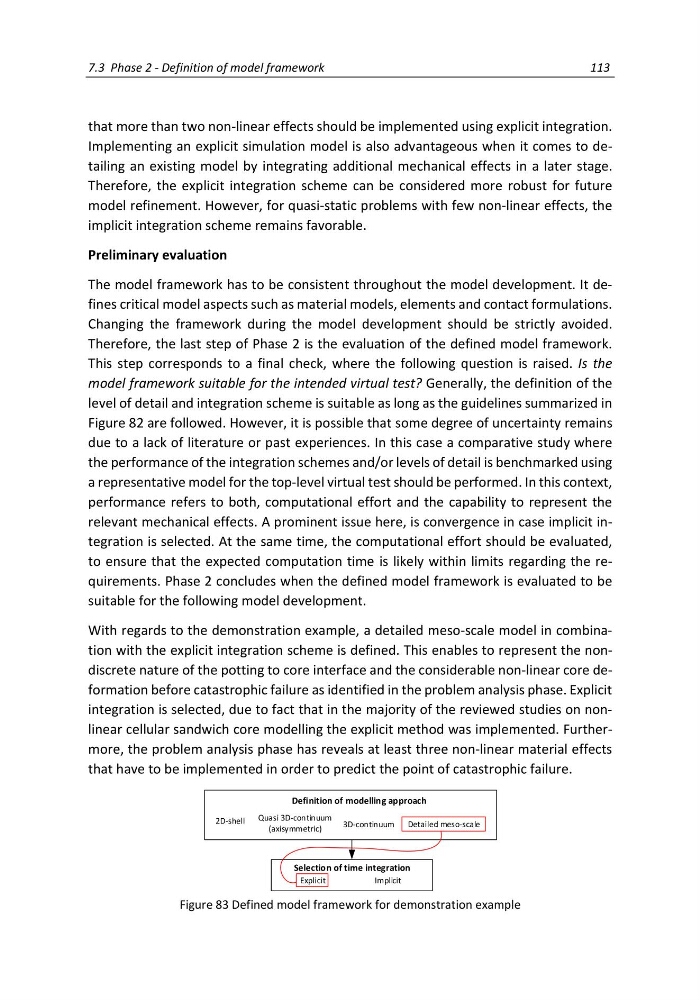
With regards to the demonstration example, a detailed meso-scale model in combination with the explicit integration scheme is defined. This enables to represent the nondiscrete nature of the potting to core interface and the considerable non-linear core deformation before catastrophic failure as identified in the problem analysis phase. Explicit
integration is selected, due to fact that in the majority of the reviewed studies on nonlinear cellular sandwich core modelling the explicit method was implemented. Furthermore, the problem analysis phase has reveals at least three non-linear material effects
that have to be implemented in order to predict the point of catastrophic failure.
Quasi 3D-continuum
(axisymmetric)
3D-continuum Detailed meso-scale
2D-shell
Definition of modelling approach
Selection of time integration
Explicit
Implicit
Figure 83 Defined model framework for demonstration example
113
that more than two non-linear effects should be implemented using explicit integration.
Implementing an explicit simulation model is also advantageous when it comes to detailing an existing model by integrating additional mechanical effects in a later stage.
Therefore, the explicit integration scheme can be considered more robust for future
model refinement. However, for quasi-static problems with few non-linear effects, the
implicit integration scheme remains favorable.
Preliminary evaluation
The model framework has to be consistent throughout the model development. It defines critical model aspects such as material models, elements and contact formulations.
Changing the framework during the model development should be strictly avoided.
Therefore, the last step of Phase 2 is the evaluation of the defined model framework.
This step corresponds to a final check, where the following question is raised. Is the
model framework suitable for the intended virtual test? Generally, the definition of the
level of detail and integration scheme is suitable as long as the guidelines summarized in
Figure 82 are followed. However, it is possible that some degree of uncertainty remains
due to a lack of literature or past experiences. In this case a comparative study where
the performance of the integration schemes and/or levels of detail is benchmarked using
a representative model for the top-level virtual test should be performed. In this context,
performance refers to both, computational effort and the capability to represent the
relevant mechanical effects. A prominent issue here, is convergence in case implicit integration is selected. At the same time, the computational effort should be evaluated,
to ensure that the expected computation time is likely within limits regarding the requirements. Phase 2 concludes when the defined model framework is evaluated to be
suitable for the following model development.
With regards to the demonstration example, a detailed meso-scale model in combination with the explicit integration scheme is defined. This enables to represent the nondiscrete nature of the potting to core interface and the considerable non-linear core deformation before catastrophic failure as identified in the problem analysis phase. Explicit
integration is selected, due to fact that in the majority of the reviewed studies on nonlinear cellular sandwich core modelling the explicit method was implemented. Furthermore, the problem analysis phase has reveals at least three non-linear material effects
that have to be implemented in order to predict the point of catastrophic failure.
Quasi 3D-continuum
(axisymmetric)
3D-continuum Detailed meso-scale
2D-shell
Definition of modelling approach
Selection of time integration
Explicit
Implicit
Figure 83 Defined model framework for demonstration example