

3.3 Analysis of Deformation
67
3.3.1 Deformation in 1D
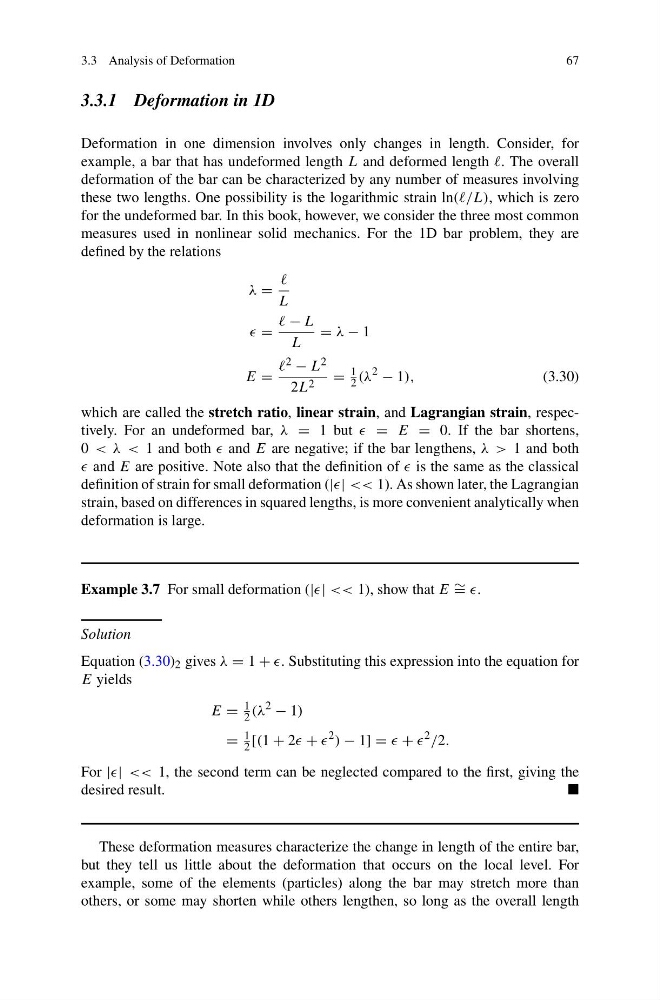
Deformation in one dimension involves only changes in length. Consider, for
example, a bar that has undeformed length L and deformed length . The overall
deformation of the bar can be characterized by any number of measures involving
these two lengths. One possibility is the logarithmic strain ln((/L), which is zero
for the undeformed bar. In this book, however, we consider the three most common
measures used in nonlinear solid mechanics. For the 1D bar problem, they are
defined by the relations
λ =
L
=
− L
L
= λ − 1
E =
2 − L 2
2L 2 =
1
2 (λ
2
− 1),
(3.30)
which are called the stretch ratio, linear strain, and Lagrangian strain, respectively. For an undeformed bar, λ = 1 but = E = 0. If the bar shortens,
0 < λ < 1 and both and E are negative; if the bar lengthens, λ > 1 and both
and E are positive. Note also that the definition of is the same as the classical
definition of strain for small deformation (|| << 1). As shown later, the Lagrangian
strain, based on differences in squared lengths, is more convenient analytically when
deformation is large.
Example 3.7 For small deformation (|| << 1), show that E ∼ = .
Solution
Equation (3.30) 2 gives λ = 1 + . Substituting this expression into the equation for
E yields
E =
1
2 (λ
2
− 1)
=
1
2 [(1 + 2 +
2 ) − 1] = +
2 /2.
For || << 1, the second term can be neglected compared to the first, giving the
desired result.
These deformation measures characterize the change in length of the entire bar,
but they tell us little about the deformation that occurs on the local level. For
example, some of the elements (particles) along the bar may stretch more than
others, or some may shorten while others lengthen, so long as the overall length
67
3.3.1 Deformation in 1D
Deformation in one dimension involves only changes in length. Consider, for
example, a bar that has undeformed length L and deformed length . The overall
deformation of the bar can be characterized by any number of measures involving
these two lengths. One possibility is the logarithmic strain ln((/L), which is zero
for the undeformed bar. In this book, however, we consider the three most common
measures used in nonlinear solid mechanics. For the 1D bar problem, they are
defined by the relations
λ =
L
=
− L
L
= λ − 1
E =
2 − L 2
2L 2 =
1
2 (λ
2
− 1),
(3.30)
which are called the stretch ratio, linear strain, and Lagrangian strain, respectively. For an undeformed bar, λ = 1 but = E = 0. If the bar shortens,
0 < λ < 1 and both and E are negative; if the bar lengthens, λ > 1 and both
and E are positive. Note also that the definition of is the same as the classical
definition of strain for small deformation (|| << 1). As shown later, the Lagrangian
strain, based on differences in squared lengths, is more convenient analytically when
deformation is large.
Example 3.7 For small deformation (|| << 1), show that E ∼ = .
Solution
Equation (3.30) 2 gives λ = 1 + . Substituting this expression into the equation for
E yields
E =
1
2 (λ
2
− 1)
=
1
2 [(1 + 2 +
2 ) − 1] = +
2 /2.
For || << 1, the second term can be neglected compared to the first, giving the
desired result.
These deformation measures characterize the change in length of the entire bar,
but they tell us little about the deformation that occurs on the local level. For
example, some of the elements (particles) along the bar may stretch more than
others, or some may shorten while others lengthen, so long as the overall length