

64
3 Continuum Mechanics and Nonlinear Elasticity
increasing t
x 1
I
x 1
I
all t
(a)
(b)
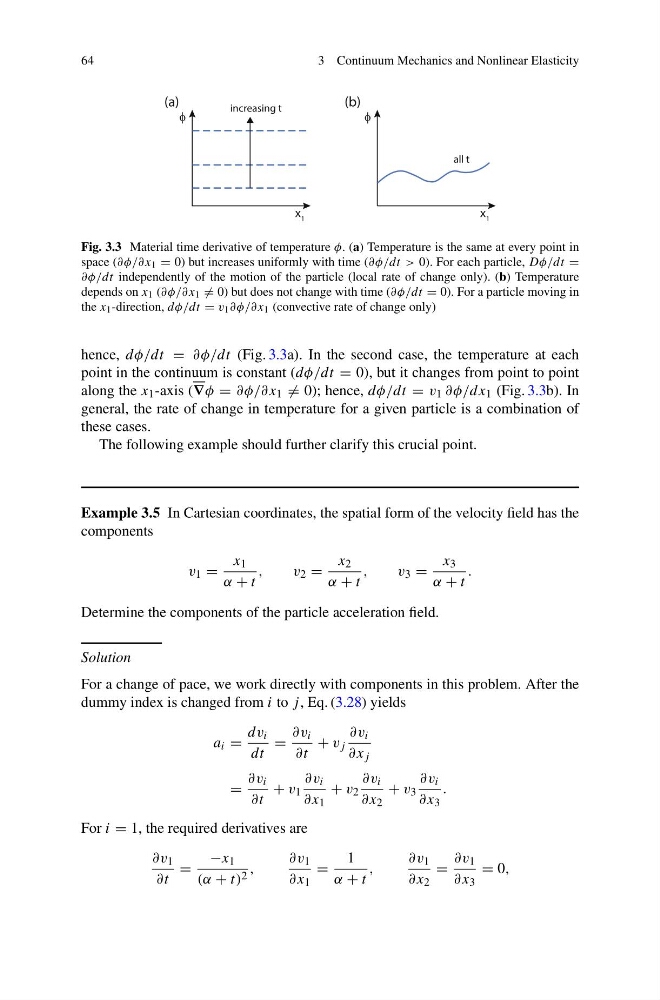
Fig. 3.3 Material time derivative of temperature φ. (a) Temperature is the same at every point in
space (∂φ/∂x 1 = 0) but increases uniformly with time (∂φ/dt > 0). For each particle, Dφ/dt =
∂φ/dt independently of the motion of the particle (local rate of change only). (b) Temperature
depends on x 1 (∂φ/∂x 1 = 0) but does not change with time (∂φ/dt = 0). For a particle moving in
the x 1 -direction, dφ/dt = v 1 ∂φ/∂x 1 (convective rate of change only)
hence, dφ/dt = ∂φ/dt (Fig. 3.3a). In the second case, the temperature at each
point in the continuum is constant (dφ/dt = 0), but it changes from point to point
along the x 1 -axis (∇φ = ∂φ/∂x 1 = 0); hence, dφ/dt = v 1 ∂φ/dx 1 (Fig. 3.3b). In
general, the rate of change in temperature for a given particle is a combination of
these cases.
The following example should further clarify this crucial point.
Example 3.5 In Cartesian coordinates, the spatial form of the velocity field has the
components
v 1 =
x 1
α + t
,
v 2 =
x 2
α + t
,
v 3 =
x 3
α + t
.
Determine the components of the particle acceleration field.
Solution
For a change of pace, we work directly with components in this problem. After the
dummy index is changed from i to j , Eq. (3.28) yields
a i =
dv i
dt
=
∂v i
∂t
+ v j
∂v i
∂x j
=
∂v i
∂t
+ v 1
∂v i
∂x 1
+ v 2
∂v i
∂x 2
+ v 3
∂v i
∂x 3
.
For i = 1, the required derivatives are
∂v 1
∂t
=
−x 1
(α + t) 2 ,
∂v 1
∂x 1
=
1
α + t
,
∂v 1
∂x 2
=
∂v 1
∂x 3
= 0,
3 Continuum Mechanics and Nonlinear Elasticity
increasing t
x 1
I
x 1
I
all t
(a)
(b)
Fig. 3.3 Material time derivative of temperature φ. (a) Temperature is the same at every point in
space (∂φ/∂x 1 = 0) but increases uniformly with time (∂φ/dt > 0). For each particle, Dφ/dt =
∂φ/dt independently of the motion of the particle (local rate of change only). (b) Temperature
depends on x 1 (∂φ/∂x 1 = 0) but does not change with time (∂φ/dt = 0). For a particle moving in
the x 1 -direction, dφ/dt = v 1 ∂φ/∂x 1 (convective rate of change only)
hence, dφ/dt = ∂φ/dt (Fig. 3.3a). In the second case, the temperature at each
point in the continuum is constant (dφ/dt = 0), but it changes from point to point
along the x 1 -axis (∇φ = ∂φ/∂x 1 = 0); hence, dφ/dt = v 1 ∂φ/dx 1 (Fig. 3.3b). In
general, the rate of change in temperature for a given particle is a combination of
these cases.
The following example should further clarify this crucial point.
Example 3.5 In Cartesian coordinates, the spatial form of the velocity field has the
components
v 1 =
x 1
α + t
,
v 2 =
x 2
α + t
,
v 3 =
x 3
α + t
.
Determine the components of the particle acceleration field.
Solution
For a change of pace, we work directly with components in this problem. After the
dummy index is changed from i to j , Eq. (3.28) yields
a i =
dv i
dt
=
∂v i
∂t
+ v j
∂v i
∂x j
=
∂v i
∂t
+ v 1
∂v i
∂x 1
+ v 2
∂v i
∂x 2
+ v 3
∂v i
∂x 3
.
For i = 1, the required derivatives are
∂v 1
∂t
=
−x 1
(α + t) 2 ,
∂v 1
∂x 1
=
1
α + t
,
∂v 1
∂x 2
=
∂v 1
∂x 3
= 0,