

2.5 Coordinate Transformation
39
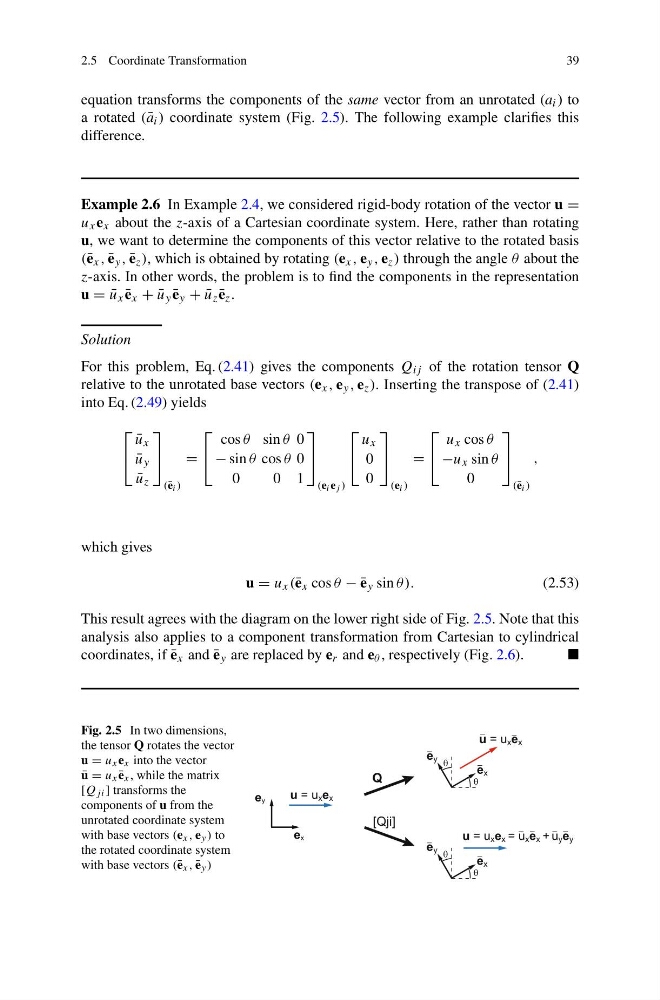
equation transforms the components of the same vector from an unrotated (a i ) to
a rotated ( ¯
a i ) coordinate system (Fig. 2.5). The following example clarifies this
difference.
Example 2.6 In Example 2.4, we considered rigid-body rotation of the vector u =
u x e x about the z-axis of a Cartesian coordinate system. Here, rather than rotating
u, we want to determine the components of this vector relative to the rotated basis
(¯ e x , ¯
e y , ¯
e z ), which is obtained by rotating (e x , e y , e z ) through the angle θ about the
z-axis. In other words, the problem is to find the components in the representation
u = ¯
u x ¯
e x + ¯
u y ¯
e y + ¯
u z ¯
e z .
Solution
For this problem, Eq. (2.41) gives the components Q ij of the rotation tensor Q
relative to the unrotated base vectors (e x , e y , e z ). Inserting the transpose of (2.41)
into Eq. (2.49) yields
⎡
⎣
¯
u x
¯
u y
¯
u z
⎤
⎦
(¯ e i )
=
⎡
⎣
cos θ sin θ 0
− sin θ cos θ 0
0
0 1
⎤
⎦
(e i e j )
⎡
⎣
u x
0
0
⎤
⎦
(e i )
=
⎡
⎣
u x cos θ
−u x sin θ
0
⎤
⎦
(¯ e i )
,
which gives
u = u x (¯ e x cos θ − ¯
e y sin θ).
(2.53)
This result agrees with the diagram on the lower right side of Fig. 2.5. Note that this
analysis also applies to a component transformation from Cartesian to cylindrical
coordinates, if ¯
e x and ¯
e y are replaced by e r and e θ , respectively (Fig. 2.6).
Fig. 2.5 In two dimensions,
the tensor Q rotates the vector
u = u x e x into the vector
¯
u = u x ¯
e x , while the matrix
[Q ji ] transforms the
components of u from the
unrotated coordinate system
with base vectors (e x , e y ) to
the rotated coordinate system
with base vectors (¯ e x , ¯
e y )
u = u x e x
T
T
e x
e y
_
_
u = u x e x
ex
ey
Q
_
T
T
e x
e y
_
_
[Qji]
u = u x e x = u x e x + u y e y
_
_
_ _
_
39
equation transforms the components of the same vector from an unrotated (a i ) to
a rotated ( ¯
a i ) coordinate system (Fig. 2.5). The following example clarifies this
difference.
Example 2.6 In Example 2.4, we considered rigid-body rotation of the vector u =
u x e x about the z-axis of a Cartesian coordinate system. Here, rather than rotating
u, we want to determine the components of this vector relative to the rotated basis
(¯ e x , ¯
e y , ¯
e z ), which is obtained by rotating (e x , e y , e z ) through the angle θ about the
z-axis. In other words, the problem is to find the components in the representation
u = ¯
u x ¯
e x + ¯
u y ¯
e y + ¯
u z ¯
e z .
Solution
For this problem, Eq. (2.41) gives the components Q ij of the rotation tensor Q
relative to the unrotated base vectors (e x , e y , e z ). Inserting the transpose of (2.41)
into Eq. (2.49) yields
⎡
⎣
¯
u x
¯
u y
¯
u z
⎤
⎦
(¯ e i )
=
⎡
⎣
cos θ sin θ 0
− sin θ cos θ 0
0
0 1
⎤
⎦
(e i e j )
⎡
⎣
u x
0
0
⎤
⎦
(e i )
=
⎡
⎣
u x cos θ
−u x sin θ
0
⎤
⎦
(¯ e i )
,
which gives
u = u x (¯ e x cos θ − ¯
e y sin θ).
(2.53)
This result agrees with the diagram on the lower right side of Fig. 2.5. Note that this
analysis also applies to a component transformation from Cartesian to cylindrical
coordinates, if ¯
e x and ¯
e y are replaced by e r and e θ , respectively (Fig. 2.6).
Fig. 2.5 In two dimensions,
the tensor Q rotates the vector
u = u x e x into the vector
¯
u = u x ¯
e x , while the matrix
[Q ji ] transforms the
components of u from the
unrotated coordinate system
with base vectors (e x , e y ) to
the rotated coordinate system
with base vectors (¯ e x , ¯
e y )
u = u x e x
T
T
e x
e y
_
_
u = u x e x
ex
ey
Q
_
T
T
e x
e y
_
_
[Qji]
u = u x e x = u x e x + u y e y
_
_
_ _
_