

8.6 Neural Development
479
During the past 50 years, speculation about folding mechanisms has centered
on two main ideas. According to the axon tension hypothesis, tension in axons
connecting different regions of the cortex pulls these areas together, causing the
surface to buckle (Van Essen 1997). However, more recent data on fiber architecture
and mechanical stress seem to contradict this mechanism (Xu et al. 2010b; Garcia
et al. 2018). The second idea, the differential growth hypothesis, posits that
tangential expansion of the cortex is constrained by the core, putting the cortex
into compression and causing it to buckle (Richman et al. 1975; Xu et al. 2010b).
In general, this hypothesis has proven to be consistent with most experimental
observations.
Although mechanical forces directly cause cortical folding, genes may ensure
a consistent folding pattern by controlling regional cell proliferation, as well as
the patterns of axon bundles and of the glial fibers that guide neuron migration.
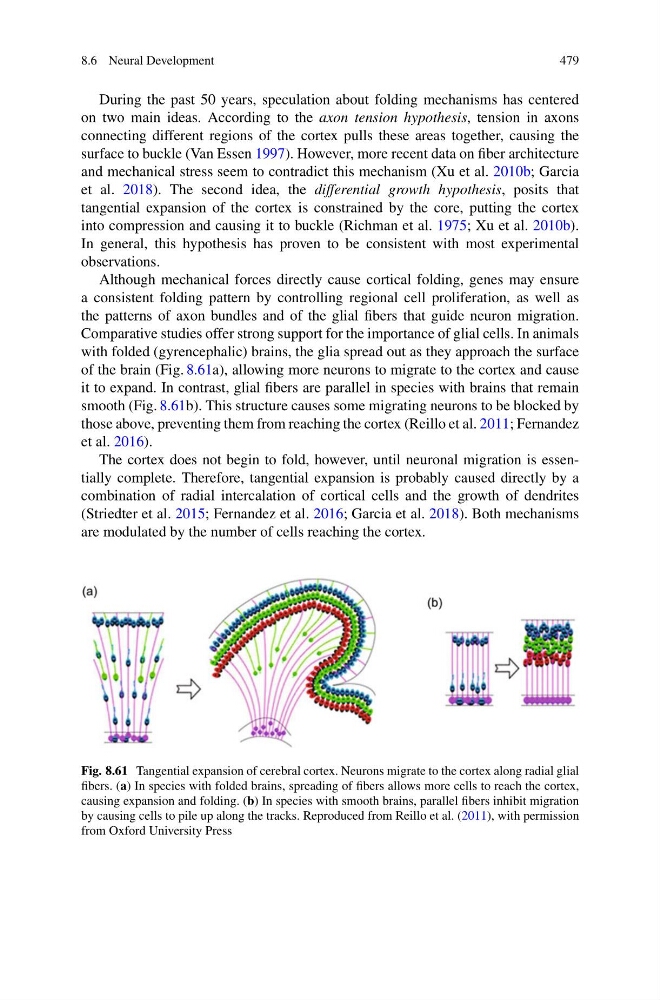
Comparative studies offer strong support for the importance of glial cells. In animals
with folded (gyrencephalic) brains, the glia spread out as they approach the surface
of the brain (Fig. 8.61a), allowing more neurons to migrate to the cortex and cause
it to expand. In contrast, glial fibers are parallel in species with brains that remain
smooth (Fig. 8.61b). This structure causes some migrating neurons to be blocked by
those above, preventing them from reaching the cortex (Reillo et al. 2011; Fernandez
et al. 2016).
The cortex does not begin to fold, however, until neuronal migration is essentially complete. Therefore, tangential expansion is probably caused directly by a
combination of radial intercalation of cortical cells and the growth of dendrites
(Striedter et al. 2015; Fernandez et al. 2016; Garcia et al. 2018). Both mechanisms
are modulated by the number of cells reaching the cortex.
Fig. 8.61 Tangential expansion of cerebral cortex. Neurons migrate to the cortex along radial glial
fibers. (a) In species with folded brains, spreading of fibers allows more cells to reach the cortex,
causing expansion and folding. (b) In species with smooth brains, parallel fibers inhibit migration
by causing cells to pile up along the tracks. Reproduced from Reillo et al. (2011), with permission
from Oxford University Press
479
During the past 50 years, speculation about folding mechanisms has centered
on two main ideas. According to the axon tension hypothesis, tension in axons
connecting different regions of the cortex pulls these areas together, causing the
surface to buckle (Van Essen 1997). However, more recent data on fiber architecture
and mechanical stress seem to contradict this mechanism (Xu et al. 2010b; Garcia
et al. 2018). The second idea, the differential growth hypothesis, posits that
tangential expansion of the cortex is constrained by the core, putting the cortex
into compression and causing it to buckle (Richman et al. 1975; Xu et al. 2010b).
In general, this hypothesis has proven to be consistent with most experimental
observations.
Although mechanical forces directly cause cortical folding, genes may ensure
a consistent folding pattern by controlling regional cell proliferation, as well as
the patterns of axon bundles and of the glial fibers that guide neuron migration.
Comparative studies offer strong support for the importance of glial cells. In animals
with folded (gyrencephalic) brains, the glia spread out as they approach the surface
of the brain (Fig. 8.61a), allowing more neurons to migrate to the cortex and cause
it to expand. In contrast, glial fibers are parallel in species with brains that remain
smooth (Fig. 8.61b). This structure causes some migrating neurons to be blocked by
those above, preventing them from reaching the cortex (Reillo et al. 2011; Fernandez
et al. 2016).
The cortex does not begin to fold, however, until neuronal migration is essentially complete. Therefore, tangential expansion is probably caused directly by a
combination of radial intercalation of cortical cells and the growth of dendrites
(Striedter et al. 2015; Fernandez et al. 2016; Garcia et al. 2018). Both mechanisms
are modulated by the number of cells reaching the cortex.
Fig. 8.61 Tangential expansion of cerebral cortex. Neurons migrate to the cortex along radial glial
fibers. (a) In species with folded brains, spreading of fibers allows more cells to reach the cortex,
causing expansion and folding. (b) In species with smooth brains, parallel fibers inhibit migration
by causing cells to pile up along the tracks. Reproduced from Reillo et al. (2011), with permission
from Oxford University Press