

8.4 Gastrulation
431
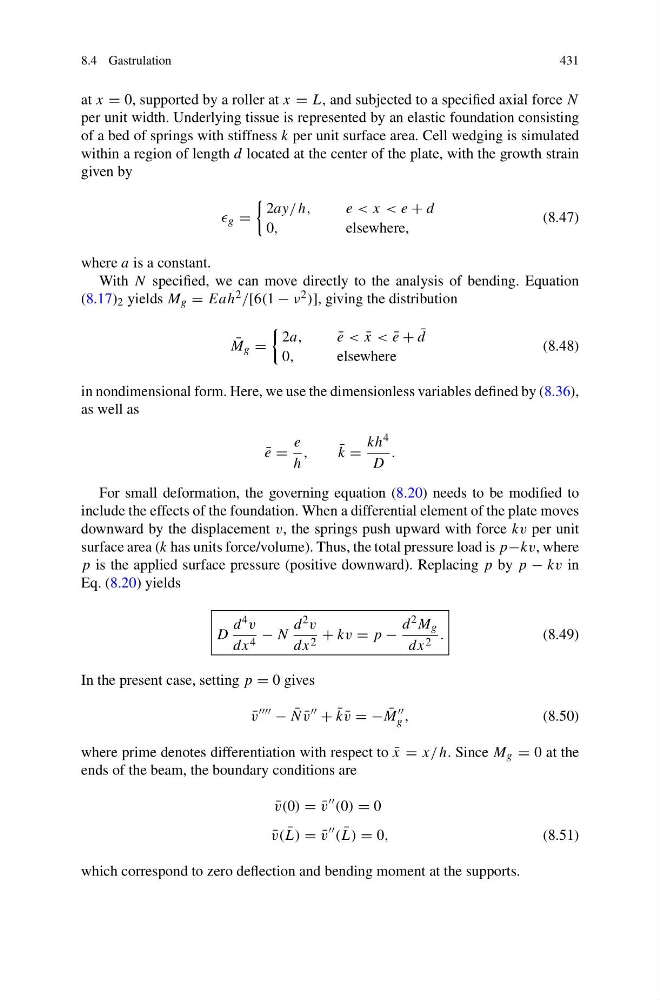
at x = 0, supported by a roller at x = L, and subjected to a specified axial force N
per unit width. Underlying tissue is represented by an elastic foundation consisting
of a bed of springs with stiffness k per unit surface area. Cell wedging is simulated
within a region of length d located at the center of the plate, with the growth strain
given by
g =
2ay/h,
e < x < e + d
0,
elsewhere,
(8.47)
where a is a constant.
With N specified, we can move directly to the analysis of bending. Equation
(8.17) 2 yields M g = Eah 2 /[6(1 − ν 2 )], giving the distribution
¯
M g =
2a,
¯
e < ¯
x < ¯
e + ¯
d
0,
elsewhere
(8.48)
in nondimensional form. Here, we use the dimensionless variables defined by (8.36),
as well as
¯
e =
e
h
,
¯
k =
kh 4
D
.
For small deformation, the governing equation (8.20) needs to be modified to
include the effects of the foundation. When a differential element of the plate moves
downward by the displacement v, the springs push upward with force kv per unit
surface area (k has units force/volume). Thus, the total pressure load is p−kv, where
p is the applied surface pressure (positive downward). Replacing p by p − kv in
Eq. (8.20) yields
D
d 4 v
dx 4 − N
d 2 v
dx 2 + kv = p −
d 2 M g
dx 2 .
(8.49)
In the present case, setting p = 0 gives
¯
v
− ¯
N ¯
v
+ ¯
k ¯
v = − ¯
M
g ,
(8.50)
where prime denotes differentiation with respect to ¯
x = x/ h. Since M g = 0 at the
ends of the beam, the boundary conditions are
¯
v(0) = ¯
v
(0) = 0
¯
v( ¯
L) = ¯
v
( ¯
L) = 0,
(8.51)
which correspond to zero deflection and bending moment at the supports.
431
at x = 0, supported by a roller at x = L, and subjected to a specified axial force N
per unit width. Underlying tissue is represented by an elastic foundation consisting
of a bed of springs with stiffness k per unit surface area. Cell wedging is simulated
within a region of length d located at the center of the plate, with the growth strain
given by
g =
2ay/h,
e < x < e + d
0,
elsewhere,
(8.47)
where a is a constant.
With N specified, we can move directly to the analysis of bending. Equation
(8.17) 2 yields M g = Eah 2 /[6(1 − ν 2 )], giving the distribution
¯
M g =
2a,
¯
e < ¯
x < ¯
e + ¯
d
0,
elsewhere
(8.48)
in nondimensional form. Here, we use the dimensionless variables defined by (8.36),
as well as
¯
e =
e
h
,
¯
k =
kh 4
D
.
For small deformation, the governing equation (8.20) needs to be modified to
include the effects of the foundation. When a differential element of the plate moves
downward by the displacement v, the springs push upward with force kv per unit
surface area (k has units force/volume). Thus, the total pressure load is p−kv, where
p is the applied surface pressure (positive downward). Replacing p by p − kv in
Eq. (8.20) yields
D
d 4 v
dx 4 − N
d 2 v
dx 2 + kv = p −
d 2 M g
dx 2 .
(8.49)
In the present case, setting p = 0 gives
¯
v
− ¯
N ¯
v
+ ¯
k ¯
v = − ¯
M
g ,
(8.50)
where prime denotes differentiation with respect to ¯
x = x/ h. Since M g = 0 at the
ends of the beam, the boundary conditions are
¯
v(0) = ¯
v
(0) = 0
¯
v( ¯
L) = ¯
v
( ¯
L) = 0,
(8.51)
which correspond to zero deflection and bending moment at the supports.