

8.3 Linear Theory for Growing Beams and Plates
427
( ¯
x, ¯
v, ¯
L, ¯
d) = (x, v, L, d)h
−1
( ¯
N, ¯
N g ) = (N, N g )h
2 /D
( ¯
M, ¯
M g ) = (M, M g )h/D.
(8.36)
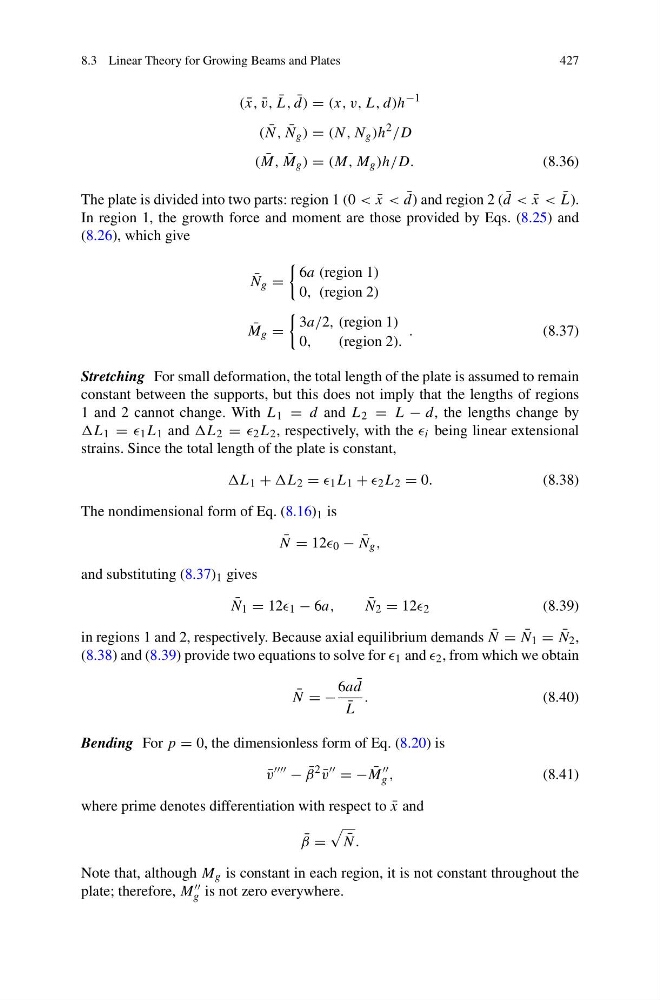
The plate is divided into two parts: region 1 (0 < ¯
x < ¯
d) and region 2 ( ¯
d < ¯
x < ¯
L).
In region 1, the growth force and moment are those provided by Eqs. (8.25) and
(8.26), which give
¯
N g =
6a (region 1)
0, (region 2)
¯
M g =
3a/2, (region 1)
0,
(region 2).
.
(8.37)
Stretching For small deformation, the total length of the plate is assumed to remain
constant between the supports, but this does not imply that the lengths of regions
1 and 2 cannot change. With L 1 = d and L 2 = L − d, the lengths change by
L 1 = 1 L 1 and L 2 = 2 L 2 , respectively, with the i being linear extensional
strains. Since the total length of the plate is constant,
L 1 + L 2 = 1 L 1 + 2 L 2 = 0.
(8.38)
The nondimensional form of Eq. (8.16) 1 is
¯
N = 12 0 − ¯
N g ,
and substituting (8.37) 1 gives
¯
N 1 = 12 1 − 6a,
¯
N 2 = 12 2
(8.39)
in regions 1 and 2, respectively. Because axial equilibrium demands ¯
N = ¯
N 1 = ¯
N 2 ,
(8.38) and (8.39) provide two equations to solve for 1 and 2 , from which we obtain
¯
N = −
6a ¯
d
¯
L
.
(8.40)
Bending For p = 0, the dimensionless form of Eq. (8.20) is
¯
v
− ¯
β
2
¯
v
= − ¯
M
g ,
(8.41)
where prime denotes differentiation with respect to ¯
x and
¯
β =
¯
N.
Note that, although M g is constant in each region, it is not constant throughout the
plate; therefore, M
g is not zero everywhere.
427
( ¯
x, ¯
v, ¯
L, ¯
d) = (x, v, L, d)h
−1
( ¯
N, ¯
N g ) = (N, N g )h
2 /D
( ¯
M, ¯
M g ) = (M, M g )h/D.
(8.36)
The plate is divided into two parts: region 1 (0 < ¯
x < ¯
d) and region 2 ( ¯
d < ¯
x < ¯
L).
In region 1, the growth force and moment are those provided by Eqs. (8.25) and
(8.26), which give
¯
N g =
6a (region 1)
0, (region 2)
¯
M g =
3a/2, (region 1)
0,
(region 2).
.
(8.37)
Stretching For small deformation, the total length of the plate is assumed to remain
constant between the supports, but this does not imply that the lengths of regions
1 and 2 cannot change. With L 1 = d and L 2 = L − d, the lengths change by
L 1 = 1 L 1 and L 2 = 2 L 2 , respectively, with the i being linear extensional
strains. Since the total length of the plate is constant,
L 1 + L 2 = 1 L 1 + 2 L 2 = 0.
(8.38)
The nondimensional form of Eq. (8.16) 1 is
¯
N = 12 0 − ¯
N g ,
and substituting (8.37) 1 gives
¯
N 1 = 12 1 − 6a,
¯
N 2 = 12 2
(8.39)
in regions 1 and 2, respectively. Because axial equilibrium demands ¯
N = ¯
N 1 = ¯
N 2 ,
(8.38) and (8.39) provide two equations to solve for 1 and 2 , from which we obtain
¯
N = −
6a ¯
d
¯
L
.
(8.40)
Bending For p = 0, the dimensionless form of Eq. (8.20) is
¯
v
− ¯
β
2
¯
v
= − ¯
M
g ,
(8.41)
where prime denotes differentiation with respect to ¯
x and
¯
β =
¯
N.
Note that, although M g is constant in each region, it is not constant throughout the
plate; therefore, M
g is not zero everywhere.