

8.3 Linear Theory for Growing Beams and Plates
417
For no bending, κ = 0 and Eq. (8.8) gives the axial stresses
σ = E(( 0 − g ) =
Ea
3
12y 2
h 2 − 1
(part a)
σ = −EE g = Ea
4y 2
h 2 − 1
(part b).
This is the same problem considered in Example 6.5 (page 270), where an exact
nonlinear solution is found for a beam composed of neo-Hookean material. With
g = G − 1 and H = h/2, Eq. (6.33) gives the same growth distribution considered
here. Thus, the linear and nonlinear results can be compared. To do this, we set
ν = 0.5 for an incompressible material, and the neo-Hookean modulus becomes
c = μ/2 = E/6 in Eq. (6.34).
Results
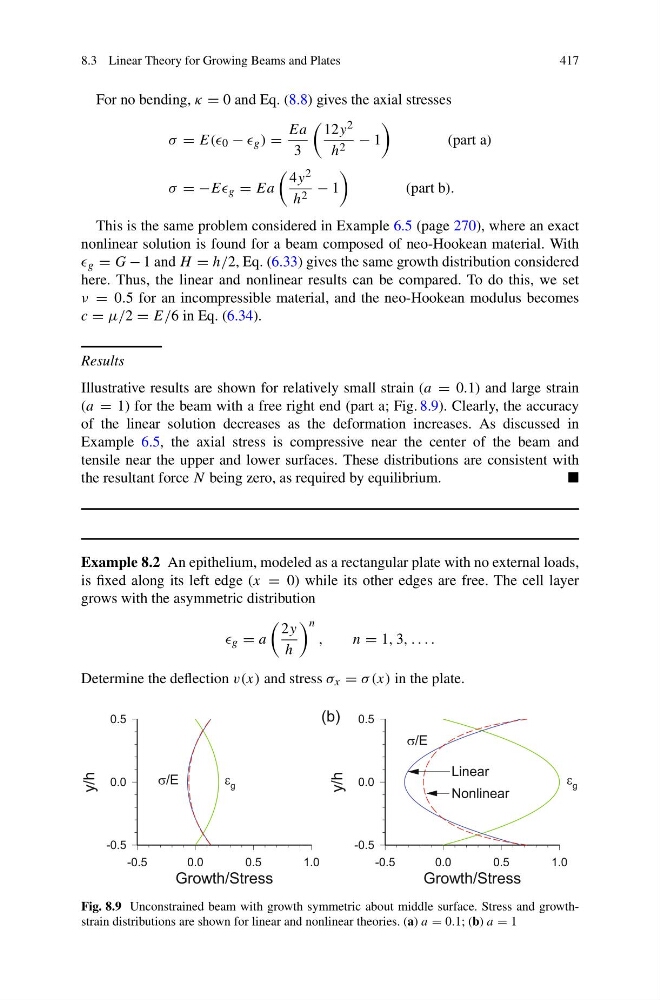
Illustrative results are shown for relatively small strain (a = 0.1) and large strain
(a = 1) for the beam with a free right end (part a; Fig. 8.9). Clearly, the accuracy
of the linear solution decreases as the deformation increases. As discussed in
Example 6.5, the axial stress is compressive near the center of the beam and
tensile near the upper and lower surfaces. These distributions are consistent with
the resultant force N being zero, as required by equilibrium.
Example 8.2 An epithelium, modeled as a rectangular plate with no external loads,
is fixed along its left edge (x = 0) while its other edges are free. The cell layer
grows with the asymmetric distribution
g = a
2y
h
n
,
n= 1, 3, . . . .
Determine the deflection v(x) and stress σ x = σ (x) in the plate.
Fig. 8.9 Unconstrained beam with growth symmetric about middle surface. Stress and growthstrain distributions are shown for linear and nonlinear theories. (a) a = 0.1; (b) a = 1
417
For no bending, κ = 0 and Eq. (8.8) gives the axial stresses
σ = E(( 0 − g ) =
Ea
3
12y 2
h 2 − 1
(part a)
σ = −EE g = Ea
4y 2
h 2 − 1
(part b).
This is the same problem considered in Example 6.5 (page 270), where an exact
nonlinear solution is found for a beam composed of neo-Hookean material. With
g = G − 1 and H = h/2, Eq. (6.33) gives the same growth distribution considered
here. Thus, the linear and nonlinear results can be compared. To do this, we set
ν = 0.5 for an incompressible material, and the neo-Hookean modulus becomes
c = μ/2 = E/6 in Eq. (6.34).
Results
Illustrative results are shown for relatively small strain (a = 0.1) and large strain
(a = 1) for the beam with a free right end (part a; Fig. 8.9). Clearly, the accuracy
of the linear solution decreases as the deformation increases. As discussed in
Example 6.5, the axial stress is compressive near the center of the beam and
tensile near the upper and lower surfaces. These distributions are consistent with
the resultant force N being zero, as required by equilibrium.
Example 8.2 An epithelium, modeled as a rectangular plate with no external loads,
is fixed along its left edge (x = 0) while its other edges are free. The cell layer
grows with the asymmetric distribution
g = a
2y
h
n
,
n= 1, 3, . . . .
Determine the deflection v(x) and stress σ x = σ (x) in the plate.
Fig. 8.9 Unconstrained beam with growth symmetric about middle surface. Stress and growthstrain distributions are shown for linear and nonlinear theories. (a) a = 0.1; (b) a = 1