

7.8 Case Study: Changing Fiber Orientation During Cyclic Stretch
397
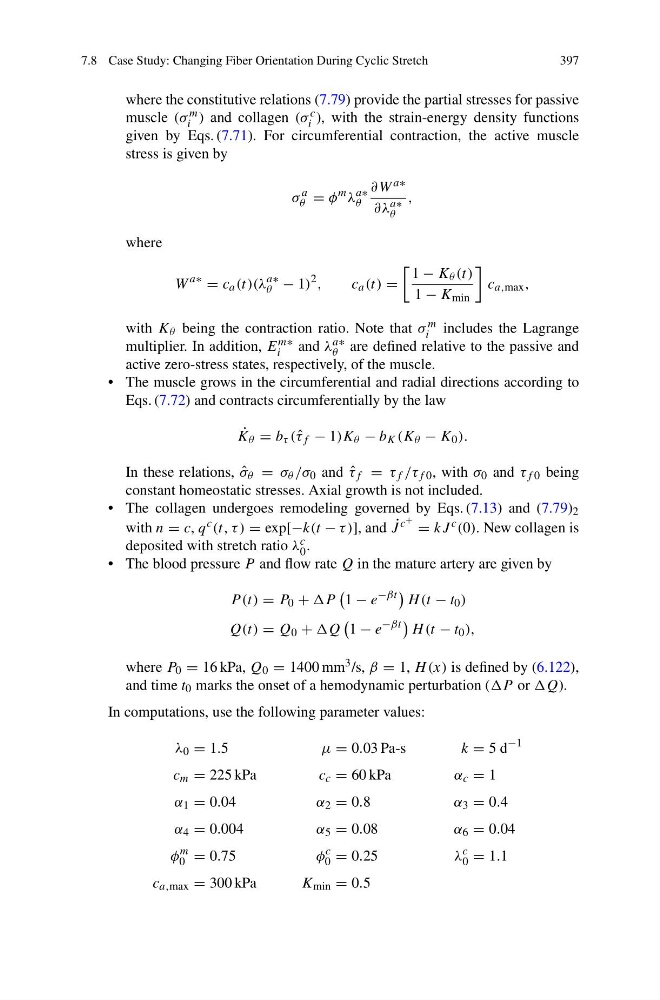
where the constitutive relations (7.79) provide the partial stresses for passive
muscle (σ m
i ) and collagen (σ c
i ), with the strain-energy density functions
given by Eqs. (7.71). For circumferential contraction, the active muscle
stress is given by
σ
a
θ = φ
m λ
a∗
θ
∂W a∗
∂λ a∗
θ
,
where
W
a∗
= c a (t)(λ
a∗
θ − 1)
2 ,
c a (t) =
1 − K θ (t)
1 − K min
c a,max ,
with K θ being the contraction ratio. Note that σ m
i includes the Lagrange
multiplier. In addition, E m∗
i
and λ a∗
θ are defined relative to the passive and
active zero-stress states, respectively, of the muscle.
• The muscle grows in the circumferential and radial directions according to
Eqs. (7.72) and contracts circumferentially by the law
˙
K θ = b τ ( ˆ
τ f − 1)K θ − b K (K θ − K 0 ).
In these relations, ˆ
σ θ = σ θ /σ 0 and ˆ
τ f = τ f /τ f 0 , with σ 0 and τ f 0 being
constant homeostatic stresses. Axial growth is not included.
• The collagen undergoes remodeling governed by Eqs. (7.13) and (7.79) 2
with n = c, q c (t, τ ) = exp[−k(t − τ )], and ˙
J c + = kJ c (0). New collagen is
deposited with stretch ratio λ c
0 .
• The blood pressure P and flow rate Q in the mature artery are given by
P (t) = P 0 + P
1 − e
−βt
H (t − t 0 )
Q(t) = Q 0 + Q
1 − e
−βt
H (t − t 0 ),
where P 0 = 16 kPa, Q 0 = 1400 mm 3 /s, β = 1, H (x) is defined by (6.122),
and time t 0 marks the onset of a hemodynamic perturbation (P or Q).
In computations, use the following parameter values:
λ 0 = 1.5
μ = 0.03 Pa-s
k = 5 d
−1
c m = 225 kPa
c c = 60 kPa
α c = 1
α 1 = 0.04
α 2 = 0.8
α 3 = 0.4
α 4 = 0.004
α 5 = 0.08
α 6 = 0.04
φ
m
0 = 0.75
φ
c
0 = 0.25
λ
c
0 = 1.1
c a,max = 300 kPa
K min = 0.5
397
where the constitutive relations (7.79) provide the partial stresses for passive
muscle (σ m
i ) and collagen (σ c
i ), with the strain-energy density functions
given by Eqs. (7.71). For circumferential contraction, the active muscle
stress is given by
σ
a
θ = φ
m λ
a∗
θ
∂W a∗
∂λ a∗
θ
,
where
W
a∗
= c a (t)(λ
a∗
θ − 1)
2 ,
c a (t) =
1 − K θ (t)
1 − K min
c a,max ,
with K θ being the contraction ratio. Note that σ m
i includes the Lagrange
multiplier. In addition, E m∗
i
and λ a∗
θ are defined relative to the passive and
active zero-stress states, respectively, of the muscle.
• The muscle grows in the circumferential and radial directions according to
Eqs. (7.72) and contracts circumferentially by the law
˙
K θ = b τ ( ˆ
τ f − 1)K θ − b K (K θ − K 0 ).
In these relations, ˆ
σ θ = σ θ /σ 0 and ˆ
τ f = τ f /τ f 0 , with σ 0 and τ f 0 being
constant homeostatic stresses. Axial growth is not included.
• The collagen undergoes remodeling governed by Eqs. (7.13) and (7.79) 2
with n = c, q c (t, τ ) = exp[−k(t − τ )], and ˙
J c + = kJ c (0). New collagen is
deposited with stretch ratio λ c
0 .
• The blood pressure P and flow rate Q in the mature artery are given by
P (t) = P 0 + P
1 − e
−βt
H (t − t 0 )
Q(t) = Q 0 + Q
1 − e
−βt
H (t − t 0 ),
where P 0 = 16 kPa, Q 0 = 1400 mm 3 /s, β = 1, H (x) is defined by (6.122),
and time t 0 marks the onset of a hemodynamic perturbation (P or Q).
In computations, use the following parameter values:
λ 0 = 1.5
μ = 0.03 Pa-s
k = 5 d
−1
c m = 225 kPa
c c = 60 kPa
α c = 1
α 1 = 0.04
α 2 = 0.8
α 3 = 0.4
α 4 = 0.004
α 5 = 0.08
α 6 = 0.04
φ
m
0 = 0.75
φ
c
0 = 0.25
λ
c
0 = 1.1
c a,max = 300 kPa
K min = 0.5