

360
7 Remodeling
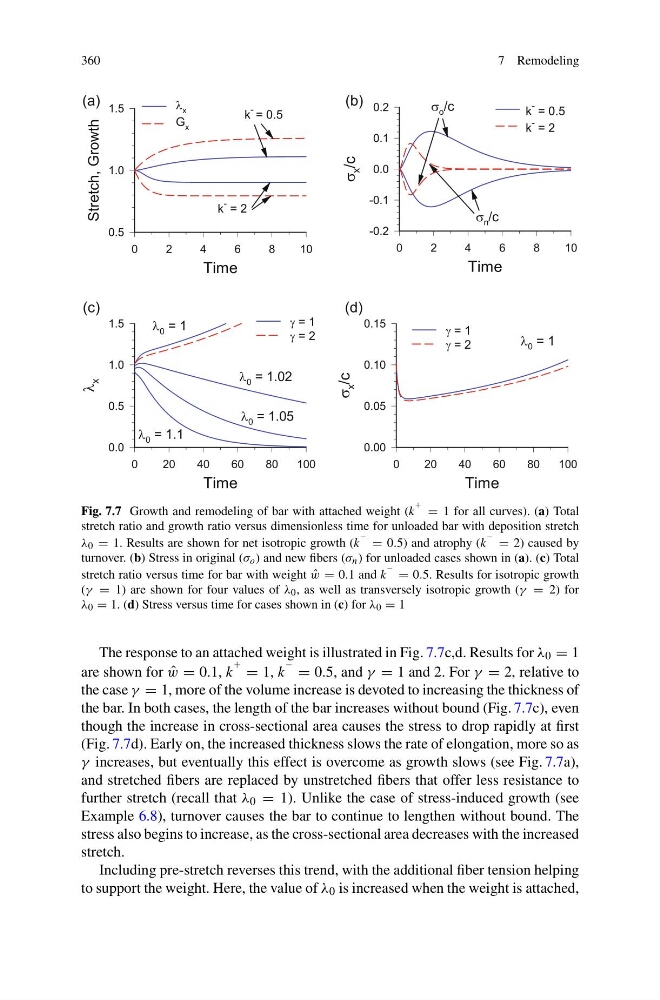
Fig. 7.7 Growth and remodeling of bar with attached weight (k
+ = 1 for all curves). (a) Total
stretch ratio and growth ratio versus dimensionless time for unloaded bar with deposition stretch
λ 0 = 1. Results are shown for net isotropic growth (k
− = 0.5) and atrophy (k
− = 2) caused by
turnover. (b) Stress in original (σ o ) and new fibers (σ n ) for unloaded cases shown in (a). (c) Total
stretch ratio versus time for bar with weight ˆ
w = 0.1 and k
− = 0.5. Results for isotropic growth
(γ = 1) are shown for four values of λ 0 , as well as transversely isotropic growth (γ = 2) for
λ 0 = 1. (d) Stress versus time for cases shown in (c) for λ 0 = 1
The response to an attached weight is illustrated in Fig. 7.7c,d. Results for λ 0 = 1
are shown for ˆ
w = 0.1, k
+ = 1, k
− = 0.5, and γ = 1 and 2. For γ = 2, relative to
the case γ = 1, more of the volume increase is devoted to increasing the thickness of
the bar. In both cases, the length of the bar increases without bound (Fig. 7.7c), even
though the increase in cross-sectional area causes the stress to drop rapidly at first
(Fig. 7.7d). Early on, the increased thickness slows the rate of elongation, more so as
γ increases, but eventually this effect is overcome as growth slows (see Fig. 7.7a),
and stretched fibers are replaced by unstretched fibers that offer less resistance to
further stretch (recall that λ 0 = 1). Unlike the case of stress-induced growth (see
Example 6.8), turnover causes the bar to continue to lengthen without bound. The
stress also begins to increase, as the cross-sectional area decreases with the increased
stretch.
Including pre-stretch reverses this trend, with the additional fiber tension helping
to support the weight. Here, the value of λ 0 is increased when the weight is attached,
7 Remodeling
Fig. 7.7 Growth and remodeling of bar with attached weight (k
+ = 1 for all curves). (a) Total
stretch ratio and growth ratio versus dimensionless time for unloaded bar with deposition stretch
λ 0 = 1. Results are shown for net isotropic growth (k
− = 0.5) and atrophy (k
− = 2) caused by
turnover. (b) Stress in original (σ o ) and new fibers (σ n ) for unloaded cases shown in (a). (c) Total
stretch ratio versus time for bar with weight ˆ
w = 0.1 and k
− = 0.5. Results for isotropic growth
(γ = 1) are shown for four values of λ 0 , as well as transversely isotropic growth (γ = 2) for
λ 0 = 1. (d) Stress versus time for cases shown in (c) for λ 0 = 1
The response to an attached weight is illustrated in Fig. 7.7c,d. Results for λ 0 = 1
are shown for ˆ
w = 0.1, k
+ = 1, k
− = 0.5, and γ = 1 and 2. For γ = 2, relative to
the case γ = 1, more of the volume increase is devoted to increasing the thickness of
the bar. In both cases, the length of the bar increases without bound (Fig. 7.7c), even
though the increase in cross-sectional area causes the stress to drop rapidly at first
(Fig. 7.7d). Early on, the increased thickness slows the rate of elongation, more so as
γ increases, but eventually this effect is overcome as growth slows (see Fig. 7.7a),
and stretched fibers are replaced by unstretched fibers that offer less resistance to
further stretch (recall that λ 0 = 1). Unlike the case of stress-induced growth (see
Example 6.8), turnover causes the bar to continue to lengthen without bound. The
stress also begins to increase, as the cross-sectional area decreases with the increased
stretch.
Including pre-stretch reverses this trend, with the additional fiber tension helping
to support the weight. Here, the value of λ 0 is increased when the weight is attached,