

7.3 Theory for Remodeling in 1D
353
If the bar is composed entirely of one fiber family n, then J n (0) = 1 and this relation
satisfies G n
x (0) = 1. Note also that setting γ = 1 gives isotropic growth, while the
growth is solely longitudinal if γ = 0.
In summary, the growth ratios for the nth fiber family can be computed using
Eqs. (7.13) and (7.24). If the deposition and total stretch ratios are known, Eq. (7.20)
then provides the elastic stretch ratios to be used in computing stress.
7.3.3 Constitutive Relations for Remodeling
Suppose a bar consists of a mixture of N pseudoelastic fiber families oriented in
the axial (x) direction. As illustrated in Fig. 7.5, each family includes fibers that
were created at various times in the past and are stretched different amounts. Let
¯
σ n
i (λ n∗
i (t, τ )) be response functions at the current time t for fibers belonging to
family n (n = 1, 2, . . . N) that were created at time τ . Then, analogous to Eq. (7.13),
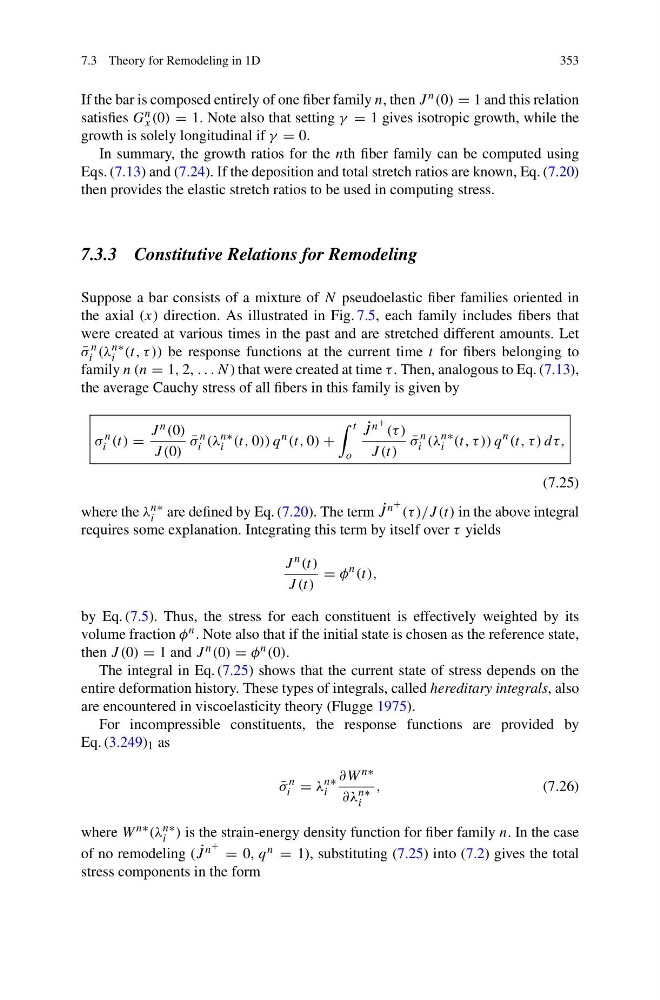
the average Cauchy stress of all fibers in this family is given by
σ n
i (t) =
J n (0)
J (0)
¯
σ n
i (λ n∗
i (t, 0)) q n (t, 0) +
t
o
˙
J n + (τ )
J (t)
¯
σ
n
i (λ
n∗
i (t, τ )) q
n (t, τ ) dτ,
(7.25)
where the λ n∗
i are defined by Eq. (7.20). The term ˙
J n + (τ )/J (t) in the above integral
requires some explanation. Integrating this term by itself over τ yields
J n (t)
J (t)
= φ
n (t),
by Eq. (7.5). Thus, the stress for each constituent is effectively weighted by its
volume fraction φ n . Note also that if the initial state is chosen as the reference state,
then J (0) = 1 and J n (0) = φ n (0).
The integral in Eq. (7.25) shows that the current state of stress depends on the
entire deformation history. These types of integrals, called hereditary integrals, also
are encountered in viscoelasticity theory (Flugge 1975).
For incompressible constituents, the response functions are provided by
Eq. (3.249) 1 as
¯
σ
n
i = λ
n∗
i
∂W n∗
∂λ n∗
i
,
(7.26)
where W n∗ (λ n∗
i ) is the strain-energy density function for fiber family n. In the case
of no remodeling ( ˙
J n + = 0, q n = 1), substituting (7.25) into (7.2) gives the total
stress components in the form
353
If the bar is composed entirely of one fiber family n, then J n (0) = 1 and this relation
satisfies G n
x (0) = 1. Note also that setting γ = 1 gives isotropic growth, while the
growth is solely longitudinal if γ = 0.
In summary, the growth ratios for the nth fiber family can be computed using
Eqs. (7.13) and (7.24). If the deposition and total stretch ratios are known, Eq. (7.20)
then provides the elastic stretch ratios to be used in computing stress.
7.3.3 Constitutive Relations for Remodeling
Suppose a bar consists of a mixture of N pseudoelastic fiber families oriented in
the axial (x) direction. As illustrated in Fig. 7.5, each family includes fibers that
were created at various times in the past and are stretched different amounts. Let
¯
σ n
i (λ n∗
i (t, τ )) be response functions at the current time t for fibers belonging to
family n (n = 1, 2, . . . N) that were created at time τ . Then, analogous to Eq. (7.13),
the average Cauchy stress of all fibers in this family is given by
σ n
i (t) =
J n (0)
J (0)
¯
σ n
i (λ n∗
i (t, 0)) q n (t, 0) +
t
o
˙
J n + (τ )
J (t)
¯
σ
n
i (λ
n∗
i (t, τ )) q
n (t, τ ) dτ,
(7.25)
where the λ n∗
i are defined by Eq. (7.20). The term ˙
J n + (τ )/J (t) in the above integral
requires some explanation. Integrating this term by itself over τ yields
J n (t)
J (t)
= φ
n (t),
by Eq. (7.5). Thus, the stress for each constituent is effectively weighted by its
volume fraction φ n . Note also that if the initial state is chosen as the reference state,
then J (0) = 1 and J n (0) = φ n (0).
The integral in Eq. (7.25) shows that the current state of stress depends on the
entire deformation history. These types of integrals, called hereditary integrals, also
are encountered in viscoelasticity theory (Flugge 1975).
For incompressible constituents, the response functions are provided by
Eq. (3.249) 1 as
¯
σ
n
i = λ
n∗
i
∂W n∗
∂λ n∗
i
,
(7.26)
where W n∗ (λ n∗
i ) is the strain-energy density function for fiber family n. In the case
of no remodeling ( ˙
J n + = 0, q n = 1), substituting (7.25) into (7.2) gives the total
stress components in the form