

7.3 Theory for Remodeling in 1D
351
0
t = 0
t = W 1
O 1
O 2
O 3
V 0
O 0
t = W 2
O
0
= O 0
O
0
= O 0 O 1
O
1
= O 0
O
0
= O 0 O 2
O
1
= O 0 O 2 /O 1
O
2
= O 0
O
0
= O 0 O 3
O
1
= O 0 O 3 /O 1
O
2
= O 0 O 3 /O 2
O
3
= O 0
t = W 3
0
1
2
3
V 0
O 0
V 0
O 0
V 0
O 0
0
0
0
1
1
1
2
2
3
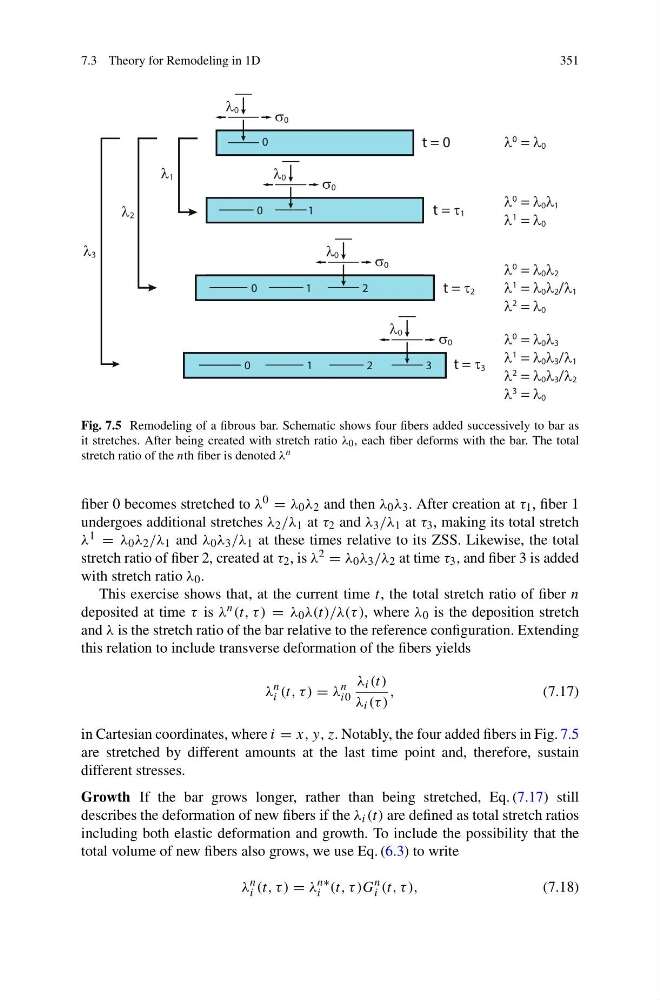
Fig. 7.5 Remodeling of a fibrous bar. Schematic shows four fibers added successively to bar as
it stretches. After being created with stretch ratio λ 0 , each fiber deforms with the bar. The total
stretch ratio of the nth fiber is denoted λ n
fiber 0 becomes stretched to λ 0 = λ 0 λ 2 and then λ 0 λ 3 . After creation at τ 1 , fiber 1
undergoes additional stretches λ 2 /λ 1 at τ 2 and λ 3 /λ 1 at τ 3 , making its total stretch
λ 1 = λ 0 λ 2 /λ 1 and λ 0 λ 3 /λ 1 at these times relative to its ZSS. Likewise, the total
stretch ratio of fiber 2, created at τ 2 , is λ 2 = λ 0 λ 3 /λ 2 at time τ 3 , and fiber 3 is added
with stretch ratio λ 0 .
This exercise shows that, at the current time t, the total stretch ratio of fiber n
deposited at time τ is λ n (t, τ ) = λ 0 λ(t)/λ(τ ), where λ 0 is the deposition stretch
and λ is the stretch ratio of the bar relative to the reference configuration. Extending
this relation to include transverse deformation of the fibers yields
λ
n
i (t, τ ) = λ
n
i0
λ i (t)
λ i (τ )
,
(7.17)
in Cartesian coordinates, where i = x, y, z. Notably, the four added fibers in Fig. 7.5
are stretched by different amounts at the last time point and, therefore, sustain
different stresses.
Growth If the bar grows longer, rather than being stretched, Eq. (7.17) still
describes the deformation of new fibers if the λ i (t) are defined as total stretch ratios
including both elastic deformation and growth. To include the possibility that the
total volume of new fibers also grows, we use Eq. (6.3) to write
λ
n
i (t, τ ) = λ
n∗
i (t, τ )G
n
i (t, τ ),
(7.18)
351
0
t = 0
t = W 1
O 1
O 2
O 3
V 0
O 0
t = W 2
O
0
= O 0
O
0
= O 0 O 1
O
1
= O 0
O
0
= O 0 O 2
O
1
= O 0 O 2 /O 1
O
2
= O 0
O
0
= O 0 O 3
O
1
= O 0 O 3 /O 1
O
2
= O 0 O 3 /O 2
O
3
= O 0
t = W 3
0
1
2
3
V 0
O 0
V 0
O 0
V 0
O 0
0
0
0
1
1
1
2
2
3
Fig. 7.5 Remodeling of a fibrous bar. Schematic shows four fibers added successively to bar as
it stretches. After being created with stretch ratio λ 0 , each fiber deforms with the bar. The total
stretch ratio of the nth fiber is denoted λ n
fiber 0 becomes stretched to λ 0 = λ 0 λ 2 and then λ 0 λ 3 . After creation at τ 1 , fiber 1
undergoes additional stretches λ 2 /λ 1 at τ 2 and λ 3 /λ 1 at τ 3 , making its total stretch
λ 1 = λ 0 λ 2 /λ 1 and λ 0 λ 3 /λ 1 at these times relative to its ZSS. Likewise, the total
stretch ratio of fiber 2, created at τ 2 , is λ 2 = λ 0 λ 3 /λ 2 at time τ 3 , and fiber 3 is added
with stretch ratio λ 0 .
This exercise shows that, at the current time t, the total stretch ratio of fiber n
deposited at time τ is λ n (t, τ ) = λ 0 λ(t)/λ(τ ), where λ 0 is the deposition stretch
and λ is the stretch ratio of the bar relative to the reference configuration. Extending
this relation to include transverse deformation of the fibers yields
λ
n
i (t, τ ) = λ
n
i0
λ i (t)
λ i (τ )
,
(7.17)
in Cartesian coordinates, where i = x, y, z. Notably, the four added fibers in Fig. 7.5
are stretched by different amounts at the last time point and, therefore, sustain
different stresses.
Growth If the bar grows longer, rather than being stretched, Eq. (7.17) still
describes the deformation of new fibers if the λ i (t) are defined as total stretch ratios
including both elastic deformation and growth. To include the possibility that the
total volume of new fibers also grows, we use Eq. (6.3) to write
λ
n
i (t, τ ) = λ
n∗
i (t, τ )G
n
i (t, τ ),
(7.18)