

20
2 Vector and Tensor Analysis
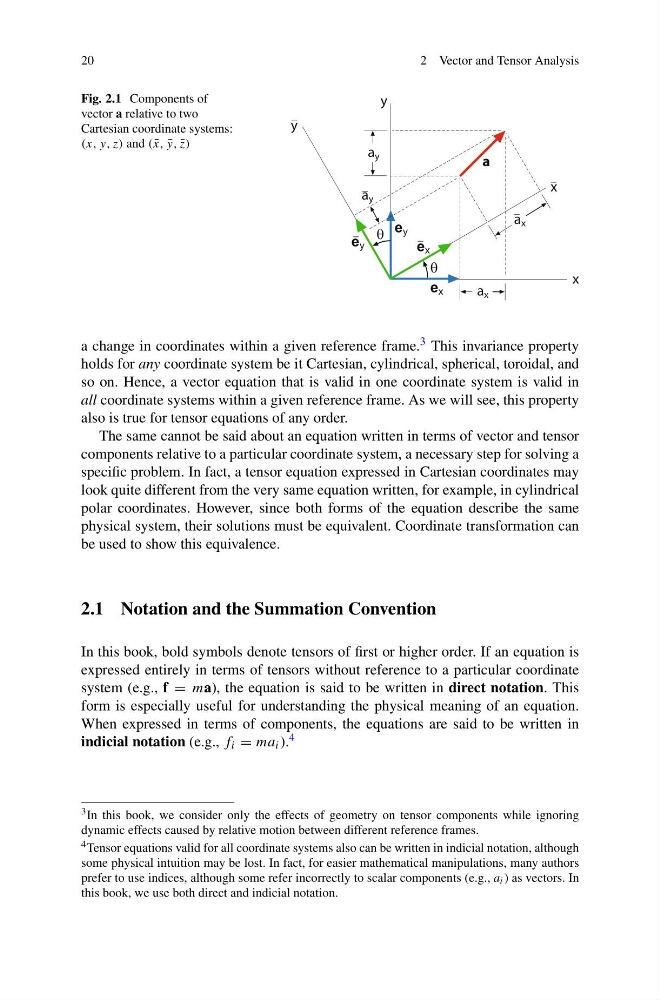
Fig. 2.1 Components of
vector a relative to two
Cartesian coordinate systems:
(x, y, z) and ( ¯
x, ¯
y, ¯
z)
x
y
x
y
a
a x
a y
a x
a y
θ
θ
e x
e y
e x
e y
_
_
_
_
_
_
a change in coordinates within a given reference frame. 3 This invariance property
holds for any coordinate system be it Cartesian, cylindrical, spherical, toroidal, and
so on. Hence, a vector equation that is valid in one coordinate system is valid in
all coordinate systems within a given reference frame. As we will see, this property
also is true for tensor equations of any order.
The same cannot be said about an equation written in terms of vector and tensor
components relative to a particular coordinate system, a necessary step for solving a
specific problem. In fact, a tensor equation expressed in Cartesian coordinates may
look quite different from the very same equation written, for example, in cylindrical
polar coordinates. However, since both forms of the equation describe the same
physical system, their solutions must be equivalent. Coordinate transformation can
be used to show this equivalence.
2.1 Notation and the Summation Convention
In this book, bold symbols denote tensors of first or higher order. If an equation is
expressed entirely in terms of tensors without reference to a particular coordinate
system (e.g., f = ma), the equation is said to be written in direct notation. This
form is especially useful for understanding the physical meaning of an equation.
When expressed in terms of components, the equations are said to be written in
indicial notation (e.g., f i = ma i ). 4
3 In this book, we consider only the effects of geometry on tensor components while ignoring
dynamic effects caused by relative motion between different reference frames.
4 Tensor equations valid for all coordinate systems also can be written in indicial notation, although
some physical intuition may be lost. In fact, for easier mathematical manipulations, many authors
prefer to use indices, although some refer incorrectly to scalar components (e.g., a i ) as vectors. In
this book, we use both direct and indicial notation.
2 Vector and Tensor Analysis
Fig. 2.1 Components of
vector a relative to two
Cartesian coordinate systems:
(x, y, z) and ( ¯
x, ¯
y, ¯
z)
x
y
x
y
a
a x
a y
a x
a y
θ
θ
e x
e y
e x
e y
_
_
_
_
_
_
a change in coordinates within a given reference frame. 3 This invariance property
holds for any coordinate system be it Cartesian, cylindrical, spherical, toroidal, and
so on. Hence, a vector equation that is valid in one coordinate system is valid in
all coordinate systems within a given reference frame. As we will see, this property
also is true for tensor equations of any order.
The same cannot be said about an equation written in terms of vector and tensor
components relative to a particular coordinate system, a necessary step for solving a
specific problem. In fact, a tensor equation expressed in Cartesian coordinates may
look quite different from the very same equation written, for example, in cylindrical
polar coordinates. However, since both forms of the equation describe the same
physical system, their solutions must be equivalent. Coordinate transformation can
be used to show this equivalence.
2.1 Notation and the Summation Convention
In this book, bold symbols denote tensors of first or higher order. If an equation is
expressed entirely in terms of tensors without reference to a particular coordinate
system (e.g., f = ma), the equation is said to be written in direct notation. This
form is especially useful for understanding the physical meaning of an equation.
When expressed in terms of components, the equations are said to be written in
indicial notation (e.g., f i = ma i ). 4
3 In this book, we consider only the effects of geometry on tensor components while ignoring
dynamic effects caused by relative motion between different reference frames.
4 Tensor equations valid for all coordinate systems also can be written in indicial notation, although
some physical intuition may be lost. In fact, for easier mathematical manipulations, many authors
prefer to use indices, although some refer incorrectly to scalar components (e.g., a i ) as vectors. In
this book, we use both direct and indicial notation.