

6.10 Theory for Combined Growth and Contraction
313
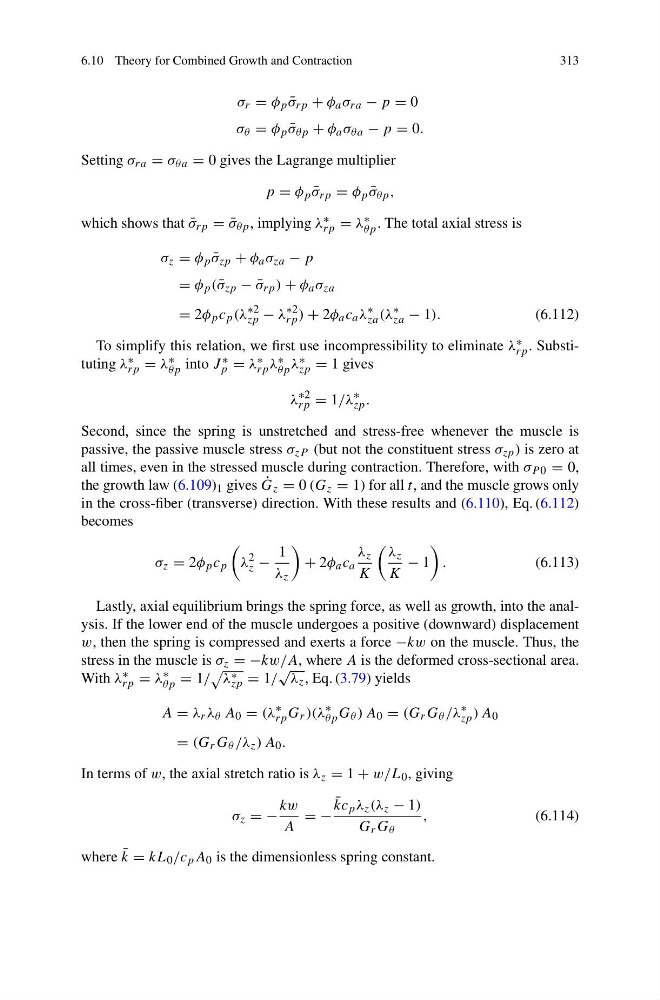
σ r = φ p ¯
σ rp + φ a σ ra − p = 0
σ θ = φ p ¯
σ θp + φ a σ θa − p = 0.
Setting σ ra = σ θa = 0 gives the Lagrange multiplier
p = φ p ¯
σ rp = φ p ¯
σ θp ,
which shows that ¯
σ rp = ¯
σ θp , implying λ ∗
rp = λ ∗
θp . The total axial stress is
σ z = φ p ¯
σ zp + φ a σ za − p
= φ p ( ¯
σ zp − ¯
σ rp ) + φ a σ za
= 2φ p c p (λ
∗2
zp − λ
∗2
rp ) + 2φ a c a λ
∗
za (λ
∗
za − 1).
(6.112)
To simplify this relation, we first use incompressibility to eliminate λ ∗
rp . Substituting λ ∗
rp = λ ∗
θp into J ∗
p = λ ∗
rp λ ∗
θp λ ∗
zp = 1 gives
λ
∗2
rp = 1/λ
∗
zp .
Second, since the spring is unstretched and stress-free whenever the muscle is
passive, the passive muscle stress σ zP (but not the constituent stress σ zp ) is zero at
all times, even in the stressed muscle during contraction. Therefore, with σ P 0 = 0,
the growth law (6.109) 1 gives ˙
G z = 0 (G z = 1) for all t, and the muscle grows only
in the cross-fiber (transverse) direction. With these results and (6.110), Eq. (6.112)
becomes
σ z = 2φ p c p
λ
2
z −
1
λ z
+ 2φ a c a
λ z
K
λ z
K
− 1
.
(6.113)
Lastly, axial equilibrium brings the spring force, as well as growth, into the analysis. If the lower end of the muscle undergoes a positive (downward) displacement
w, then the spring is compressed and exerts a force −kw on the muscle. Thus, the
stress in the muscle is σ z = −kw/A, where A is the deformed cross-sectional area.
With λ ∗
rp = λ ∗
θp = 1/
λ ∗
zp = 1/
√
λ z , Eq. (3.79) yields
A = λ r λ θ A 0 = (λ
∗
rp G r )(λ
∗
θp G θ ) A 0 = (G r G θ /λ
∗
zp ) A 0
= (G r G θ /λ z ) A 0 .
In terms of w, the axial stretch ratio is λ z = 1 + w/L 0 , giving
σ z = −
kw
A
= −
¯
kc p λ z (λ z − 1)
G r G θ
,
(6.114)
where ¯
k = kL 0 /c p A 0 is the dimensionless spring constant.
313
σ r = φ p ¯
σ rp + φ a σ ra − p = 0
σ θ = φ p ¯
σ θp + φ a σ θa − p = 0.
Setting σ ra = σ θa = 0 gives the Lagrange multiplier
p = φ p ¯
σ rp = φ p ¯
σ θp ,
which shows that ¯
σ rp = ¯
σ θp , implying λ ∗
rp = λ ∗
θp . The total axial stress is
σ z = φ p ¯
σ zp + φ a σ za − p
= φ p ( ¯
σ zp − ¯
σ rp ) + φ a σ za
= 2φ p c p (λ
∗2
zp − λ
∗2
rp ) + 2φ a c a λ
∗
za (λ
∗
za − 1).
(6.112)
To simplify this relation, we first use incompressibility to eliminate λ ∗
rp . Substituting λ ∗
rp = λ ∗
θp into J ∗
p = λ ∗
rp λ ∗
θp λ ∗
zp = 1 gives
λ
∗2
rp = 1/λ
∗
zp .
Second, since the spring is unstretched and stress-free whenever the muscle is
passive, the passive muscle stress σ zP (but not the constituent stress σ zp ) is zero at
all times, even in the stressed muscle during contraction. Therefore, with σ P 0 = 0,
the growth law (6.109) 1 gives ˙
G z = 0 (G z = 1) for all t, and the muscle grows only
in the cross-fiber (transverse) direction. With these results and (6.110), Eq. (6.112)
becomes
σ z = 2φ p c p
λ
2
z −
1
λ z
+ 2φ a c a
λ z
K
λ z
K
− 1
.
(6.113)
Lastly, axial equilibrium brings the spring force, as well as growth, into the analysis. If the lower end of the muscle undergoes a positive (downward) displacement
w, then the spring is compressed and exerts a force −kw on the muscle. Thus, the
stress in the muscle is σ z = −kw/A, where A is the deformed cross-sectional area.
With λ ∗
rp = λ ∗
θp = 1/
λ ∗
zp = 1/
√
λ z , Eq. (3.79) yields
A = λ r λ θ A 0 = (λ
∗
rp G r )(λ
∗
θp G θ ) A 0 = (G r G θ /λ
∗
zp ) A 0
= (G r G θ /λ z ) A 0 .
In terms of w, the axial stretch ratio is λ z = 1 + w/L 0 , giving
σ z = −
kw
A
= −
¯
kc p λ z (λ z − 1)
G r G θ
,
(6.114)
where ¯
k = kL 0 /c p A 0 is the dimensionless spring constant.