

304
6 Growth
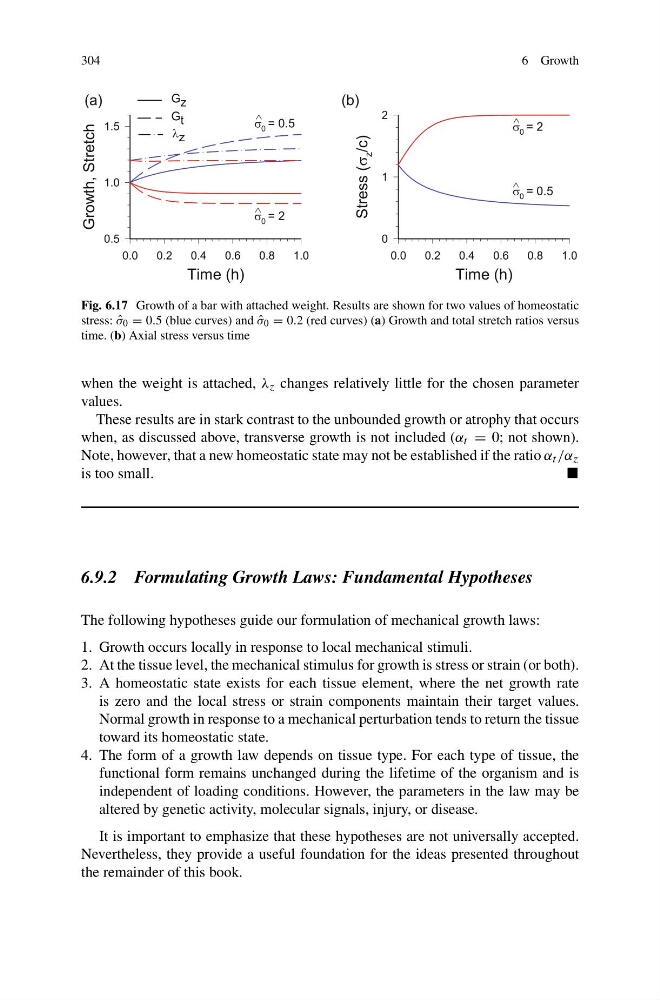
Fig. 6.17 Growth of a bar with attached weight. Results are shown for two values of homeostatic
stress: ˆ
σ 0 = 0.5 (blue curves) and ˆ
σ 0 = 0.2 (red curves) (a) Growth and total stretch ratios versus
time. (b) Axial stress versus time
when the weight is attached, λ z changes relatively little for the chosen parameter
values.
These results are in stark contrast to the unbounded growth or atrophy that occurs
when, as discussed above, transverse growth is not included (α t = 0; not shown).
Note, however, that a new homeostatic state may not be established if the ratio α t /α z
is too small.
6.9.2 Formulating Growth Laws: Fundamental Hypotheses
The following hypotheses guide our formulation of mechanical growth laws:
1. Growth occurs locally in response to local mechanical stimuli.
2. At the tissue level, the mechanical stimulus for growth is stress or strain (or both).
3. A homeostatic state exists for each tissue element, where the net growth rate
is zero and the local stress or strain components maintain their target values.
Normal growth in response to a mechanical perturbation tends to return the tissue
toward its homeostatic state.
4. The form of a growth law depends on tissue type. For each type of tissue, the
functional form remains unchanged during the lifetime of the organism and is
independent of loading conditions. However, the parameters in the law may be
altered by genetic activity, molecular signals, injury, or disease.
It is important to emphasize that these hypotheses are not universally accepted.
Nevertheless, they provide a useful foundation for the ideas presented throughout
the remainder of this book.
6 Growth
Fig. 6.17 Growth of a bar with attached weight. Results are shown for two values of homeostatic
stress: ˆ
σ 0 = 0.5 (blue curves) and ˆ
σ 0 = 0.2 (red curves) (a) Growth and total stretch ratios versus
time. (b) Axial stress versus time
when the weight is attached, λ z changes relatively little for the chosen parameter
values.
These results are in stark contrast to the unbounded growth or atrophy that occurs
when, as discussed above, transverse growth is not included (α t = 0; not shown).
Note, however, that a new homeostatic state may not be established if the ratio α t /α z
is too small.
6.9.2 Formulating Growth Laws: Fundamental Hypotheses
The following hypotheses guide our formulation of mechanical growth laws:
1. Growth occurs locally in response to local mechanical stimuli.
2. At the tissue level, the mechanical stimulus for growth is stress or strain (or both).
3. A homeostatic state exists for each tissue element, where the net growth rate
is zero and the local stress or strain components maintain their target values.
Normal growth in response to a mechanical perturbation tends to return the tissue
toward its homeostatic state.
4. The form of a growth law depends on tissue type. For each type of tissue, the
functional form remains unchanged during the lifetime of the organism and is
independent of loading conditions. However, the parameters in the law may be
altered by genetic activity, molecular signals, injury, or disease.
It is important to emphasize that these hypotheses are not universally accepted.
Nevertheless, they provide a useful foundation for the ideas presented throughout
the remainder of this book.