

298
6 Growth
of ongoing debate. The intent here is to introduce some of the main concepts as a
starting point for future study.
6.9.1 Mechanical Growth Laws
A central task in quantitative mechanobiology is the determination of growth laws,
which are constitutive relations that define how cells and tissues grow in response to
mechanical stimuli. If such laws indeed exist (not yet clear), they probably have
evolved over eons to optimize function. Since biological tissues have different
functions, the existence of a universal growth law is unlikely. Thus, growth laws
need to be determined experimentally for each tissue type.
The growth laws considered here are phenomenological, as they do not include
microscopic details. Hypertrophy (cell enlargement), hyperplasia (cell division),
and matrix swelling are treated as mechanically equivalent processes. Moreover,
we assume that growth at each point in a tissue depends on the local mechanical
environment. In an artery, for example, growth is assumed to be a function of stress
or strain at each point, rather than blood pressure or average wall stress.
In early work on this topic, Fung (1990, 1991) proposed a growth law of the form
˙
m = C( ¯
σ − a)
k 1 (b − ¯
σ )
k 2 ( ¯
σ − c)
k 3 ,
(6.85)
where ˙
m is the rate of change in mass, ¯
σ is a scalar measure of average stress [e.g.,
¯
σ = (σ 11 + σ 22 + σ 33 )/3], and the parameters are to be determined experimentally.
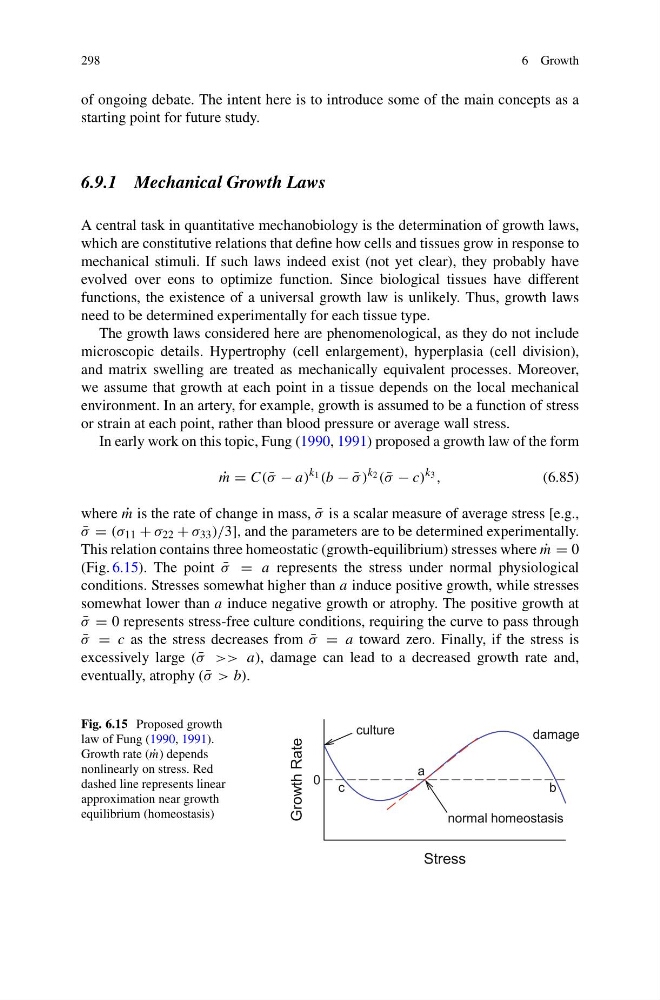
This relation contains three homeostatic (growth-equilibrium) stresses where ˙
m = 0
(Fig. 6.15). The point ¯
σ = a represents the stress under normal physiological
conditions. Stresses somewhat higher than a induce positive growth, while stresses
somewhat lower than a induce negative growth or atrophy. The positive growth at
¯
σ = 0 represents stress-free culture conditions, requiring the curve to pass through
¯
σ = c as the stress decreases from ¯
σ = a toward zero. Finally, if the stress is
excessively large ( ¯
σ >> a), damage can lead to a decreased growth rate and,
eventually, atrophy ( ¯
σ > b).
Fig. 6.15 Proposed growth
law of Fung (1990, 1991).
Growth rate ( ˙
m) depends
nonlinearly on stress. Red
dashed line represents linear
approximation near growth
equilibrium (homeostasis)
6 Growth
of ongoing debate. The intent here is to introduce some of the main concepts as a
starting point for future study.
6.9.1 Mechanical Growth Laws
A central task in quantitative mechanobiology is the determination of growth laws,
which are constitutive relations that define how cells and tissues grow in response to
mechanical stimuli. If such laws indeed exist (not yet clear), they probably have
evolved over eons to optimize function. Since biological tissues have different
functions, the existence of a universal growth law is unlikely. Thus, growth laws
need to be determined experimentally for each tissue type.
The growth laws considered here are phenomenological, as they do not include
microscopic details. Hypertrophy (cell enlargement), hyperplasia (cell division),
and matrix swelling are treated as mechanically equivalent processes. Moreover,
we assume that growth at each point in a tissue depends on the local mechanical
environment. In an artery, for example, growth is assumed to be a function of stress
or strain at each point, rather than blood pressure or average wall stress.
In early work on this topic, Fung (1990, 1991) proposed a growth law of the form
˙
m = C( ¯
σ − a)
k 1 (b − ¯
σ )
k 2 ( ¯
σ − c)
k 3 ,
(6.85)
where ˙
m is the rate of change in mass, ¯
σ is a scalar measure of average stress [e.g.,
¯
σ = (σ 11 + σ 22 + σ 33 )/3], and the parameters are to be determined experimentally.
This relation contains three homeostatic (growth-equilibrium) stresses where ˙
m = 0
(Fig. 6.15). The point ¯
σ = a represents the stress under normal physiological
conditions. Stresses somewhat higher than a induce positive growth, while stresses
somewhat lower than a induce negative growth or atrophy. The positive growth at
¯
σ = 0 represents stress-free culture conditions, requiring the curve to pass through
¯
σ = c as the stress decreases from ¯
σ = a toward zero. Finally, if the stress is
excessively large ( ¯
σ >> a), damage can lead to a decreased growth rate and,
eventually, atrophy ( ¯
σ > b).
Fig. 6.15 Proposed growth
law of Fung (1990, 1991).
Growth rate ( ˙
m) depends
nonlinearly on stress. Red
dashed line represents linear
approximation near growth
equilibrium (homeostasis)